


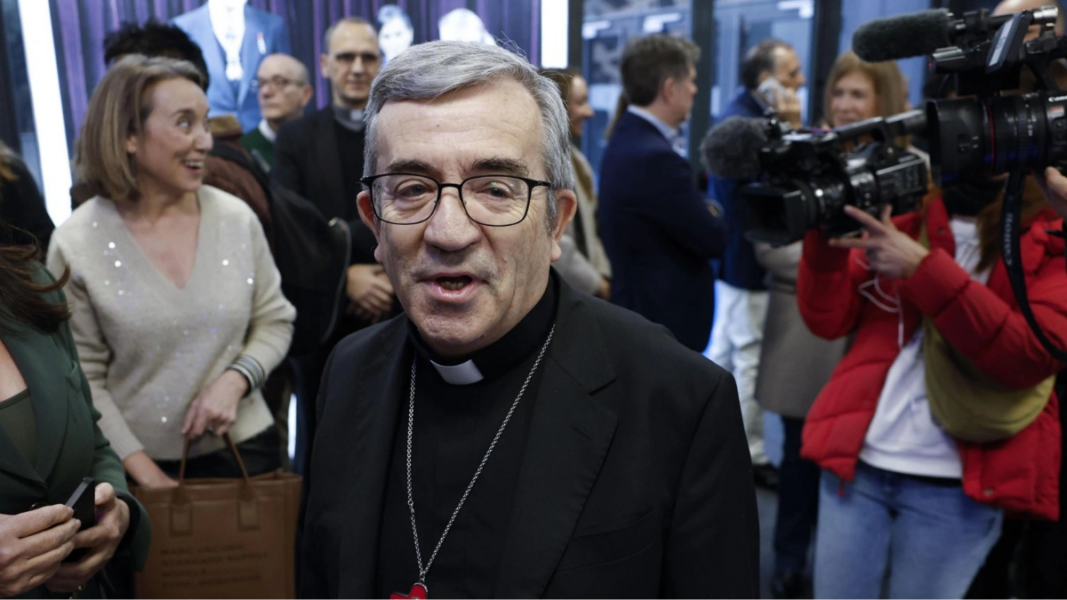
The president of the Spanish Episcopal Conference and archbishop of Valladolid, Luis Argüello, made it clear that the debate on abortion must be addressed from reason and scientific evidence, and not as an ideological issue. During an informational breakfast organized by La Razón, the prelate argued that the protection of human life is not an exclusive stance of believers, but a demand that challenges any person willing to heed objective data.
Science and human dignity
Argüello stated that abortion has become a “scapegoat” that seems to measure the validity of progressivism in the Western world, when in reality the issue affects the very foundation of coexistence and the understanding of the human person.
In statements reported by COPE, the archbishop emphasized that current medical advances compel a rethinking of the arguments that supported the first abortion laws. He recalled that when many of those laws were passed, current ultrasounds and detailed knowledge of the human genome did not exist.
“Today we know indubitably that from conception there exists a subject distinct from the mother,” he noted. From that premise, he considered it a “fallacy” to reduce the debate to the right over one’s own body, as it involves—as he explained—a distinct life that must be protected. In that sense, he insisted that it is a matter of “science against ideological fanatics.”
The person against modern individualism
In his speech, Argüello also addressed what he called the “three ways” of the Christian claim. The first has to do with the understanding of the person. In his view, modern culture has reduced the human being to an autonomous individual with pretensions of power, weakening the relational dimension that is an essential part of the human condition.
Against that vision, he advocated an anthropology that recognizes the human being as freedom and grace, reason and faith, relationship and community. He also warned of the new challenges posed by artificial intelligence and the delegation of human decisions to algorithms, in a context that demands reaffirming the dignity of all life.
Church, democracy, and ethical reference
Argüello also reflected on the relationship between the Church and society at a time he described as one of profound transformation. He acknowledged the current distance between both realities, but defended that this gap does not imply indifference, but rather the possibility of an evangelizing dialogue.
In a scenario marked by the crisis of trust in democratic institutions and by new forms of economic and technological power, the archbishop proposed that the Church can contribute by strengthening ethical awareness and promoting what Pope Francis called “social friendship.”
In his opinion, moral relativism today shows its limits, and it is necessary to return ethical references to the public space that democracy cannot provide for itself.
Migration, coherence, and public life
During the colloquium, Argüello defended the Church’s support for the regularization of immigrants, although he acknowledged that this stance generates discomfort in some sectors. He warned of the existence of a “double life” in certain Catholics who separate their faith from their economic or social criteria.
Likewise, the president of the Episcopal Conference insisted that the Christian proposal does not seek to establish a “paradise on earth,” but rather to sow concrete signs of dignity, justice, and the common good in history. In Lent time, he recalled that Christian hope is founded on the conviction that neither evil nor death has the last word.