


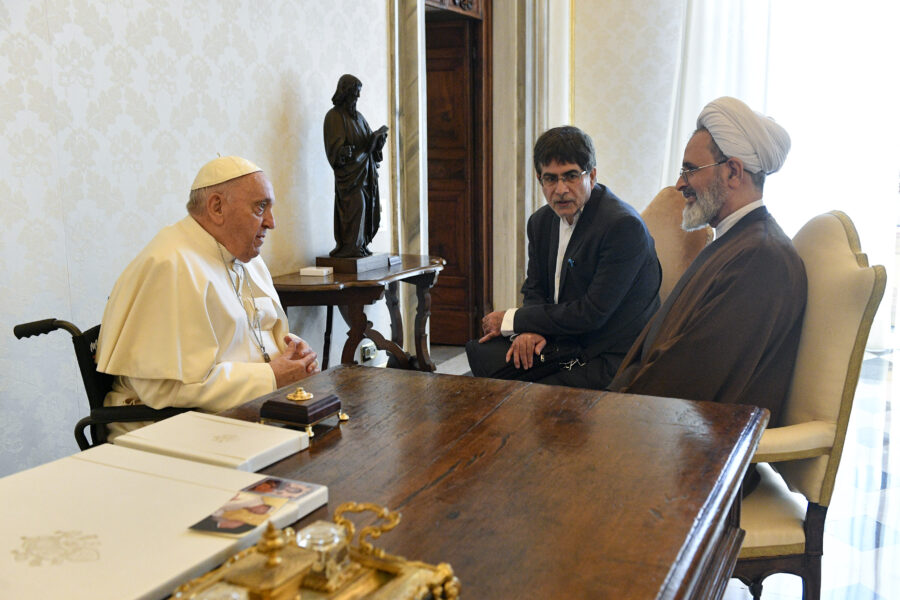
In May 2022, Pope Francis received in audience at the Vatican the Iranian ayatollah Alireza Arafi, then president of Iran’s Islamic seminaries and one of the most influential figures in the country’s Shiite religious structure. Four years later, his name returns to the international forefront after assuming supreme leadership functions in Tehran following the death under Israeli and American fire of Ayatollah Ali Jamenei.
The meeting took place in the Apostolic Palace and was officially presented as an encounter within the framework of interreligious dialogue. The Iranian delegation conveyed to the Pontiff messages from their country’s religious leadership and emphasized the need for cooperation between religions in the face of major contemporary conflicts. References to the defense of the oppressed, the situation in the Middle East, and the public role of religion were part of the discourse disseminated by Iranian sources after the meeting.
From the Vatican side, the communication was succinct and in line with the usual style of this type of audiences: insistence on the value of dialogue, peace, and understanding between religious traditions. No joint statement was published, nor were specific commitments arising from the conversation detailed. The meeting fit into the Holy See’s diplomatic strategy of keeping channels open with the Islamic world, particularly with Shiism, following the papal trip to Iraq in 2021.
Vatican Diplomacy: Iran Yes, Saudi Arabia No
This episode highlights a fact that is often overlooked: between the Holy See and Iran, there are full diplomatic relations. The Islamic Republic has an ambassador accredited to the Vatican, and the Holy See maintains its own diplomatic representation in Tehran. Therefore, it is not just a simple protocol gesture or an isolated meeting, but a stable institutional link that allows regular interlocution at the highest level.
This data contrasts with the situation of another key actor in the war that is unfolding: Saudi Arabia, which does not maintain formal diplomatic relations with the Holy See and, therefore, does not have an ambassador accredited to the Vatican. Although in recent years there have been contacts and gestures of rapprochement, there is no full exchange of diplomatic representations that does exist with Iran.
Arafi’s figure was not marginal at the time. In addition to directing the Iranian religious seminaries, he held relevant positions in the institutional framework of the Islamic Republic and was linked to the bodies that advise the supreme leader. His presence in the Vatican was interpreted as mutual recognition between religious authorities with effective political weight.
The current context inevitably alters the retrospective reading of that audience. Following Jamenei’s death, Arafi has assumed leadership functions within the framework of Iran’s constitutional mechanism, awaiting the final designation by the Assembly of Experts. He is not a simple religious dignitary, but a figure positioned at the apex of a system in which spiritual authority and political power are intertwined.