


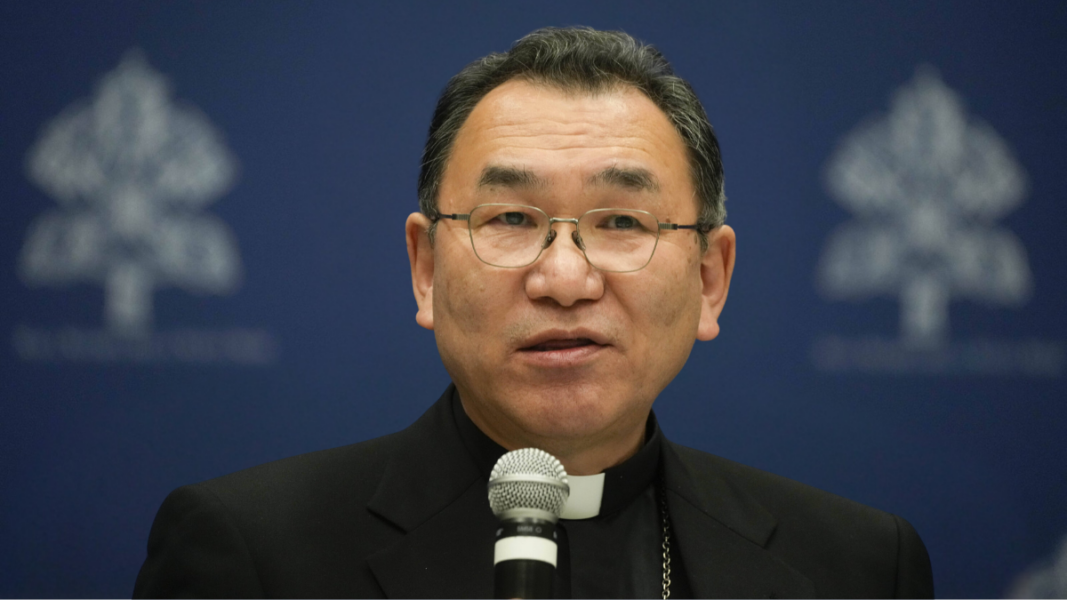
The Church in Japan faces a “polite persecution” that, under the guise of institutional neutrality, progressively restricts the public presence of faith, as warned by Cardinal Tarcisio Isao Kikuchi, Archbishop of Tokyo, in statements reported by the media outlet Crux.
The cardinal was reacting to recent interventions at the UN Human Rights Council, where representatives of the Holy See alerted that so-called “new rights”—linked to agendas such as abortion, euthanasia, or gender ideology—are being used to erode historically recognized fundamental freedoms, including religious freedom.
Freedom Recognized in Law, Limited in Practice
Kikuchi recalled that the Japanese Constitution formally guarantees religious freedom and establishes a strict separation between religion and state, a result of the negative experience of state Shintoism before and during World War II.
However, he explained that in practice, an interpretation has taken hold that expels any religious voice from public debate. Religious activities are tolerated as long as they remain confined within temples and churches. When the Church intervenes in issues affecting human dignity—such as nuclear disarmament or the defense of migrants—it is accused of being “too political.”
“It is often argued that, by virtue of the principle of separation between religion and state, the Church should refrain from speaking on matters considered political,” the cardinal noted.
Moral Marginalization of Religion
The Archbishop of Tokyo described a situation in which religion is not recognized as a moral authority in public space. As long as the Church remains silent and limited to its internal sphere, it is considered harmless. But when it exercises its right to propose an ethical vision based on human dignity, it encounters social resistance.
Japan is a highly secularized society, where regular religious practice is difficult even without open persecution. Sunday is not widely recognized as a day of rest, and organized religion arouses cultural indifference, except when associated with folk traditions.
In this context, the warning about “new rights” takes on relevance: according to the position expressed by the Holy See at the UN, the ideological redefinition of human rights risks becoming an instrument to silence traditional religious convictions.
Catholic Identity Without Complexes
Kikuchi, who also chairs Caritas Internationalis, emphasized that Catholic identity cannot be diluted to avoid cultural tensions. “Our activities must be rooted in the Catholic understanding of human dignity, the sanctity of life, and ethical values,” he affirmed.
The cardinal defended the idea that the Church in Japan, despite being a minority, has a history dating back to 1549 and has the capacity to actively collaborate in the mission of the Church in Asia. In a global context where the notion of human rights is in dispute, its witness raises a fundamental debate: whether religious freedom will continue to be a fundamental right or will be subordinated to new ideological constructs.