


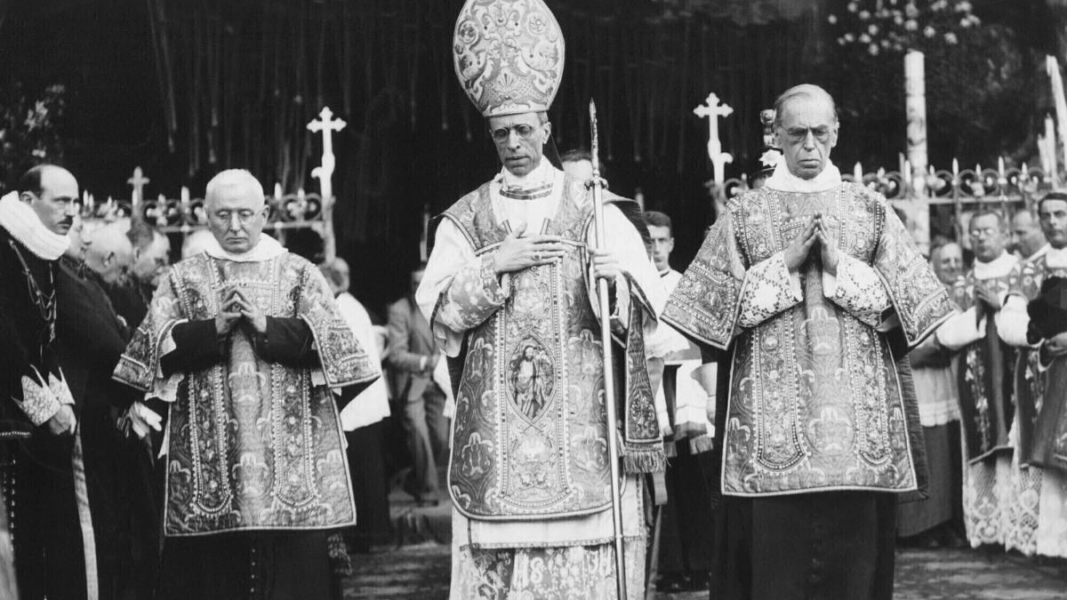
This March 2 marks the 150th anniversary of the birth of Eugenio Pacelli, Pope Pius XII, who was elected Pontiff on the same day in 1939 when he turned 63 years old. His election took place on the eve of World War II, in one of the most dramatic moments of the 20th century, when Europe was hurtling toward conflict and totalitarian ideologies openly threatened human dignity and the freedom of the Church.
For 19 years, 7 months, and one week, Pius XII led the Church amid the world war, the collapse of the traditional European order, and the subsequent advance of communism. His pontificate was marked by exceptional circumstances that demanded diplomatic prudence, doctrinal firmness, and intense humanitarian action.
A pontiff in the midst of the 20th century’s storm
Elected just six months before the outbreak of the war, Pius XII had to govern the universal Church in a context of persecutions, deportations, and unprecedented devastation. The Holy See developed a broad work of assistance and mediation during those years, while the Pope maintained the necessary neutrality to preserve channels for humanitarian intervention.
After the conflict, he faced the hardening of communist regimes in Eastern Europe and defended with clarity the freedom of the Church against atheistic systems. On the doctrinal level, his magisterium left encyclicals of great theological weight such as Mystici Corporis Christi (1943) and Humani Generis (1950), in addition to the proclamation of the dogma of the Assumption in 1950.
A deeply musical soul
Beyond the statesman and the theologian, the commemoration of this anniversary has allowed the rediscovery of a lesser-known but revealing aspect of his personality: his profound musical sensitivity, as recalled by the medium OnePeterFive.
From his youth, Pacelli showed an intense love for music. Violins that he himself played were kept in the family home, and during his stay in Germany, he developed a special affinity for the great Germanic composers: Bach, Beethoven, and, in particular, Richard Wagner.
Already as Pope, his relationship with music was not superficial or merely ceremonial. In 1954, he received Maria Callas in private audience after having listened with enthusiasm to a radio broadcast of Parsifal. The meeting led to an animated conversation about the interpretation of Wagner and the inseparability between music and word in the composer’s work.
Music also marked significant moments of his pontificate. In 1945, a few months after the end of the war in Europe, Verdi’s Réquiem resounded in the Vatican as a gesture of memory and reconciliation. In 1955, the Israel Philharmonic Orchestra performed works by Beethoven in the Apostolic Palace as a show of gratitude for the Holy See’s humanitarian efforts in favor of Jews during the war.
Music, faith, and contemplation
Pius XII followed with attention the radio broadcasts of the main Italian theaters and, in the last days of his life, asked to listen to Beethoven’s First Symphony. Three days before his death, in October 1958, he requested that a record of the German composer be played for him.
Artists such as Beniamino Gigli or Giacomo Lauri Volpi left testimony of the Pontiff’s aesthetic sensitivity. The latter described his voice as deeply spiritual, capable of uniting word and resonance in a synthesis that he called vox mystica: word, sound, idea, and spirit fused in a single expression.
Culture and faith in a time of crisis
In an era marked by ideological violence and cultural fracture, Pius XII’s musical sensitivity was not merely a personal trait, but an expression of a deeply rooted spirituality. Beneath the austere figure of the Pope who guided the Church through one of the darkest periods of the 20th century, beat a cultivated consciousness that saw in beauty a path to God.
On the 150th anniversary of his birth, the figure of Pius XII remains inseparably linked to the dramatic challenges of his time. But it also reveals an intimate dimension: that of a shepherd who, amid the historical storm, knew how to find in music a language of transcendence and hope.