


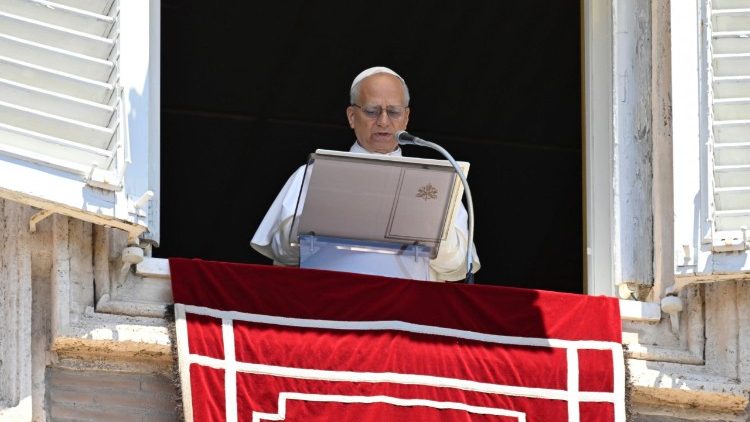
In the Angelus of this March 1, 2026, Pope Leo XIV centered his address on the military escalation in the Middle East and, in particular, on the clash between the United States, Israel, and Iran. “I continue to follow with deep concern what is happening in the Middle East and in Iran in these dramatic hours,” he stated before the faithful.
The Pontiff warned about “the possibility of a tragedy of enormous proportions” and linked the risk of regional expansion to a dynamic of action-reaction that, in his view, must be stopped as soon as possible. In that vein, he made an explicit appeal to the parties involved to cut the spiral of war before the conflict reaches a point of no return.
“In the face of the possibility of a tragedy of enormous proportions, I make a fervent appeal to the parties involved to assume the moral responsibility to stop the spiral of violence before it becomes an irreparable abyss.”
Leo XIV insisted that the way to contain the crisis cannot be based on threats or the use of force, but rather on a framework of verifiable negotiation. “Stability and peace are not built with reciprocal threats or with weapons that sow destruction, pain, and death, but only through reasonable, authentic, and responsible dialogue,” he stated, also calling for “diplomacy to recover its role” and for the promotion of “the good of the peoples who yearn for peaceful coexistence founded on justice”.
“Stability and peace are not built with reciprocal threats or with weapons that sow destruction, pain, and death, but only through reasonable, authentic, and responsible dialogue.”
After his main reference to the Middle East and Iran, the Pope added a mention of the “worrying news of clashes between Pakistan and Afghanistan” and raised his “plea for an urgent return to dialogue,” inviting prayer so that “concord may prevail in all the conflicts of the world” and recalling that “only peace, a gift from God, can heal the wounds between peoples”.
“In these days, worrying news also arrives of clashes between Pakistan and Afghanistan, and I raise my plea for an urgent return to dialogue.”
At this point, an inevitable clarification is in order: in the Afghan case, the appeal to “dialogue” may be perceived as naive if one considers the nature of the current Taliban government, whose real willingness to verifiable commitments is absurd. The approach, in any case, maintains the neutral logic and low geopolitical profile of the Holy See in conflicts in recent years: insisting on de-escalation and preserving a language capable of sustaining open channels with all parties.
The Pope concluded his address by expressing closeness to the populations of Minas Gerais (Brazil) affected by recent floods, assuring his prayer for the victims, the affected families, and those participating in relief efforts.