


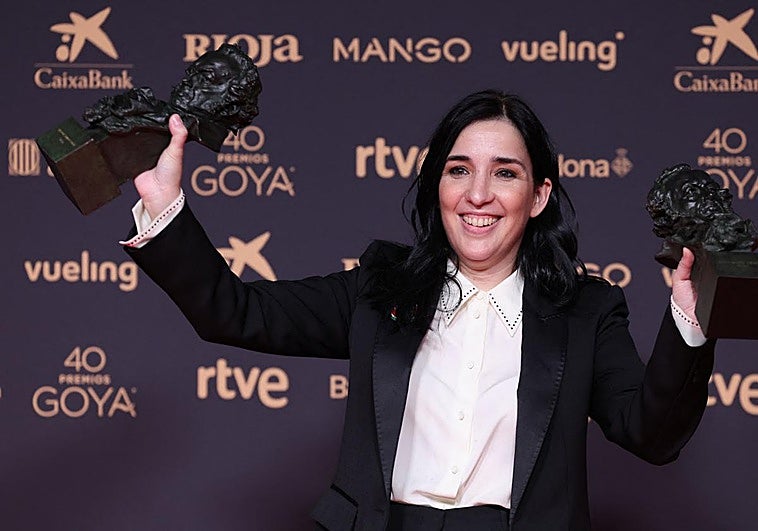
In the latest edition of the Premios Goya, Spanish cinema once again turned its gaze inward with the usual mix of cultural advocacy and ideological reading of the moment. However, amid predictable speeches and routine acknowledgments, one film achieved something less common: opening a real debate about faith, vocation, and the misunderstanding that many believers experience in contemporary society. It is Los Domingos, whose presence at the gala did not go unnoticed and which took home the most relevant statuettes.
The film, centered on the inner journey of a young woman who seriously considers religious vocation in a hostile family and social environment, has managed to appeal to very different audiences. Beyond its cinematic value, its true impact has been in the conversation it has generated: why is it so scandalous today for a girl to want to dedicate herself to God? At what point did faith stop being perceived as a reasonable option to become a symptom of lack or alienation?
That background was clearly exposed when actress and host Silvia Abril, wife of fellow host Andreu Buenafuente, publicly referred to another of the nominated films and took the opportunity to slip in a reflection that, far from being anecdotal, reveals a widespread mentality. “I stick with Sorda because I think it’s more necessary. I refuse to accept that the youth coming up have that lack and that pull toward Christianity. I was going to say the mystical, but it’s not the mystical. It makes me sad that they need to believe in something and cling to Christian faith. I feel sorry for the Church, what a setup you’ve got going,” she stated.
The statement assumes that Christian faith is a sort of emotional refuge for disoriented spirits, a psychological crutch rather than a rational and free adherence. Believing would be a symptom of emptiness; vocation, an indication of fragility; the Church, a simple mechanism that capitalizes on that need.
Precisely there lies the merit of Los Domingos. The film does not present faith as escapism, but as conflict. Its protagonist is not a naive or manipulated young woman, but someone who goes through doubts, family tensions, environmental pressure, and the real weight of a radical decision. The misunderstanding is not caricature: it is the concrete reaction of an environment that interprets consecration as an absurd renunciation of a “normal” life.
It is striking, moreover, that faith is spoken of as a symptom of lack in a cultural context marked by the rise of anxiety and depression. Andreu Buenafuente himself has acknowledged on various occasions his depressive episodes and the need to temporarily step away from public exposure. Perhaps before reducing religious vocation to “clinging to something,” it would be wise to ask whether there is not in the human being a deeper search for meaning than mere emotional management.
The Christian tradition holds precisely that: that existential emptiness is not filled with distractions or success, but with a truth that gives unity to life. Denying that possibility does not make it disappear. For a young woman to discover in faith a concrete call is not a pathological symptom; it can simply be a coherent response to that search.
The success of Los Domingos is not measured only in nominations or spotlights, but in having forced the verbalization of a cultural discomfort: Christian faith remains alive among young people and not all experience it as an escape, but as a conscious choice. The controversy is no accident. It is the sign that the religious question is far from being settled.