


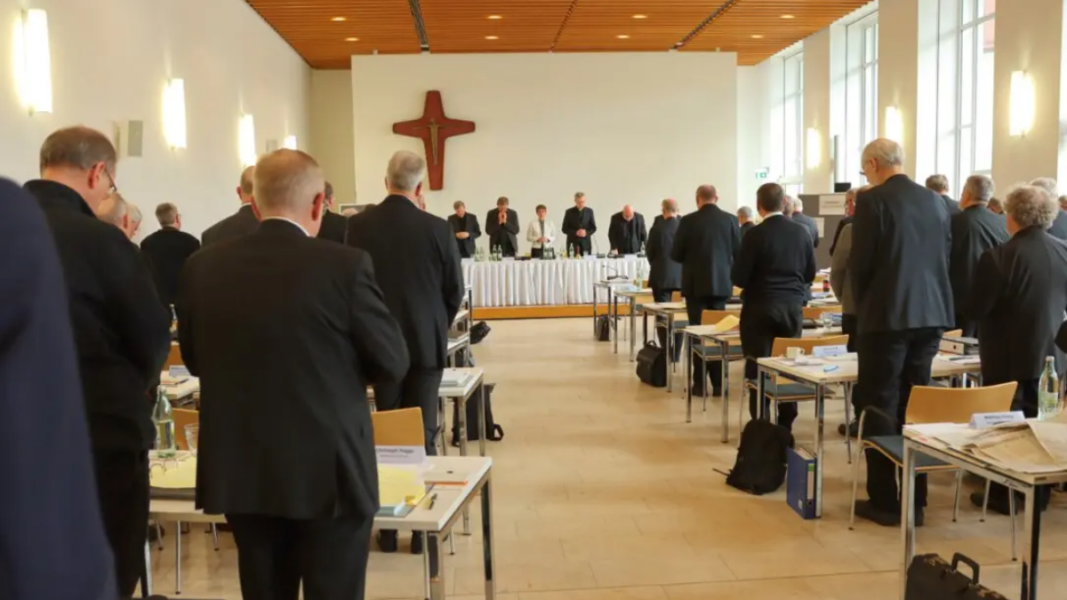
As the days go by, more details are being revealed about the last plenary assembly of the German Episcopal Conference (DBK). According to the magazine Communio, the vote on the statutes of the future «Synodal Conference» showed that support for the new body is far from unanimous. Although the necessary qualified majority was formally achieved, it was done with a two-thirds majority reached by a very narrow margin, confirming that a significant part of the bishops maintains serious reservations about the timeliness and legitimacy of the project.
While its promoters present it as an instrument of co-responsibility and lay participation, critics warn of the risk of consolidating a national body with decision-making capacity that could strain communion with the universal Church.
Four bishops on the sidelines and uncertain funding
The fracture is not just theoretical. Four bishops—Regensburg, Eichstätt, Passau, and Cologne—did not participate in the work of the Synodal Committee. In addition, the funding planned for 2026 does not guarantee that all dioceses will effectively contribute to the new body, despite the formal approval of a common budget.
Read also: Bishop Oster will not implement the reforms of the German Synodal Way in his diocese
The DBK’s general secretary, Beate Gilles, tried to convey an image of joint progress, pointing out that at least the financial framework has been agreed upon. However, everything is conditioned on the final decision of the Holy See.
Disputed election of Wilmer
The internal fracture was also reflected in the election of the new president of the German Episcopal Conference. According to Communio, there was a disputed vote between Bishop Franz-Josef Overbeck, representative of the most reformist sector, and Heiner Wilmer.
In the first two rounds, neither achieved the necessary two-thirds qualified majority. Finally, Wilmer was elected in the third vote by simple majority, a fact that reveals the absence of solid support at a key moment for the Church in Germany.
The final decision is in Rome
The future of the Synodal Conference now depends on the Vatican. If Rome grants the recognitio ad experimentum, the body will be able to begin its provisional journey. If it imposes modifications or rejects the project, no clear alternative plan seems to exist at the moment.
What has become clear is the great division within the Church in Germany. The narrow approval of the statutes dismantles any narrative of unanimity and confirms that the debate on the limits of synodality and fidelity to the hierarchical structure remains open.