


Mons. Alberto José González Chaves
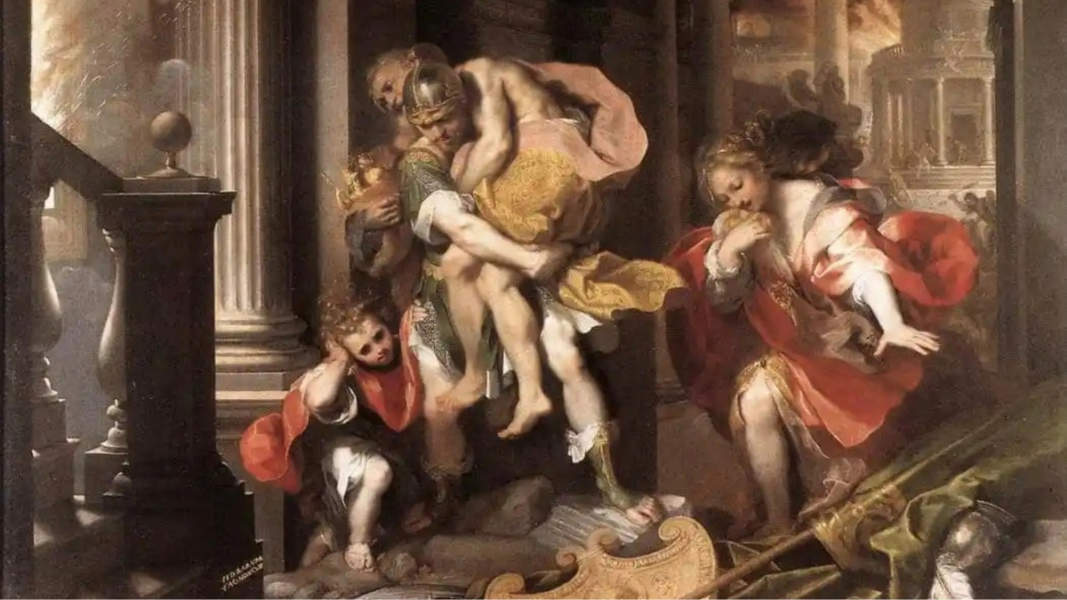
In the Aeneid, there is a scene of crushing density: Troy is burning. It is not just a city: a civilization, a memory, a way of inhabiting the world is burning. The walls that had resisted for centuries give way in a single night, and the smoke darkens the sky as if it wanted to erase even the memory of what had been. Aeneas then understands that there is no possible defense, that it is no longer about saving stones, but about saving something deeper and more fragile: the soul of Troy. And at that moment, Virgil offers us one of the greatest gestures that literature has known. Aeneas does not flee alone. He does not flee lightly, free of weight. The poet says, with a sobriety that contains all the trembling of the world: et sublato montes genitore petivi. “And, having loaded my father, I headed toward the mountains.”
He does not abandon his father. He cannot abandon the origin, the tradition. No! He takes his genitor and loads him onto his shoulders when everything seems lost. He carries him, precisely, because everything seems lost.
This image contains, in a certain way, the drama and the vocation of a priest who sees, weeping, that Troy is burning, the one with the horse full of enemies. Not in the external and visible sense of a warlike persecution, but in that other more subtle and painful one in which certainties weaken, forms dissolve, memory becomes fragile, and the soul runs the risk of getting used to living without roots. That priest, in the midst of this twilight, experiences a double temptation.
The first is to flee lightly, to shed the weight, to adapt without resistance to the dominant wind, to convince himself that everything ancient is an obstacle and that the only way to survive is to forget and… even to ingratiate himself with the Greeks… dona ferentes.
The second temptation is to remain immobile among the ruins, clinging to the stones, confusing fidelity with paralysis, love with nostalgia, rootedness with fear.
But Aeneas’s path is another: he neither abandons the past nor settles in it; he carries it and walks toward the future. That father whom Aeneas carries on his shoulders is not an old man: it is the living tradition and memory; it is the received identity, not chosen. It is that which we have not invented and which, precisely for that reason, constitutes us.
Tradition, in the life of the Church, is not a set of dead forms, nor a museum of ancient gestures, nor an aesthetic preference among others. It is the father: that which has begotten us in the faith. It is the living continuity of Christ in time; the Voice that we have heard before learning to speak.
A priest does not make the Church: he receives it. Nor does he invent the priesthood, because he inherits and participates in it; nor does he produce the mystery, but serves it. Therefore, when everything seems to waver, his first movement is not to shed it, but to carry it with reverent love and faithful gratitude.
Not as one who bears a strange weight, but sustaining that which has given him life.
But Virgil adds something decisive: montes petivi. “I sought the mountains.” It is not about remaining among the ruins nor walking in circles around what was. It is about advancing, seeking, climbing, undeterred by discouragement, like the little saint of Fray Juan:
Seeking my loves
I will go through those mountains and riverbanks;
I will not pick the flowers,
nor fear the beasts,
and I will pass the strongholds and borders.
It is about heading toward a place from which something new can begin.
The mountains, in Scripture, are always the place of God’s manifestation. The mountain is the broad and joyful height of the promise, where the horizon widens and the sky becomes closer. Climbing the mountain is an act of hope: it is believing that the visible end is not the real end because God continues to work when his footprints are hidden and his silence thickens, bloody and overwhelming. Climbing the mountain is believing that the same Lord who allowed the night is already preparing the dawn… and the feast:
And then to the ascents
of the stone caverns, we will go, which are well hidden,
and there we will enter,
and taste the must of pomegranates.
The priest who embraces tradition is not a man who looks back with sadness. He is someone who looks forward with serenity, precisely because he does not walk alone: he walks with the father on his shoulders, with the Church of always, with the faith of the centuries and the saints, with that of the grandparents and the poor.
He walks with the Holy Mass that does not age, because it belongs to heaven more than to time. And with the Word of God that has not lost its power or its relevance, because it was not born of human creativity nor of synodality, but of divine fidelity, eternal, immutable, full of youth and pure beauty.
And as he walks, that priest, whether a young singer or a nonagenarian, murmurs smiling, amid manly and sturdy tears, soundless and elegant:
introibo ad altare Dei, ad Deum qui lætificat juventutem meam.
And upon kissing the altar of his daily love, he senses every morning, with the illusion of a child, something that only those who have not abandoned the path perceive: behind the mountains, the sun still exists. He does not yet see it fully but intuits it, senses it, and believes it.
There is a moment, just before dawn, when the night seems darker than ever. But it is
the quiet night
in the companionship of the dawn’s risings,
the silent music,
the sonorous solitude…
And it is precisely then that the horizon begins, imperceptibly, to light up.
The priest is, by vocation, a man of that instant. Not a man of nostalgia and even less of fear. He is a cultivator of supernatural hope. Because he knows that the Church is not his work, that it does not depend on his strength, that Christ has already conquered!
Et sublato montes genitore petivi.
It is not the phrase of a fugitive but the certainty of a founder.
Because only one who has known how to carry the father can become a father. Only one who has known how to guard the tradition can transmit it. Only one who has known how to walk in the night can recognize the first ray of sun.
And when, finally, the priest reaches the height, he does not discover a finished world, but a world that begins.
Behind the mountains, the sun does not only illuminate: it smiles at the silent, heroic, and bleeding fidelity of those who did not abandon or victimize themselves. It smiles at the chivalry and self-forgetfulness of those who carried with love what seemed a weight, and discovered that it was, in reality, a promise of unfading youth.