


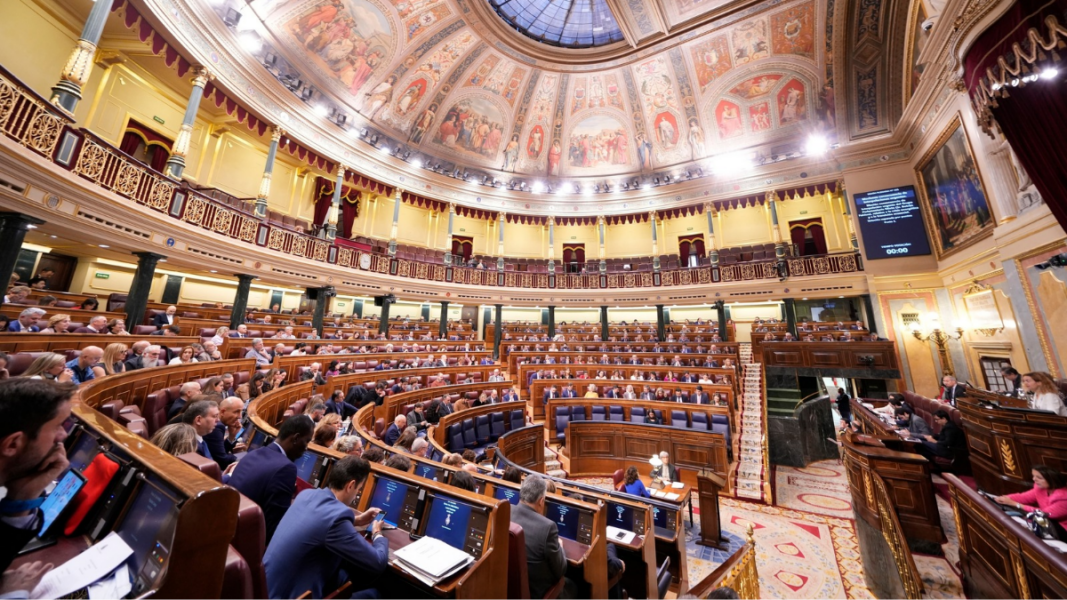
León XIV’s intervention in the Spanish Cortes will turn the Pope into an actor within the Spanish political framework, even if his intention is strictly moral or pastoral. The exact content of the speech doesn’t matter. The setting does. The hemicycle today in Spain is not a neutral or peaceful space; it is a field of forces. And there, every word will be read in terms of alignment or confrontation.
The Government will attempt to capitalize on the institutional image. It will present the Pope’s presence as proof of democratic normalcy and dialogue, even though much of its legislative agenda has clashed head-on with Catholic doctrine on core issues. The institutional photograph will be used as symbolic validation: the State receives the Pontiff, the Pontiff speaks before the popular sovereignty, the system works. That will be the official narrative framework.
At the same time, the Executive’s more ideologized partners will react in one of two registers: either critical theatricalization—gestures of coldness, partial absence, subsequent statements of disavowal—or selective use of the speech if they find elements compatible with their social agenda. If the Pope insists on migration, poverty, or dialogue, they will appropriate it; if he emphasizes anthropological issues or the centrality of life, they will mark distance. In both cases, they will turn it into a piece of their own narrative.
The opposition, for its part, will find itself in an uncomfortable position. If it applauds enthusiastically, it will be accused of instrumentalizing religion; if it maintains a sober attitude, it will seem lukewarm to its more conservative electorate. The result will be a fragmented reception that reflects the country’s structural division. There will be no moment of genuine cross-cutting consensus. There will be a sum of tactical interests.
In the ecclesial sphere, the effect will be equally divisive. One sector will interpret the appearance as a sign of brave public presence. Another will read it as an unnecessary exposure of the Pope to a politically decomposing environment that has promoted laws contrary to Catholic morality. If the speech avoids direct confrontations with those laws, the perception of accommodation will grow; if it mentions them explicitly, the political reaction will escalate. There is no neutral point.
The key lies in the asymmetry of the risk. For the Spanish political actors, the cost is low: one day of debate, some headlines, one more photo in the archive. For the Pope, the potential cost is reputational and universal. The image of León XIV will be projected internationally from a hemicycle marked by tension, and any gesture—lukewarm applause, empty seats, heated reactions—will be fixed as a symbol.
What is going to happen, therefore, is predictable: immediate politicization, selective appropriation of the message, and partisan reading of the gesture. The intervention will not be evaluated in theological or spiritual terms, but in terms of political utility. And the fact that the initiative came from the Holy See intensifies that reading: it will not seem like a mere institutional courtesy, but a strategic decision assumed from Rome. In a polarized environment, every strategic decision is interpreted as a taking of position. Whose idea was it? Is the Secretariat of State really looking out for the Pope’s interests? Is it Cobo’s idea, currying favor with the Government, to contribute to forcing this reckless gesture?
Both the trip to the Canary Islands, with the extremely high risk of a pull effect that could end in tragedy; and the speech at the request of the Holy See in a session of such polarized Cortes, with a government furiously anticlerical and with open scandals, are two travel decisions that seem imprudent. The question is whether it is a blunder by Cardinal Cobo (not the sharpest pencil in the box) or a deliberate maneuver by a Secretariat of State little attentive to the Pope’s interests.