


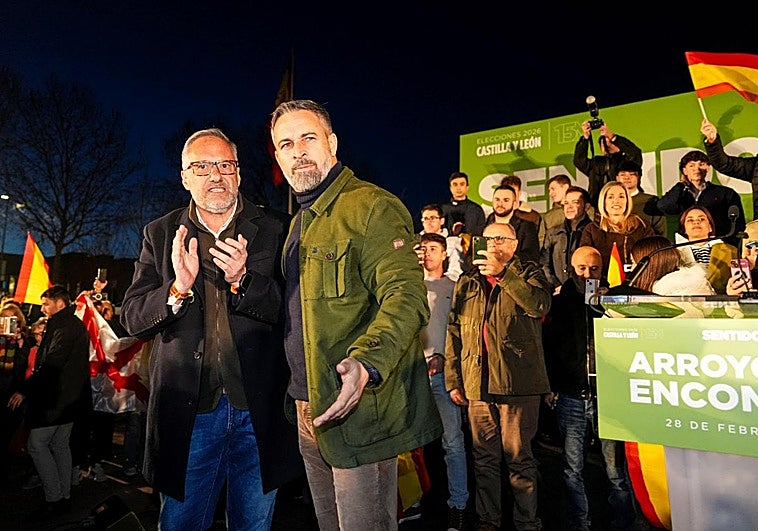
In an event held in Arroyo de la Encomienda as part of the election campaign in Castile and León, the president of Vox, Santiago Abascal, devoted a substantial part of his speech to issues that directly affect the public position of the Church in Spain. His words, especially those referring to some bishops, highlight pastoral approaches detached from the reality of ordinary people, which becomes explicit again in the midst of the electoral contest.
Abascal framed his speech in the claim of “common sense” as the guiding criterion for political action. “Common sense is the way our families have behaved, the values they have taught us, our traditions, what is normal in our society, what has been common to all and that suddenly seems to be in question,” he stated to the attendees.
In that context, he criticized certain policies linked to the Green Deal and the climate agenda, which, he argued, are also penetrating the educational sphere. He recounted as an example a personal experience: “The other day my children came to me with the ecological footprint, moreover, in a religious concerted school, and they had to calculate what ecological footprint they were leaving and that they were very polluting.” He then added: “I with five children, I’m leaving a lot of ecological footprint. I don’t know, well if in a religious school they have to tell us that even having children is leaving an ecological footprint… well yes, let them tell us clearly.”
Another direct part of the speech came when referring to reports about warnings from bishops regarding Vox. “I saw that I don’t know how many bishops were warning against Vox… there were some, because some have attacked us harshly and even questioned my condition as a Catholic,” he pointed out. He then formulated a very clear phrase: “It is surprising the drift of a part of the pastors… let the bishops say Mass, but if they are going to start defending the migratory invasion, it seems to me that many parishioners won’t like it.”
Abascal linked that supposed “defense” of mass immigration to a cultural and religious risk for Spain: “Many Spaniards won’t like that some bishops condemn them to migratory invasion and Islamization, precisely. To being replaced. To women, in a few decades in Spain, having to go covered.”
The Vox leader described the current migration policy as an “open borders” system in which “whoever wants enters,” is attended with public resources and, after some time, remains in an irregular situation without effective integration. “That is not common sense, that is not normal,” he concluded, rejecting that his approaches can be reduced to “xenophobia” or “hatred of foreigners.”
The statements place at the center of the debate the relationship between the Church’s social doctrine on migration and its concrete political translation. While the Magisterium insists on the dignity of every person and the duty of welcome, it places on another level and recognizes the competence of States to order migratory flows according to the common good. The interpretation and balance between both principles requires, above all, listening to ordinary people and applying common sense.