


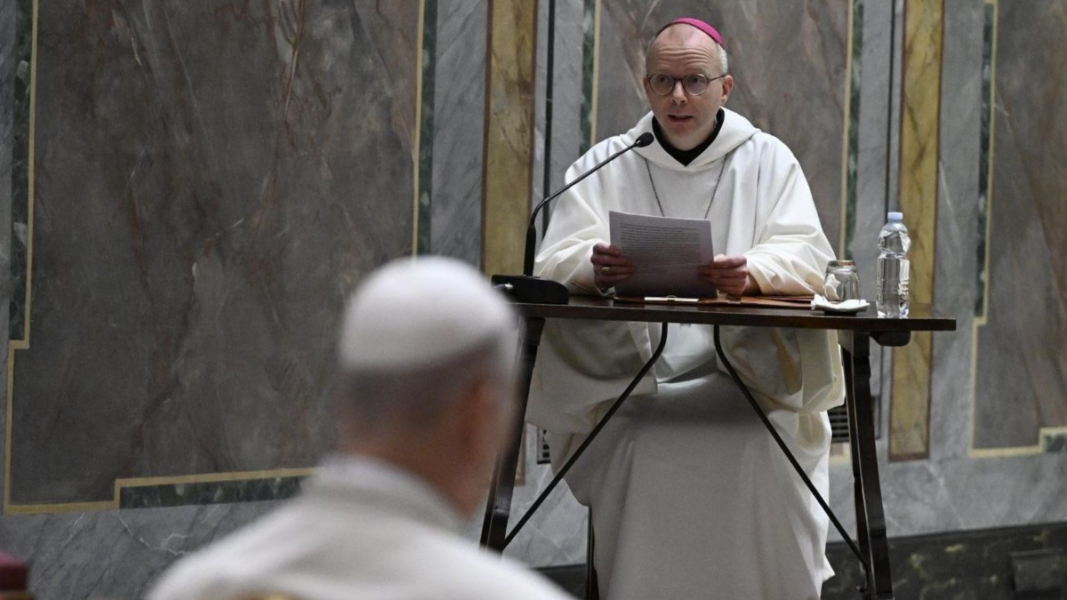
The reform of the Church does not begin with structures, but with the spiritual quality of those who govern it. That has been the axis of the tenth Lenten meditation preached by Bishop Erik Varden before Pope Leo XIV, the cardinals residing in Rome, and the officials of the Dicasteries of the Curia.
According to L’Osservatore Romano, the reflection, delivered in the Pauline Chapel as part of the Lenten Spiritual Exercises, revolved around the concept of «consideration», taking as reference the homonymous treatise by Saint Bernard of Clairvaux addressed to Pope Eugene III.
Saint Bernard and the Art of Governing
Varden recalled that Saint Bernard wrote De consideratione as a letter addressed to a former monk of Clairvaux who, against all odds, was elected Pope. The treatise, which became a true “best seller” at the time, did not propose institutional reforms, but a spiritual orientation for the exercise of government.
Contemplation, the preacher explained, deals with already known truths; consideration, on the other hand, seeks truth in the concrete and changing circumstances of human affairs. It is “the tension of the mind in search of truth” amid daily responsibilities.
Faced with the Church’s problems, Saint Bernard did not offer administrative recipes, but an essential criterion: to surround oneself with upright collaborators.
The Profile of Collaborators
The qualities that Bernard asked of the Pope remain relevant today: men of proven integrity, obedient, patient, and meek; firm in the Catholic faith, faithful in the ministry, lovers of concord and unity; prudent in counsel and sober in speech.
In short, these are people who trust more in prayer than in their own cunning. “Their entrance is without fanfare, their exit without pomp”, recalled the text quoted in the meditation.
For Varden, a Church governed in this way would reflect the harmony of the heavenly hierarchies and clearly manifest its primary mission: to give glory to God.
Looking to the Heights to Order the Temporal
Saint Bernard warned Eugene III that, to judge earthly matters correctly, it was necessary to seek through them what is above. Far from being an evasion, this attitude implies “returning to the homeland”.
The meditation also emphasized the centrality of God as “omnipotent will, benevolent virtue, and immutable reason”, who creates man to participate in his beatitude. Only in the light of that truth can pastoral tasks be rightly ordered.
The Weight of the Episcopal Ministry
Varden also evoked Saint Augustine, who described the episcopal office as a burden, the soldier’s pack on campaign. However, that weight becomes light when it is recognized as participation in the “easy yoke” of Christ.
“Carry your burden to the end: if you love it, it will be light; if you hate it, it will be heavy”, Augustine recalled. Pastoral responsibility may seem arduous, but it is luminous when lived as a service shared with Christ.
The meditation concluded with a quote from Saint Bernard that summarizes the ultimate meaning of the ministry: the deposit entrusted to the pastors belongs to Christ and must be returned to him. Governing the Church, therefore, is not administering one’s own power, but safeguarding someone else’s treasure.