


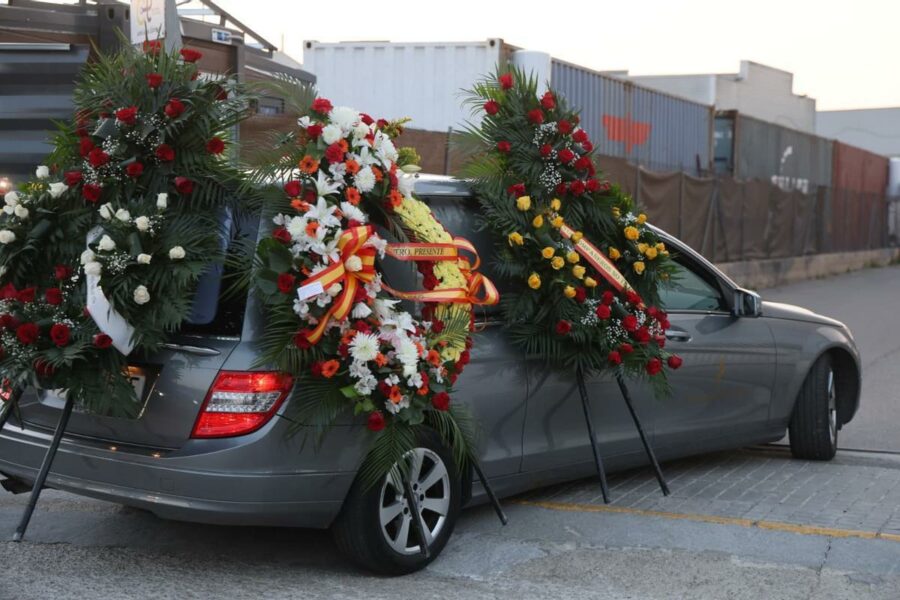
Yesterday, in the chapel of the Játiva funeral home, Valencia, the corpore insepulto mass was held in suffrage for the soul of Lieutenant Colonel of the Civil Guard Antonio Tejero Molina. All media have echoed the news of Antonio Tejero’s death, but few have looked deeply and broadly at his figure. He did so, as could not be otherwise, Father Ramón Tejero, his son, during the funeral homily.
It was a homily loaded with spiritual depth and filial tenderness, structured around the three great pillars that, as the priest explained, always sustained his father’s life.
The Sea and the Heart of Christ
Ramón began by evoking a luminous image: his father was fascinated by the sea. He liked to contemplate it in silence, letting himself be enveloped by its immensity, by its beauty and by its clarity. In the sea he saw something more than that: he saw a reflection of God.
Just as the sea is great, beautiful, and enveloping, so, Ramón Tejero explained, Antonio contemplated God. He always lived immersed in the immense heart of Christ. Like someone who dives into the sea and lets himself be surrounded by it, so Antonio Tejero lived his faith. He did not live faith on the surface, but within, embraced by that divine presence that gave meaning to everything.
First Pillar: Faith
The first of the pillars was his faith. An immense, constant faith, exercised amid difficulties and trials; a faith that did not waver, but confessed and lived like that of a convinced Catholic.
Ramón then recounted an anecdote that moved everyone. When his father was stationed as commander of the San Sebastián command post, at the Inchaurrondo barracks, the family attended mass at a nearby parish. The parish priest, with openly hostile positions toward the Civil Guard and Spain, belittled and insulted those who wore the uniform, in those harsh years when the attacks of the terrorist group ETA ended the lives of so many Spaniards, many of them Civil Guards. Antonio gathered his children. He explained to them that that priest was deeply mistaken, ideologically ill, and that his words in each homily were offensive toward Spain and the Civil Guard. But he added something that revealed the depth of his faith: despite everything, he was a priest of Jesus Christ. And when he pronounced the words of consecration, God Himself became present on the altar, and it was no longer that priest enemy of Spain but Christ Himself in the sanctuary.
The decision was clear and exemplary: they would attend every Sunday to fulfill the precept, they would pray fervently as a family, and during the homily, they would step outside the church and return when the Creed began. This is how Antonio defended the dignity of his own without abandoning obedience to God. It was a lesson in coherence, in the absolute primacy of faith, and in a supernatural vision that helped cultivate his own priestly vocation in his son Ramón.
He highlighted his devotion to the Mother of God, and especially to the Virgin of the Pillar, to whom he had been consecrated as a knight since he was a Civil Guard cadet officer.
Second Pillar: Spain
The second pillar was his love for Spain, which he always saw as a mother. To Spain he consecrated his entire life. He served it with the valor of the best soldiers, with the commitment of the best sons, with the heroic exercise of the Christian virtue of patriotism.
Ramón recalled how his father understood service to Spain as a vocation. When he believed that Spain was threatened, when it was besieged and attacked by separatism, he stepped forward. He risked his career, his freedom, and his peace of mind for what he considered a sacred duty. If Spain was a destiny in the universal, a historical mission, Antonio had to consecrate his life to the defense of the Fatherland and always kept in mind the oath before the flag.
His entire military career was distinguished by the staunch defense of Spain.
Third Pillar: the Family
Ramón spoke with special emotion about Antonio’s marriage to Carmen, his wife, whom he repeatedly remembered. In their union, Father Tejero explained, they lived intensely the work of God’s creation. They understood their marriage as a participation in the very mystery of the Trinity: to reflect in their love the communion between the Father, the Son, and the Holy Spirit.
The family was not a secondary sphere for Antonio, but the very heart of his life. Unity in faith, unity in love for Spain, and unity among parents, children, and grandchildren formed a single body.
Therefore, death, Father Ramón concluded, is only a step toward eternal life, and his father was fully aware that it was so. So much so that Antonio Tejero did not fear death; he longed for it as a passage to the heavenly Fatherland, that immense sea of infinite beauty that would allow him to immerse himself in God for all eternity.