


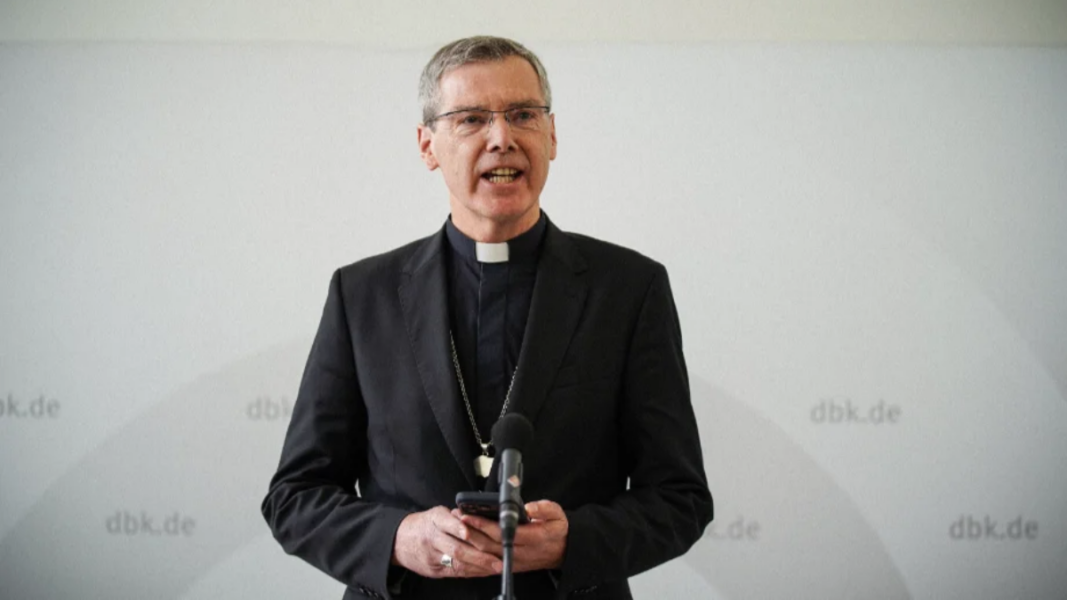
The president of the German Episcopal Conference (Deutsche Bischofskonferenz – DBK), Bishop Heiner Wilmer, stated in Würzburg that the positions of Alternative for Germany (AfD) “are not compatible with the Catholic Church”. The statement was made during the final press conference of the Spring Plenary Assembly of 2026.
Wilmer argued that the party’s “ethnic nationalism” and “slogans that despise human dignity” have no place in the Church. With these words, the German bishops reaffirmed the statement approved two years ago at the spring assembly held in Augsburg.
Warnings after analyzing the AfD’s regional program
The positioning came after the Bishop of Magdeburg, Gerhard Feige, presented to the assembly a report on the AfD’s draft government program in Saxony-Anhalt. As he explained, the implementation of that program would have “serious consequences for society”.
Feige accused the party of devaluing other political forces and institutions, including the Churches, and of not offering cooperation or real solutions to existing problems.
Criticism of the party’s social model and religious policy
Among the points highlighted by the bishops are the defense of a family model considered “retro”, the denunciation of an alleged “rainbow conspiracy” and the proposal for “remigration” of population groups. Likewise, the intention to question the financial bases of the Churches was criticized, including the immediate suppression of state benefits.
According to Feige, the AfD would be resuming, with regard to the Church, a policy similar to that of the former German Democratic Republic, by presenting it as an adversary and seeking to weaken its institutional presence.
For the defense of democracy
From Würzburg, Wilmer launched an explicit call: “Resist from the beginning” and added: “Let us protect our democracy”. In his view, the democratic system allows organizing social differences in a fair and peaceful manner.
At the same time, the bishops insisted on the need to open spaces for dialogue in society and mentioned initiatives such as the “Aufstehen für…” (“Stand Up for…”) campaign, promoted in dioceses of Hesse and Rhineland-Palatinate.