


By Fr. Paul D. Scalia
If God did not want them to eat from the tree, why did he put it there? That question is not as adolescent and petulant as it might seem. God does not act randomly in his Creation. He must have had a reason for placing that single forbidden tree in the garden. The Catechism explains it well: the tree of the knowledge of good and evil «evokes the unsurpassable limits that man, being a creature, must recognize and respect freely with trust». (CCC 396)
Now, «to recognize and respect freely with trust» is something the Devil simply cannot do. He wants his created gifts for himself, without Creator or Giver. He refuses to recognize or respect his creaturely limits. Non serviam, he boasts. I will not serve. . . .I will not observe limits.
Misery seeks company, so the Devil wants to reproduce his mentality in others. His first victims are Adam and Eve. (Genesis 3:1-7) He asks: «So God has said to you that you must not eat from any of the trees in the garden?». He does not ask to get an answer. He is suggesting that limits are absurd and that the one who sets them is hostile. God is against you because he has set limits for you. Adam and Eve bite the hook. They stretch beyond the place assigned to them and, in that very grasping, they fall.
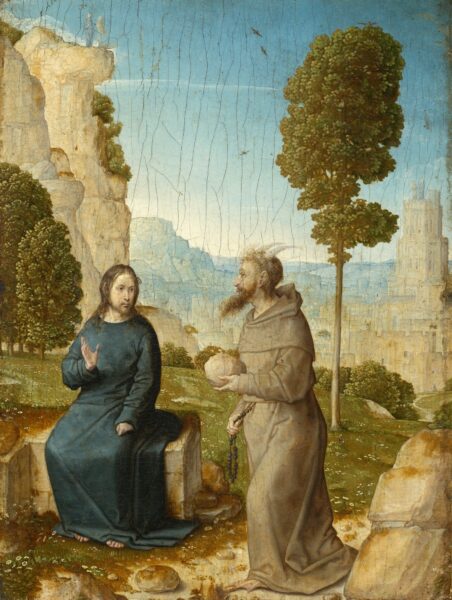
The Devil follows the same plan when he approaches Jesus in the desert. (Matthew 4:1-11) Now, if the Devil cannot understand the blessings of the creaturely condition, then the limitations of the Incarnation are absolutely impenetrable to him. The Incarnation is not a fiction or an exercise in imagination. God really confined and limited himself to our human nature: to be born of a woman, to experience tiredness, hunger, thirst, and sadness. Even to be tempted.
The Devil cannot grasp the joyful dependence of the eternal Son on the Father: «Amen, amen, I say to you: the Son can do nothing by himself. . . .I can do nothing on my own». (John 5:19.30) Nor can he understand the Son’s joyful acceptance of our created human nature. For Satan, divine power means doing what one wants, without serving anyone. Of course, it does not mean imposing limits on oneself out of humility.
That is why he pushes Jesus beyond the limits. If you are the Son of God, command that these stones become loaves of bread. Jesus experiences hunger in his human nature and joyfully trusts that the Father will sustain him. Nor will he use his divine power to create a shortcut in his ministry, offering physical food instead of spiritual. His response points to dependence, limits, and trust in God: Man does not live on bread alone, but on every word that comes from the mouth of God.
One day, Jesus will miraculously feed the multitude with loaves. Even more, he will give himself as the Bread of Life. Adam was deceived by a false hunger and grasped at the fruit of the tree. Hanging from the tree of the Cross, the New Adam feeds us with the Eucharist, his own Body and Blood. He does so not for himself, but in obedience to the Father’s will for our good.
Then comes the second temptation. The Devil proposes a bold display: that Jesus throw himself from the pinnacle of the temple and presume that the Father will save him. If you are the Son of God, throw yourself down. At bottom, Prove it.
Jesus’ divine power is unlimited, but not without purpose. It is, in a certain sense, circumscribed by reason and end. One day he will work miracles. He will cast out demons and heal, walk on water and multiply loaves. But those miracles are not parlor tricks. He does not perform them to prove who he is. In fact, he rebukes those (like the Devil) who demand signs. (Matthew 16:4; 12:39) His divine power is not exercised capriciously, but for our good: to reveal, instruct, and invite to faith.
Finally, the third and most demonic temptation: to obtain power over all the kingdoms by worshiping Satan. It is nothing more than a repetition of the temptation in the garden. Reaching beyond the place assigned to us always leads us to the feet of the Devil. True freedom is not found in grasping at power, but in receiving what God gives.
The battle in the desert is between one who has rejected all limits and Him who has limited himself—who has even clothed himself in our human nature, been wrapped in swaddling clothes, and one day will be nailed to the Cross. It is a combat between the unlimited and the Limited. Death entered the world through Adam’s proud rejection of limits. Life comes through the humble limitations of the New Adam.
We live in a culture that rejects limits and embraces the demonic concept of freedom. We think that, to be free, we must strip ourselves even of the limits of our human nature. For us, freedom demands that husband and wife be freed from their union, that a mother be freed from her unborn child, that a boy become a girl, and that our souls be loaded into machines.
In the desert, the Incarnate Lord shows us the true way. By humbling himself—by limiting himself—in our human nature and trusting in his Father, he overcomes the Devil’s temptations. He has done so not for himself, but for us. So that we may humbly follow the way he has traced and arrive at the «glorious freedom of the children of God». (Romans 8:21)
About the author
Fr. Paul Scalia is a priest of the Diocese of Arlington, Virginia, where he serves as Episcopal Vicar for the Clergy and pastor of Saint James in Falls Church. He is the author of That Nothing May Be Lost: Reflections on Catholic Doctrine and Devotion and editor of Sermons in Times of Crisis: Twelve Homilies to Stir Your Soul.