


By Fr. Raymond J. de Souza
State of the Union speeches consume abundant energy in the White House speechwriting team, which is curious, given how quickly they are usually forgotten. President Bill Clinton declared that the “era of big government is over” in 1996, but can anyone remember any other speech? Thirty years later, President Donald Trump will deliver the State of the Union address tonight.
In 1986, the State of the Union speech was already prepared; even a noon luncheon had been organized to brief the media on what to watch for.
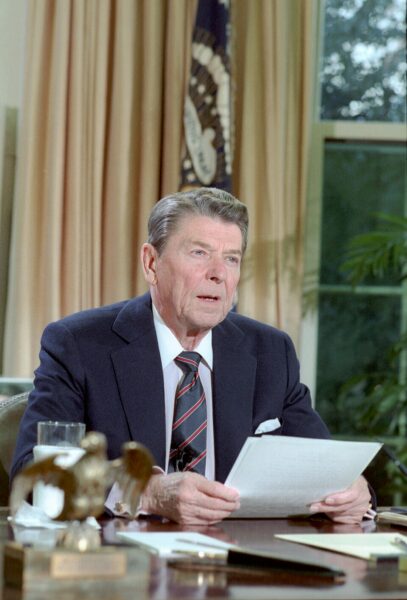
President Ronald Reagan would speak to the American people that day, but at five in the afternoon, not prime time, from the Oval Office and not from the Capitol, and from a brief text drafted quickly.
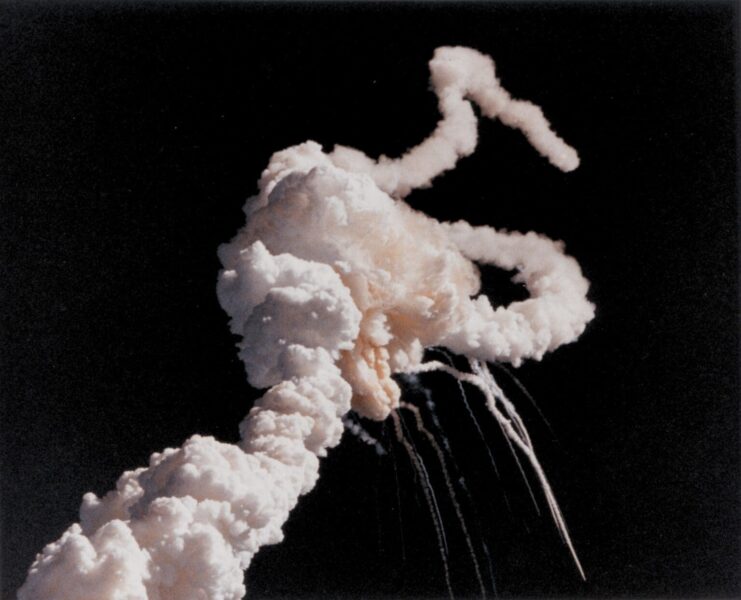
The space shuttle Challenger had exploded at the moment of liftoff.
Schoolchildren were watching it in their classrooms; a teacher was on board. The seven astronauts had died. The State of the Union speech was postponed. Reagan instead delivered one of the most memorable speeches of his long career.
And that speech launched onto the national scene a Catholic voice of great power.
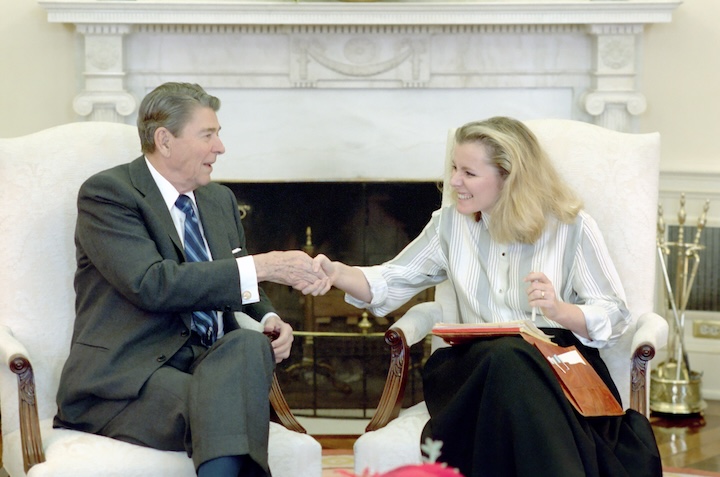
Peggy Noonan had joined Reagan’s speechwriting team after honing her craft writing daily radio commentaries for Dan Rather at CBS. She had worked on Reagan’s 1984 Pointe-du-Hoc speech for the fortieth anniversary of D-Day. But the Challenger speech was something different. The audience was much larger; the moment was immediate and heartbreaking, not historical and nostalgic.
Reagan spoke, in turn, to those in mourning: the families, the schoolchildren, the NASA workers, the American people. He reaffirmed the commitment to the space program despite the loss; he praised the spirit of adventure and discovery, comparing it to that of the great explorers of centuries past.
He concluded with verses from the poem High Flight, by John Gillespie Magee, the aviator’s national anthem. He did not mention Magee or cite the poem’s title. It was assumed that those verses were part of the common literary heritage of Americans.
Magee was born in 1922 in Shanghai, son of an American father and British mother, both Anglican missionaries. He was the eldest of four brothers and won his school’s poetry prize at age 16.
In 1940 he enlisted in the Royal Canadian Air Force—the United States had not yet entered the war—to fight overseas. He arrived in the United Kingdom in August 1941 and flew his first mission over occupied France in November. He died in December, not over France, but in Lincolnshire, colliding in mid-air with other aviators during a training flight.
He wrote High Flight after a training mission in a Spitfire that climbed to 33,000 feet. Exultant, he mailed it to his parents in early September. After his death, his father published it in the parish bulletin, and the poem spread through church press. Archibald MacLeish, Librarian of Congress, discovered it and gave it wider circulation, comparing it to In Flanders Fields, by John McCrae, the definitive elegy of the Great War.
Noonan knew the poem—and suspected Reagan did too. After the Challenger speech, Reagan told Noonan it was engraved on a plaque at his daughter’s school. High Flight is today engraved on the Challenger memorial.
A poem published posthumously by a brave aviator who was testing the then-known limits of flight was perfect for the Challenger. Magee begins with “I have slipped the surly bonds of Earth” and concludes with something like a prayer, after having “put out my hand and touched the face of God”.
The Challenger speech quoted those verses and increased Noonan’s fame, something notable for speechwriters, who usually remain anonymous. Later she would write about a “kinder and gentler nation” for George H.W. Bush, made so by “a thousand points of light”.
She would also write a beautiful memoir about the Reagan administration, What I Saw at the Revolution (1990), so popular that it had a twentieth-anniversary commemorative edition for Reagan’s centennial birth in 2011. It was followed by another book on Reagan, When Character Was King (2001), and one on another hero, John Paul the Great: Remembering a Spiritual Father (2005).
She has written a column in the Wall Street Journal for more than 25 years, where her Catholic faith appears regularly. She is the Catholic speaker turned to when someone competent and affable is wanted, who shows something new and makes one proud to be Catholic. Hence the honorary doctorates from Notre Dame and the Catholic University of America, as well as her participation in the 2022 Al Smith dinner.
In my own writings, I have frequently turned to anniversaries as a source of inspiration, and I thought I had learned that from St. John Paul the Great.
“His lifelong interest in anniversaries and jubilee years derives from his conviction that God’s action in history has sanctified time,” wrote biographer George Weigel in Witness to Hope. “Time is the dramatic stage that God chose to enter in order to save the world. Anniversaries and jubilees are occasions to bring to Christian consciousness the deep dimension of history”.
Now I believe I learned it from Noonan. I read What I Saw at the Revolution as a college student because I had seen the Challenger speech in high school. She included in that brief speech two anniversaries.
“Nineteen years ago, almost to the day, we lost three astronauts in a terrible accident on the ground,” Reagan said at the beginning.
And at the end: “There’s a coincidence today. On this day 390 years ago, the great explorer Sir Francis Drake died aboard his ship off the coast of Panama. In his life the great frontiers were the oceans, and a historian later said, ‘He lived by the sea, died on it and was buried in it.’ Well, today we can say of the Challenger crew: Their dedication was, like Drake’s, complete”.
A deep understanding of history recognizes that there are no mere coincidences in Providence, an expression that John Paul himself used when visiting Fatima on the first anniversary of his assassination attempt.
The arc of the Challenger speech followed the trajectory of aviation, rising from the surly bonds. Later, Noonan received a letter from a citizen who had written a poem about the Challenger and sent it to her. It concluded: “They left us looking to the sky”.
A great speech does that too. Forty years ago, it did.
About the author
Fr. Raymond J. de Souza is a Canadian priest, Catholic commentator, and Senior Fellow at Cardus.