


By Amy Fahey
On this day following the 225th anniversary of the birth of Saint John Henry Cardinal Newman, we would do well to remember a man whose temperament and talents marked him early for academic renown, oratorical brilliance, and sanctity.
Who was this man?
This man was extraordinarily popular at Oxford, becoming a magnet for thoughtful students who hung on his every word: «they flocked to his lectures, imitated his manner of speaking, his ways and his dress.» And yet, his biographer continues, «he wished to be left alone to pursue his own studies, to fulfill the duties that soon fell upon him… But he had been born in the wrong era for those quiet ambitions.»
This man wrote lyrically about the qualities of a gentleman scholar, noting that «his mind should be subtle, keen, and clear, his memory happy, his voice flexible, sweet, and resonant, his bearing and all his movements lively, chivalrous, and restrained.» According to all contemporary testimonies, he lived up to his ideal.
This man traveled to Rome, where he was deeply influenced by the life and example of Saint Philip Neri, and became convinced of the work he had to accomplish in England.
This man was set on his path of conversion to Catholicism by reading the Church Fathers. When he began to understand the implications of their teaching, the question that arose for him, as his biographer notes, was not «whether the Church of England was heretical, but whether heresy was a matter of great importance.»
This man’s entry into the Catholic Church was universally lamented among the Established Church and the State as a catastrophic loss for England; in the words of a prominent politician of his time: «it is a great pity… because he was one of England’s diamonds.»
This man was involved in the founding of a university in Ireland, where «the ambition of serene scholarship and of a kindly and sympathetic society, so rudely disturbed at Oxford, seemed once more attainable.»
Who was this man, dear reader? None other than Edmund Campion, the sixteenth-century English recusant saint and martyr. These are his life, his works, and his words, and his biographer is Evelyn Waugh, whose Edmund Campion: A Life remains one of the greatest works of modern hagiography.
Waugh presents us with a deeply human and sympathetic portrait of a man whose life, as my rhetorical game demonstrates, resembles Newman’s in so many ways, like the two panels of a diptych.
Is it merely a happy coincidence or a mere curious historical alignment that allows us to see Newman’s life as a reflection of Campion’s, or to consider Campion as a precursor of Newman? Or is it too bold to suggest that, had Edmund Campion not existed, there would have been no Saint John Henry Cardinal Newman, Doctor of the Church and Co-patron of Education?
In addressing these questions, we cannot overlook a central difference in the lives of these two saints who sought to restore the Faith in England: Newman lived to nearly ninety years; Campion’s life was cut short at forty-one by «the hangman and the butcher.»
Set alongside Newman’s life, Campion’s can easily be read as an absolute failure. As Waugh reminds us, after Campion’s brutal martyrdom and the near extinction of the Church in England for centuries, it was tempting to conclude that «the whole gallant sacrifice seemed to have been prodigal and vain.»
Waugh particularly laments the loss of Campion to the course of English prose, something no one could say of Newman, who has indelibly enriched our language and our letters: «[I]f Campion had continued in the life he then projected for himself, he would almost certainly have gone down in history as one of the great masters of English prose… What a translator of the Vulgate was lost in Campion!»
Newman himself seems to echo such laments in his famous sermon «Second Spring»:
Oh, that miserable day, centuries before we were born! What a martyrdom to live in it and see the fair form of Truth, moral and material, rent limb from limb, and each limb and organ torn out and cast into the fire, or plunged into the deep!… But at last the work was done. Truth was slain and buried with a spade.»
Buried with a spade: what a brutal word, and yet graphically appropriate for the burial of mortal limbs and eternal Truth. But that is not the end of the story. In a phrase marked by the elegant parallelism and antithesis that can be seen in these parallel lives, Newman declares regarding the fall and resurgence of the Church in England: «The fall was wonderful; and, after all, it was in the order of nature;—all things come to nought: its rising again would be a different kind of wonder, for it is in the order of grace;—and who can hope for miracles, and such a miracle as this?»
Newman attributes this «miracle» not to Campion’s intercession, but to «my own Saint Philip,» the founder of Newman’s Congregation of the Oratory, Saint Philip Neri.
When Newman composed a litany in honor of his patron saint, among the many profound titles he gives to Saint Philip is one that suggests the mystical bond between Campion and Newman: «hidden hero.» For it was Newman’s «own Saint Philip,» that cheerful and humble Italian priest, who greeted Edmund Campion with Salvete flores martyrum —»Hail, flowers of the martyrs»— when the young seminarian was in Rome preparing for the priesthood and his future sacrifice. (The greeting comes from Prudentius’s Latin hymn on the Massacre of the Innocents).
«Can we suppose religiously that the blood of our martyrs, three centuries ago and since, will never receive its reward?» Newman asks in that «Second Spring» sermon:
The long imprisonment, the foul dungeon, the weary waiting, the tyrannous trial, the barbarous sentence, the savage execution, the rack, the halter, the knife, the cauldron, the innumerable tortures of those holy victims, O my God, shall they have no reward?… And in that day of trial and desolation for England, when hearts were pierced through and through with Mary’s grief, in the crucifixion of Thy mystical Body, were not every tear that flowed and every drop of blood that was shed a seed of a future harvest, when they who sowed in tears should reap in joy?
Those who know something of Campion’s martyrdom know that a drop of his blood fell on the cloak of an uninterested spectator named Henry Walpole, who followed Campion to martyrdom after writing a lyrical tribute, «Why do I use my paper, ink, and pen?,» in which he declares: «This martyr’s blood has wet all our hearts.»
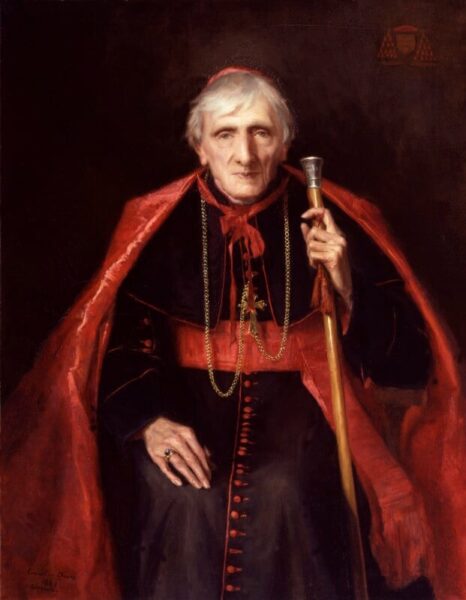
All our hearts. I have never been to Arundel Castle to see the original, but when I contemplate a copy of the so human portrait of Newman painted by Millais—in which the folds of scarlet satin threatening to engulf the elderly Cardinal are reflected in the deep folds of prayer and sacrifice etched on his face—it seems evident to me that, in some mysterious way, a drop of Campion’s blood also fell on Newman.
Such is «Thy mystical Body,» the Communion of Saints. Who knows what hidden heroes may be rising, in England and elsewhere, at this very moment, through the intercession of these men, to renew and sustain Our Lord’s Church?
Saint Edmund Campion, Saint Philip Neri, and Saint John Henry Cardinal Newman, pray for us.
About the author
Amy Fahey is a Teaching Fellow at the Thomas More College of Liberal Arts. Her essay, «Sigrid Undset, Novelist of Mercy,» appears in the forthcoming volume, Women of the Catholic Imagination (Word on Fire, 2024).