


There are news stories that do not divide the Church: they portray it. The one published by Infovaticana about the priest criminally acquitted for possession of images of nude minors —but whose conduct was described in detail in court— is not just a specific case of questionable diocesan governance. It is an uncomfortable mirror. And what is truly revealing is not only the appointment as hospital chaplain after that episode, but the automatic reaction from a part of the Catholic digital ecosystem.
It is worth recalling the bare facts stripped of sentimentality: there was an investigation, there was intervention by an IT team, there was a conviction in the first instance for possession of child pornography, and there was a subsequent acquittal because the images, even though they showed nude minors, did not fit the criminal type according to the restrictive interpretation of article 189 of the Penal Code. In other words: there was no criminal offense under that type. Period. But in the proven facts, repeated downloads and organization of files were described. That is not an opinion; it is judicial matter.
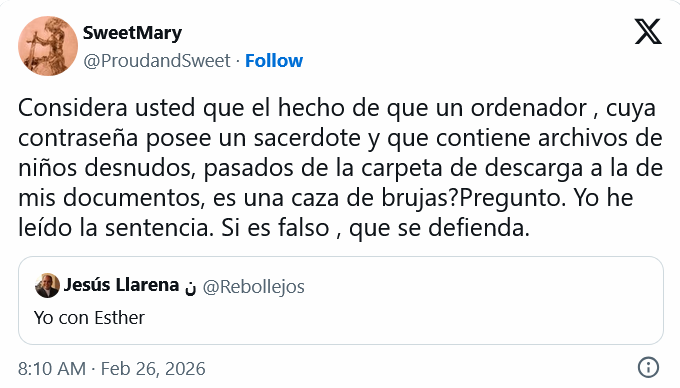
From there, the issue ceases to be criminal and becomes prudential. Is it reasonable to place in a sensitive pastoral setting someone who has been objectively linked to an episode of that nature? That is the question. It is not a new accusation, not a parallel condemnation, not a lynching. It is a matter of governance and child protection.
However, the reaction from some tweeters has been illustrative to the point of sarcasm. “I won’t back down from this even for the Pope,” says an indignant defender. The phrase, uttered in the name of loyalty, reveals just the opposite: a utilitarian papolatry. The Pope serves as a symbolic wall when it suits to close the debate, but not as a real instance of discernment. It is not obedience; it is emotional shielding.
Another star argument: “Something got downloaded to me by mistake on eMule too.” The technical alibi turned into popular catechism. It is curious that in these cases there are always selective IT errors, innocent searches, and involuntary downloads, but never an independent technical explanation to prove it. The appeal to personal anecdote substitutes objective analysis. Emotion replaces fact.
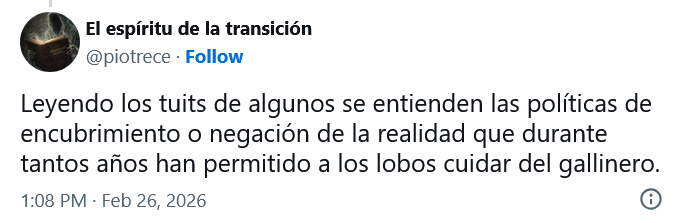
And then comes the final recourse: “God will hold you accountable.” It is the pious blackmail that turns the demand for transparency into a sin against charity. Asking becomes attacking. Investigating becomes getting revenge. Asking for prudence becomes throwing the first stone. This is how clericalism works: not as written doctrine, but as an instinctive reflex of corporate protection.
What these tweets reveal is not a sociological majority —they are a minority—, but a persistent mentality. A mentality that confuses presumption of innocence with automatic pastoral suitability. That identifies mercy with absence of consequences. That reduces child protection to a matter of criminal typicity, as if the Church should only act when a judge forces it to.
The problem is not that someone defends a priest they consider innocent. The problem is disqualifying as a “fool” or an enemy of the Church anyone who raises documented questions. The problem is that the instinct is not to protect the vulnerable and the ecclesial credibility, but to close ranks.
For decades, impunity did not survive due to a lack of laws. It survived because of this psychological mechanism: minimize, relativize, personalize the debate, and accuse of malice anyone who discomforts. “It’s not a crime.” “It’s already forgiven.” “You’re damaging the Church.” Meanwhile, the prudential question remains unanswered.
Infovaticana’s news may be liked more or less. Its approach may be discussed. But the nerve it has touched is evident. When the immediate reaction to described judicial facts is insult, caricature, or defensive invocation of the Pope, what emerges is not love for the Church. It is fear that its way of governing itself will be examined.
And there lies the heart of the matter: the Church does not lose credibility because a media outlet asks. It loses it when those who should demand the highest standards of prudence settle for the minimum criminal threshold and call any scrutiny persecution.