


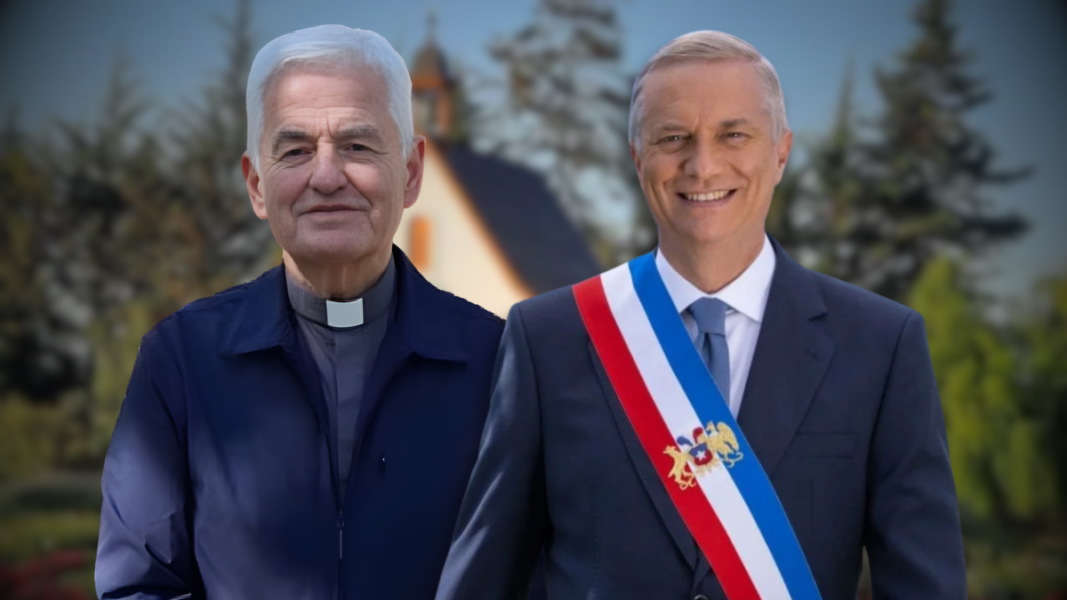
The president-elect of Chile, José Antonio Kast, appointed the priest who will assume the role of chaplain of La Moneda (government house) starting from next March 11, the date on which the change of command will take place. According to the media outlet The Clinic, the chosen one is the priest Mariano Irureta, a member of the Schoenstatt movement —the same to which the president’s family belongs— and who has an extensive pastoral trajectory.
Ecclesiastical Trajectory and Biographical Profile
Mariano Irureta Uriarte was born on September 25, 1954, in Santiago de Chile. He is the son of Narciso Irureta, a political leader of the Chilean Christian Democracy who was a member of Congress and later a minister in the 1990s.
Before entering the seminary, Irureta began studying Law at the Pontifical Catholic University of Chile. In 1974, he joined the international apostolic movement of Schoenstatt, founded in Germany in 1914 and present in various countries in America and Europe. A year later, he formally entered the community of the Schoenstatt Fathers, the priestly branch of the movement.
He was ordained a priest on August 3, 1985, in the Bellavista Shrine, one of the main centers of Schoenstatt in Chile. Throughout his ministry, he has performed pastoral and formative functions both in Chile and abroad. Among other positions, he has been an advisor to family communities of the movement in Portugal, rector of a seminary of the Schoenstatt Fathers, and provincial superior of the congregation in Chile.
Since 2015, he has served as the national director of the Schoenstatt movement in Chile. In 2025, he also assumed the role of chaplain for educational institutions linked to the movement and as vice-postulator in a beatification cause within the Catholic Church.
His appointment as chaplain of the La Moneda Palace now places him in a role of spiritual accompaniment directly linked to the seat of the Chilean Executive Power.
What is a Presidential Chaplain?
The figure of the presidential chaplain is not new in Chile, although it does not constitute a political position nor is it part of the formal structure of the cabinet. Its function is traditionally linked to the spiritual accompaniment of those who work in the seat of the Executive and to the eventual organization of religious acts in official contexts.
In historical terms, the presence of chaplains in public institutions has been common in areas such as armed forces, hospitals, universities, and parliaments, being a position understood as a voluntary service of spiritual assistance and not as a function of confessional representation of the State.
Chaplaincies in Other Countries
Various countries maintain similar figures in their institutional structures. In the United States, for example, both the Senate and the House of Representatives have had official chaplains since the 18th century, despite the constitutional principle of separation of Church and State. In the United Kingdom, Parliament maintains chaplains linked to its historical tradition. In Latin America and Europe, there are also chaplaincies associated with armed forces, hospitals, and, in some cases, government headquarters.