


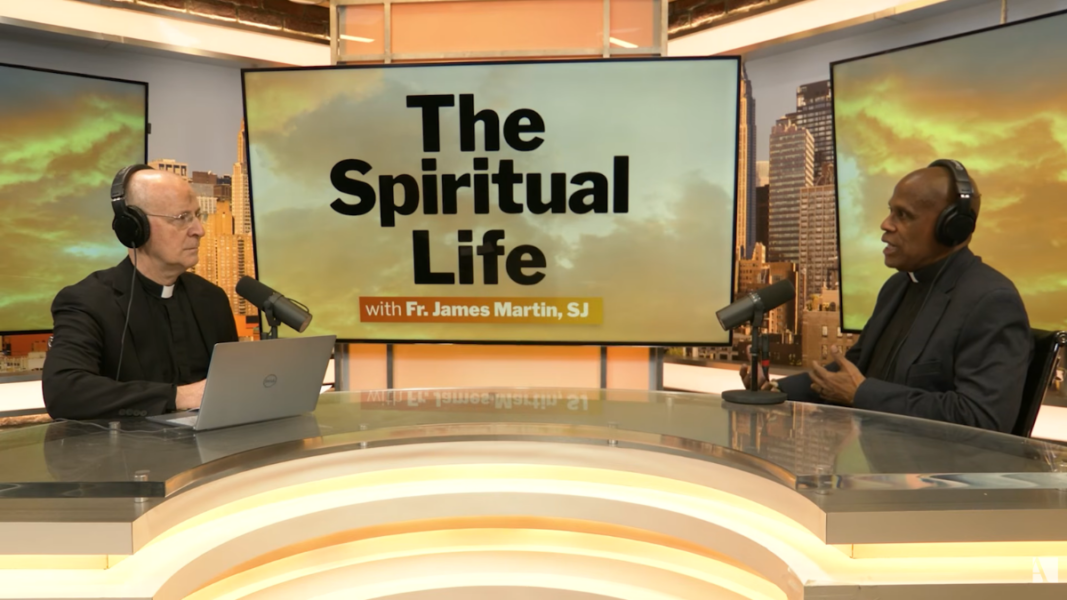
In the latest episode of the podcast The Spiritual Life, produced by America Magazine, the controversial Jesuit James Martin interviews the priest and theologian Bryan Massingale, whom he explicitly presents as a “Black and openly gay priest”, proposing him as a reference for the current Church.
From the beginning, Martin insists on clarifying that it is a “gay and celibate” priest, and emphasizes how unusual it is for a presbyter to make his «orientation» public. The conversation revolves around identity, visibility, and pastoral accompaniment, with a marked emphasis on personal authenticity as the axis of ministry.
The “Coming Out” and International Activism
Massingale explains that he decided to make his homosexual condition public in 2019, during a meeting of the Global Network of Rainbow Catholics —an ideological organization that openly promotes ideas contrary to Catholic doctrine on sexuality—. He recounts that, after hearing testimonies from people persecuted for their sexual orientation, he concluded that he could not ask others to take risks if he himself was not willing to do so.
He began his speech with an explicit statement: “I come before you as a Black and gay priest”. He later authorized the publication of the speech, which was translated into several languages. According to him, his decision was not a personalistic gesture, but a way of “letting the love of God come to light”.
“I’m Not a Hybrid Car”
In the interview, Massingale insists that his identity cannot be fragmented. He rejects being presented solely as a “gay priest” and states: “I’m not a hybrid car. I don’t have a Black hat and a gay one”. With that expression, he intends to emphasize that his racial condition and sexual orientation form a “composite reality” inseparable from his priesthood.
At another point, he states that his deepest vocation is to be “a Black and gay incarnation of the presence of Christ in the world”, holding that the grace of God can also be found in what some within the Church would consider problematic.
Rejection within the Clergy
Massingale assures that after making his orientation public, he lost priestly friendships. According to his account, some told him that if they maintained a relationship with him, others might suspect their own sexual orientation. He also claims that the greatest distancing did not come from the laity, but from bishops and fellow priests.
Martin reinforces this idea by pointing out that in certain ecclesial environments there is a prejudice to identify “gay priest” with active sexual conduct, something that both explicitly reject.
Identity and Ecclesial Model
The episode does not limit itself to narrating personal experiences, but presents that visibility as a model. Massingale holds that his authenticity has allowed students and faithful to feel “liberated” to live their own identity. He recounts, for example, how at a university graduation ceremony organized by LGBT students he received a tribute for his 40th priestly anniversary, interpreting it as a sign of support for his dual condition.
The conversation concludes with advice to parents of LGBT children who reject religious practice, recommending accompaniment, validation of pain, and the search for “welcoming” communities.
Magisterium and Discernment: What the Church Says
Beyond personal testimonies, in the Catholic tradition the priesthood is not defined by sociological or identity categories, but by the sacramental configuration with Christ, Head and Shepherd of the Church. Priestly identity arises from the sacrament of Holy Orders and participation in the one priesthood of Christ, not from cultural, racial, or affective traits.
The Church clearly distinguishes between inclination and conduct, and maintains an objective moral teaching on sexuality, while unequivocally affirming the dignity of every person. Within this framework is the Instruction of the Congregation for Catholic Education of 2005 —still in force to date— which establishes:
“The Church, while profoundly respecting the persons in question, cannot admit to the seminary or to holy orders those who practice homosexuality, present deep-seated homosexual tendencies or support the so-called gay culture.”
This is a disciplinary criterion founded on a theological vision of the priesthood and on the Church’s own vocational discernment.