


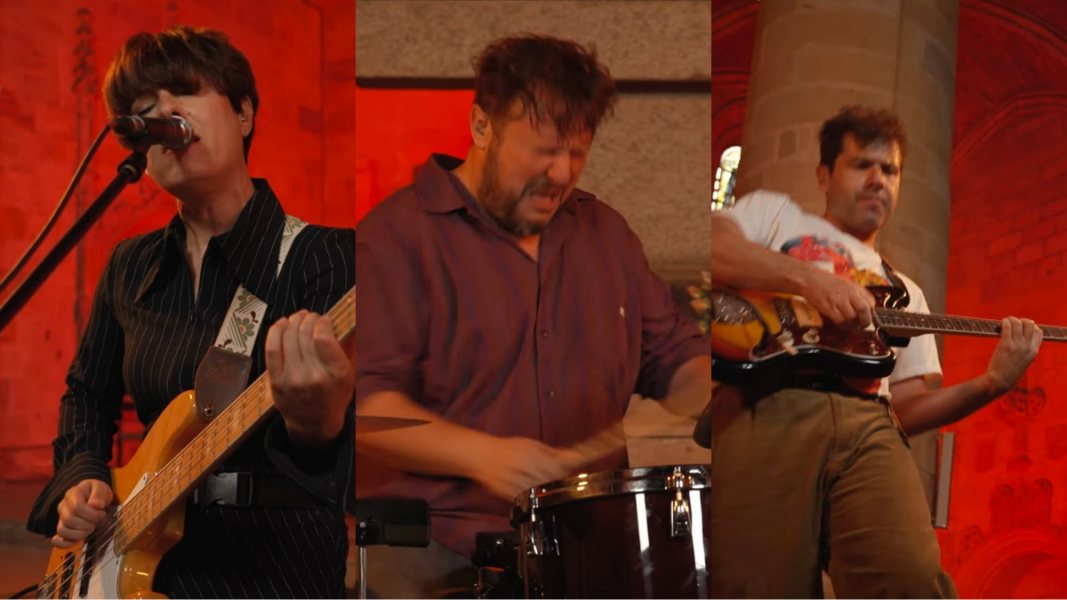
The church of the Convent of the Incarnation in Bilbao has been the chosen setting for the recording of a performance by the group Triángulo de Amor Bizarro. The video was published just a few days ago and has accumulated thousands of views. The images leave no doubt: the recording takes place in the central nave of the temple, with the altar perfectly visible in the background and a crucifix presiding over the presbytery. The entire space is bathed in intense red lighting, while professional spotlights, cameras, wiring, amplifiers, and drums occupy the area at the foot where the liturgy is usually celebrated.
During the performance, the slogan “Guillotina, puto Vox” is chanted on numerous occasions. The shout, with explicit political content and a direct reference to a historical instrument of execution, is repeated inside the temple, in front of the altar and under the cross. It is not an isolated phrase or an ambiguous nuance: it is a clear slogan, launched in a consecrated space and subsequently disseminated through social networks.
The recording is neither improvised nor clandestine. It requires permits, coordination, authorization for the use of the temple, and technical deployment. Nothing that appears in the video is accidental. The altar is part of the frame, the crucifix is visible, and the sacred architecture serves as the background for a direct political attack message. To date, there is no public explanation from the ecclesiastical authorities regarding the criteria applied to allow this use of the space.
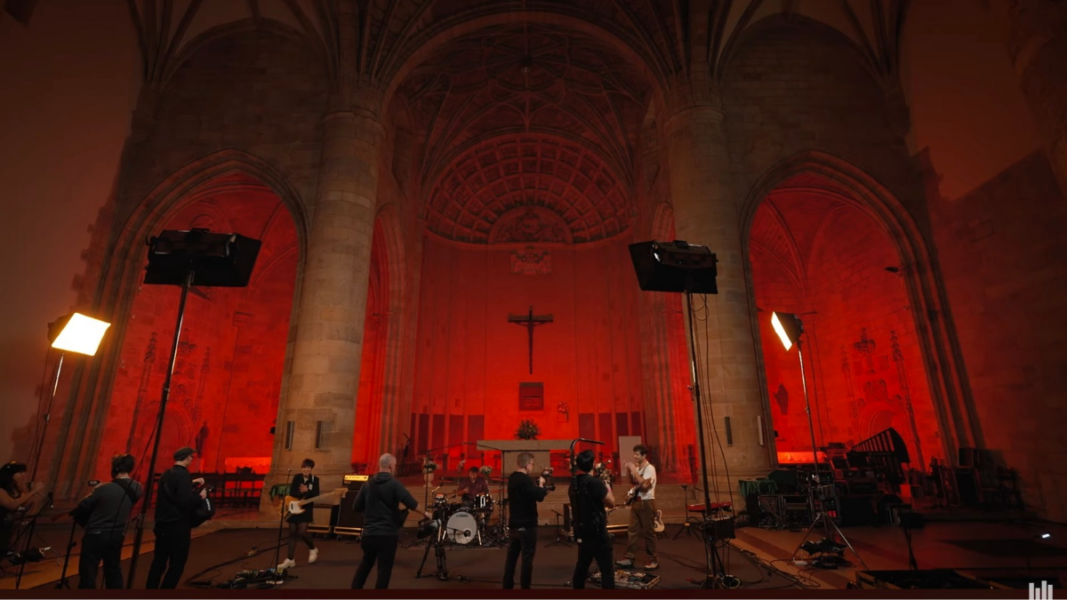
The objective fact is that in a Catholic church, a music video has been recorded and disseminated in which a slogan alluding to the guillotine against a specific political party is repeated. And the problem is no longer just bad taste or the usual provocation in certain cultural spheres. The problem is the increasingly careless management of sacred space, treated as if it were a container available for any use, even when that use involves amplifying violent slogans with a satanic aesthetic.
Many faithful are tired of seeing how temples become stages for aesthetic experiments or partisan messages that have nothing to do with the Church’s mission. One thing is to allow cultural activities compatible with the character of the place, and quite another is to lend the altar and the cross as a backdrop for guillotine shouts against a good part of the Spanish people. When the sacred is banalized to this point, the message conveyed is that anything goes, that there are no limits, and that the temple can be instrumentalized without consequences. That drift is not openness or modernity; it is a silent renunciation of safeguarding what should be protected with the utmost zeal.