



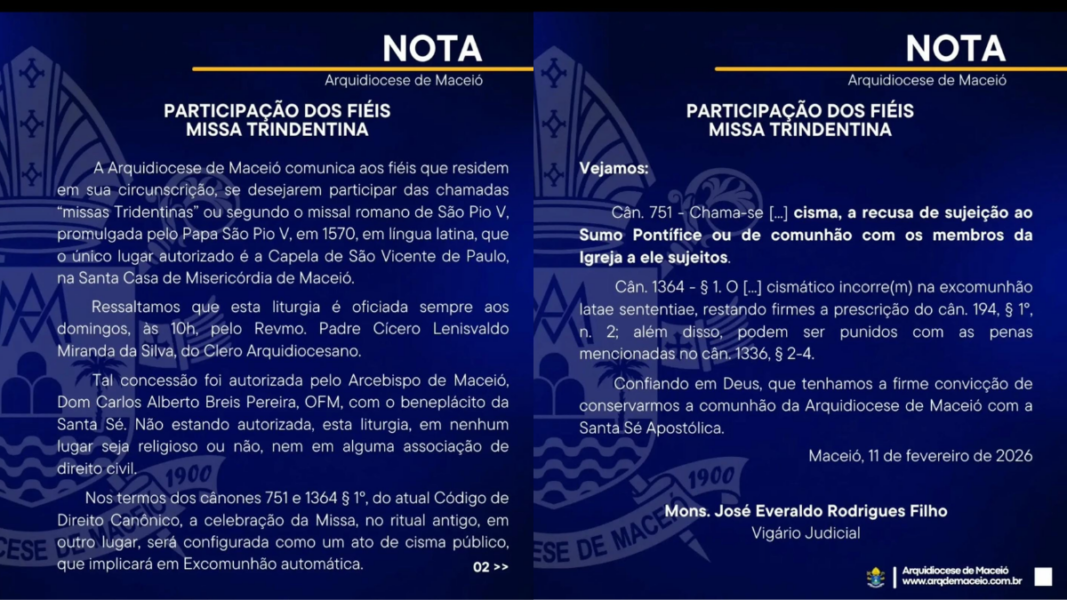
The Archdiocese of Maceió has issued an official note stating that the celebration of the Mass according to the missal of St. Pius V outside the only authorized location will be considered a “public act of schism” and that this will result in automatic excommunication for the attending faithful under canons 751 and 1364 §1 of the Code of Canon Law. The text, authorized by Bishop Carlos Alberto Breis Pereira O.F.M., also indicates that the Mass in the ancient rite is only permitted in the Chapel of São Vicente de Paulo once a week and is not authorized “in any other place,” whether religious or not, nor in civil law associations.
The issue is not merely disciplinary. One thing is to restrict a place of celebration, and another, radically different, is to label as schismatic those who participate in any unauthorized celebrations and to associate that participation with the most severe penalty in the canonical order. Speaking of schism and automatic excommunication is not a rhetorical formula: it is to place specific persons in the maximum penal territory, with devastating spiritual and juridical effects.
It is worth clarifying the concepts. Canon 751 defines schism as the refusal of submission to the Roman Pontiff or the refusal of communion with the members of the Church subject to him. That is, schism is not “doing something without permission,” nor “preferring a rite,” nor even “disobeying” in a specific point. It is a rupture of communion, formal and effective, with the authority of the Pope or with the ecclesial communion. It is an exceptional category, because it describes a fracture in the visible bond of the Church.
Canon 1364 §1 establishes that the apostate, the heretic, or the schismatic incur in excommunication latae sententiae, that is, automatic, by the very fact of committing the offense. But for there to be an “offense,” it is not enough for an ecclesiastical superior to affirm it in a note. In canonical penal law, classic principles apply: strict typicality, restrictive interpretation of penalties, imputability of the subject, and, ordinarily, a conduct objectively suitable to cause the rupture of communion described by the norm.
For this reason, identifying the celebration of the ancient rite outside an authorized place as schism raises a fundamental problem. Disciplinary illicitness, even if grave, does not automatically become schism, much less over the faithful. To speak of schism, it must be possible to prove that the act implies, by its nature or by the intention of those who perform it, a refusal of submission to the Pope or a rupture of communion. Without that intention of separation, the penal label becomes expansive and arbitrary. And when an automatic penalty is extended interpretatively beyond the penal type, what appears is legal uncertainty.
This has immediate pastoral consequences. The episcopal authority, by its very purpose, is ordered to the edification and salvation of souls. The use of maximum penal language in a liturgical conflict produces the opposite: anxiety, confusion, fear in conscience, and public scandal. If it is conveyed to the faithful that they may become excommunicated “automatically” by attending a celebration in the ancient rite outside a specific place, an improper spiritual pressure is introduced into the law, which must protect persons against disproportionate applications of punitive power.
Didactically, the decisive distinction is this. A celebration may be illicit without being schismatic. An act may be disobedient without equating to a rupture of communion with the Roman Pontiff. And a penalty as extreme as excommunication cannot become an ordinary mechanism of disciplinary control, nor be applied by conceptual extension. Excommunication is designed for cases in which communion is broken in a real and formal way, not to resolve controversies through a penal shortcut.
If, in addition, talk is of excommunication latae sententiae, the rigor must be greater. Automatic excommunication does not depend on an administrative declaration; it depends on the objective existence of the offense in the strict terms of the law. Precisely for this reason, the juridical tradition of the Church has insisted on interpreting these penalties restrictively and avoiding leaving the faithful at the mercy of maximalist readings of the penal type. When automatic excommunication is invoked in a disputed matter, the risk of injustice and abuse in conscience multiplies.
The Holy See, guarantor of unity and the correct use of universal law, should urgently clarify the scope of this type of official communications. If the idea is consolidated that celebrating or attending the ancient rite outside an authorized place is “in itself” a schismatic act, the degradation of canonical legal security reaches very serious levels. It is not a liturgical dispute: it is the very threshold between discipline and ecclesial rupture, between pastoral correction and extreme penal sanction.
Either Rome corrects and precisely delimits this qualification, or a dangerous pattern is normalized: the use of episcopal authority to produce unease and scandal in souls through maximum penal threats without the strict configuration of the offense. In the Church, authority is there to safeguard communion, not to empty of juridical content the notion of schism nor to trivialize excommunication. When law is used as a weapon and not as a guarantee, the wound is not suffered only by a group of faithful: it is suffered by the credibility of ecclesial justice and trust itself in pastoral government.