


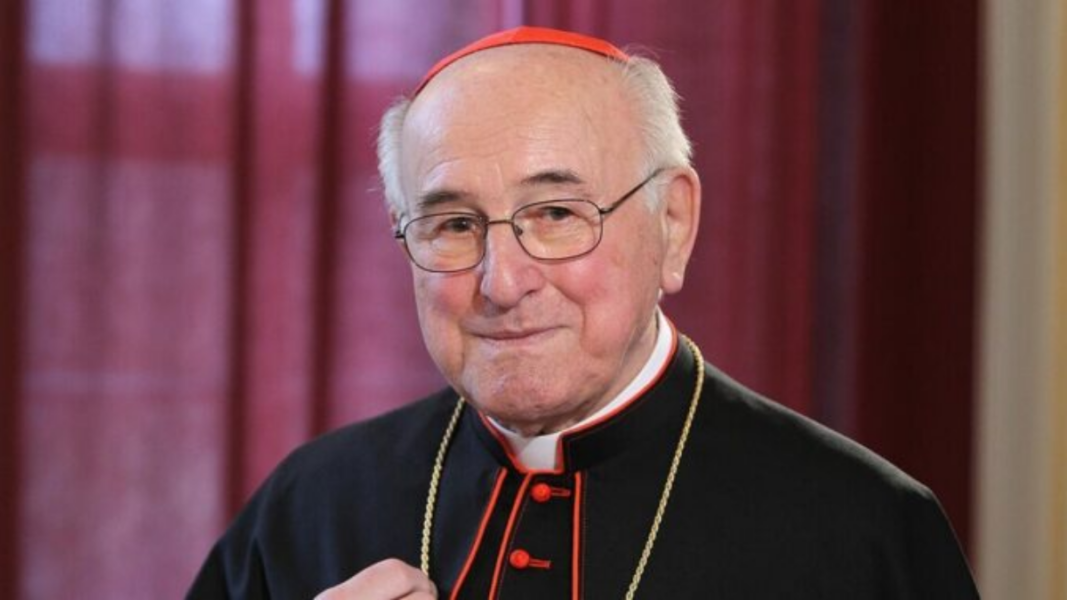
Cardinal Walter Brandmüller, at 97 years old, has issued a call in favor of a “reform of the reform” that would allow the restoration of liturgical peace in the Church. In a text published on the blog Diakonos, the German cardinal exhorts bishops and the faithful to “lay down their arms” in a dispute that, for decades, has pitted progressive and traditionalist sectors against each other regarding the celebration of the Mass, proposing a way out that passes through fidelity to the conciliar constitution Sacrosanctum Concilium and a critical review of the drifts following the Second Vatican Council.
We leave below the full text of Brandmüller:
For the love of God: «Lay down your arms!»
It was not the conciliar constitution Sacrosanctum Concilium of Vatican II, but the application of the liturgical reform after the Council, that provoked the fracture that has spread in numerous places in the Catholic world. From this arose an unhealthy conflict that pitted “progressives” against “traditionalists.” Should this surprise us? Not at all. It merely demonstrates to what extent the liturgy occupies a central place in the life of the faithful.
Moreover, the so-called “liturgical conflict” is not a phenomenon that appeared with Vatican II, nor is it exclusive to Catholicism. When, in the Orthodox Russia of 1667, Patriarch Nikon and Tsar Alexis I introduced a liturgical reform, several communities separated, some even going so far as to reject the priesthood, creating schisms that persist to this day.
In the time of the Enlightenment, heated controversies also tore apart Catholic and Protestant Western Europe regarding the introduction of new hymnals. In Catholic France, the replacement of the ancient Gallican liturgy by the new Missale Romanum in the mid-19th century provoked fierce opposition.
In summary, it was not a matter of dogma or revealed truth, as in the case of Arius or Luther. These issues were more the object of debates in intellectual circles.
What does affect, however, the everyday life of faith are the rites, the customs, the concrete forms of daily piety. And it is there that the conflict ignited, sometimes even over secondary details, such as the variation of the words of a hymn or a prayer. The controversy becomes all the more fierce the more absurd the motive for the dispute seems.
In the face of such a minefield, it is impossible to deploy a bulldozer. In most cases, it is not the doctrine of the faith that is called into question, but religious sentiment, formulas of devotion, customs. And the consequences are much deeper than an abstract theological formula, because they affect vital experience.
Likewise, it is equally erroneous to invoke slogans like “under the cassocks, a millennium of musty smell” to demand the demolition and break with tradition, for that would mean ignoring not only what is proper to Christianity, but also what is proper to human tradition transmitted as inheritance. This holds true in general for every attempt at reform, all the more so when it refers to everyday religious practice, such as the reorganization of parishes, which directly touches the life of the faithful.
And yet, surprisingly, there was no similar distrust or such marked rejection of novelty when Pius XII reformed the Easter Vigil in 1951 and then the entire Holy Week liturgy in 1955. I myself experienced it personally when I was a seminarian and young priest. And, apart from some perplexed reactions in certain rural parishes, wherever these reforms were applied faithfully, they met with joyful expectation, if not certain enthusiasm.
And yet, today, with the perspective that time provides, one might ask why, on the other hand, the reforms of Paul VI provoked certain well-known reactions. In the first case, the Church experienced a new liturgical impulse, and in the second, many saw a liturgical break with tradition.
After the pontificate of Pius XII, in numerous ecclesial circles, the election of John XXIII was perceived as a liberation from the magisterial corset. The door was opened even to dialogue with Marxism, existentialist philosophy, the Frankfurt School, Kant and Hegel—and with them a radically different way of conceiving theology. The hour had struck for theological individualism and farewells to everything that was then labeled as “old-fashioned.”
The consequences for the liturgy were grave. Arbitrariness, proliferation, and unrestrained individualism led in numerous places to the substitution of the Mass with personal compositions, often collected in spiral notebooks prepared by the celebrants. The result was liturgical chaos and an unprecedented exodus from the Church that continues to this day, despite the reforms of Paul VI.
In response, we witnessed the birth of groups and circles determined to oppose the disorder with unwavering fidelity to the Missale Romanum of Pius XII. The more arbitrariness and disorder reigned on one side, the more others entrenched themselves in refusal of any new development, despite the positive experience of Pius XII’s reforms. Thus, even the reform of Paul VI’s missal—which was not without defects—encountered numerous criticisms and resistances. And even when those objections were motivated, they were not thereby justified. The Novus Ordo had been promulgated by the Pope: despite legitimate criticisms, it had to be accepted in obedience.
And yet, what happened? For some, the reforms were not enough: they continued celebrating Mass with their spiral notebooks, the fruit of their personal creativity. Others, on the other hand, opposed fidelity to the “traditional Mass,” forgetting—or ignoring—that the rite of the Holy Mass has unfolded and transformed over the centuries, adopting different forms both in the East and in the West, according to their respective cultural contexts. In truth, the only “traditional Mass” is reduced to the words of the consecration, which, moreover, are transmitted with different formulations in the Gospels and in St. Paul. There is the only and true “traditional Mass.” And wherever this was not acknowledged, bastions were erected and the struggle continued to our days.
It must not be forgotten that authentic liturgy, celebrated conscientiously in the name of the Church, remains in many places a peaceful and everyday reality. Therefore, a question remains: how could such a virulent conflict develop? A look at history reveals something.
The battles fought after the Council of Trent did not concern the nature of the Holy Eucharist. The new Missale Romanum of Pius V was introduced gradually in the different countries, and last in France at the end of the 19th century, without causing conflicts, while ancient local rites, such as the Ambrosian rite in Milan or those proper to religious orders, continued without difficulty.
Only at the beginning of the 20th century, in the context of modernism, did the controversy over the sacrifice of the Mass resurface, though not so much around the ritual as around the very essence of the sacrifice. The outbreak of the First World War, with its tragic consequences for Europe, prevented an adequate solution, leaving this issue unresolved, latent under the ashes. And in the following years, the liturgical movement, important in the postwar period, also focused—with rare exceptions—not so much on the essence as on the execution of the liturgy, particularly the sacrifice of the Mass by communities of the faithful. The rise of communist, fascist, and Nazi dictatorships, leading to the Second World War and its consequences, once again prevented a definitive solution.
It was Pius XII, amid the problems of the postwar period and fully aware of the unresolved issues relating to the holy sacrifice of the Mass, who took up the theme in his encyclical Mediator Dei of 1947 to reaffirm and clarify the dogma of the Council of Trent and finally offer guidelines for a worthy liturgical celebration.
And yet, that was not enough to quell the controversies; on the contrary, they resurfaced with greater force, not so much around the rite as once again around the nature of the Eucharistic sacrifice. The excessive insistence—going so far as a true absolutization—of the convivial character of the Holy Mass has led, and continues to lead, to grave liturgical abuses, sometimes even to blasphemy. Abuses born of fundamental misunderstandings about the mystery of the Eucharist.
Added to this is that it almost always falls to the individual priest to decide whether the Holy Mass will be celebrated faithfully according to the Novus Ordo or whether free rein will be given to the subjective ideas of the celebrant. The cases in which episcopal authorities have intervened against abuses have been rather rare. It has still not been sufficiently understood that this dissolution of liturgical unity is caused by uncertainty, or even the loss, of authentic faith and constitutes a threat to the very unity of the faith.
It is therefore necessary—if one wishes to avoid or heal fatal fractures of ecclesial unity—to achieve peace, or at least a truce, on the liturgical front. For this reason, it is worth reprising the title of the famous pacifist novel by Bertha von Suttner, published since 1889, reissued 37 times and translated into 15 languages: “Die Waffen nieder!”: lay down your arms!
This means, first of all, disarming the language when speaking of the liturgy. At the same time, it would be appropriate to avoid all forms of reciprocal accusation. Neither side should question the seriousness of the other’s intentions. More simply put: it is advisable to show tolerance and avoid polemic. Both sides should guarantee a liturgy that scrupulously respects their respective norms. Experience shows that such a warning applies not only to the innovators, but also to the supporters of the “old Mass.”
Both should study with impartiality chapter II of the conciliar constitution Sacrosanctum Concilium to cast a critical eye on subsequent developments. Then it will become evident to what extent post-conciliar practice has deviated from this constitution, to which, it must not be forgotten, Archbishop Marcel Lefebvre himself had given his adhesion.
Only in this way, in silence and with much patience, will it be possible to work on a reform of the reform, capable of truly corresponding to the provisions of Sacrosanctum Concilium. Then the moment will come when a reform can be presented that honors the legitimate demands of both sides.
But while that day arrives, once again, for the love of God: «Lay down your arms!».