


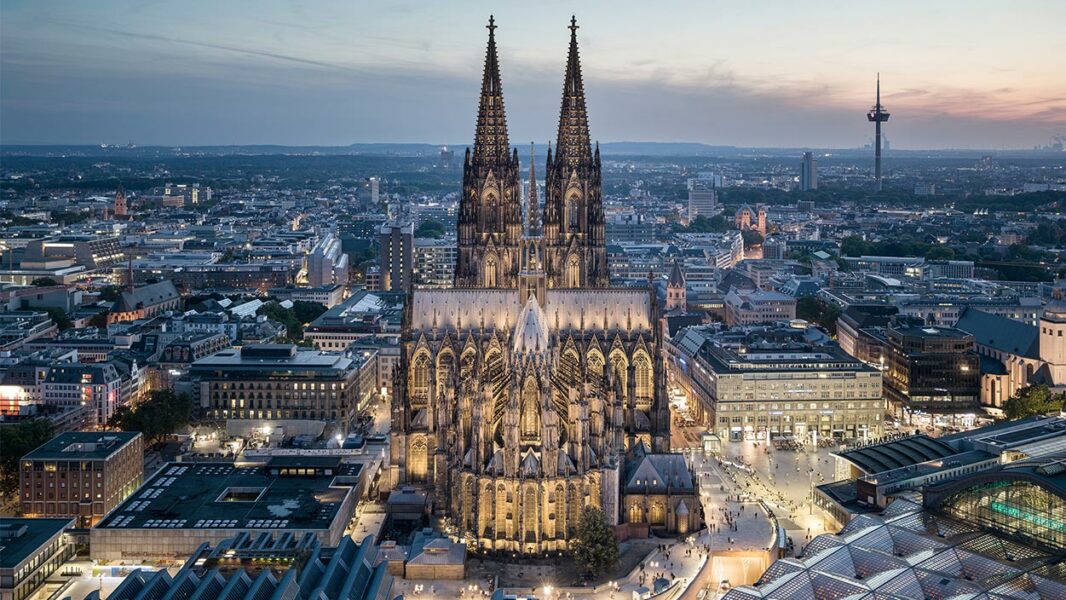
In Germany, the Catholic Church maintains one of the most solid economic structures in the world, but it presents one of the lowest sacramental indicators on the planet. The official Sunday attendance figure—6.6% of registered Catholics—admits no optimistic reinterpretations. More than 93% of those listed as Catholics do not participate regularly in the Eucharist. On this basis, the percentage of faithful aware of the need to confess and remain in a state of grace may be reduced, among Catholics themselves, to an anecdotal percentage below 1%.
We are not facing a simple loss of fervor. We are facing a massive disconnection from the sacramental core. When Sunday Mass ceases to be the structuring act of the community and becomes a minority practice, the Church stops organizing around the altar and becomes a cultural institution with Christian references. In strict terms, a community in which only one in every fifteen faithful practices regularly has ceased to be sociologically operative as a living Church and objectively endangers souls.
Vocations: structural collapse, not cyclical crisis
The vocational landscape confirms the diagnosis with arithmetic precision. With around 150 diocesan seminarians across the entire country and barely 28 annual ordinations for nearly twenty million Catholics, the ratio is the lowest in the world. This is not an insufficient replacement rate. It is a formative base incapable of sustaining its own survival.
A Church of that demographic dimension that produces fewer than thirty priests a year is inevitably heading toward a drastic reduction in its parish network, the forced concentration of communities, and structural dependence on foreign clergy. The statistic does not describe a transient difficulty. It describes a mathematical impossibility of continuity under current terms.
The contrast is especially significant when observing that, in the same territory, communities like the Fraternidad Sacerdotal San Pío X (FSSPX) and the Fraternidad Sacerdotal de San Pedro (FSSP) together have numbers of seminarians comparable to those of all German dioceses combined. And yet Germany is not historically a traditionalist stronghold. However, where the liturgy remains stable, doctrine is not negotiated, and priestly identity is affirmed clearly, vocations exist. The data is empirical.
Liturgical abuse and sacramental laxity: erosion from within
To the demographic weakness is added a qualitative deterioration that cannot be ignored. The extension of liturgical abuses, the banalization of the sacrificial sense of the Mass, the flexibilization of sacramental discipline, and a progressive reinterpretation of Catholic morality have generated a climate of permanent ambiguity. When the liturgy loses its sacred character and sacramental practice is relativized, the transmission of faith inevitably suffers.
The statistic is not the cause; it is the consequence. Decades of progressive adaptation, redefinition of doctrinal language, and symbolic erosion have produced a verifiable result: emptying.
Synodalism as the culmination of the paradigm
The so-called German synodal process does not arise in a strong Church experimenting from solidity, but in a Church that is statistically exhausted. The proposal of an increasingly laicized, deliberative, and doctrinally false model is presented as a response to the crisis. However, the data suggest that we are not facing the solution, but the final phase of a process.
Reconfiguring authority does not generate faith and contradicts the Magisterium on order. Redistributing competencies does not multiply vocations. Institutional reorganization does not substitute sacramental life. If Sunday practice stands at 6.6% and the vocational base is microscopic, the problem is not one of governance, but of identity.
State of necessity and the question of obedience
In the face of this scenario, the Fraternidad Sacerdotal San Pío X (FSSPX) has repeatedly invoked the category of state of necessity, appealing to the supreme principle of the salvation of souls as the Church’s highest law. When analyzing concrete cases like the German one, the question they raise transcends the emotional and enters the realm of the moral and juridical: when an ecclesial structure seems objectively headed toward self-disintegration, can the classical theory of obedience be applied abstractly if its practical effect is extinction?
In a Church that shows signs of mathematical disappearance, moral evaluation is not limited to formal adherence to administrative or synodal processes. It is examined in the light of the ultimate end: the preservation of faith and the transmission of grace. If obedience becomes an instrument of doctrinal erosion or sacramental emptying, the discussion ceases to be disciplinary and is situated in the plane of ecclesial survival.
Rome before an unavoidable decision
Germany has become the contemporary paradigm of the modernist itinerary: abundance of resources, institutional «sophistication,» and, simultaneously, minimal sacramental practice and vocations at historic lows. The statistic is not hostile; it is objective. And what it describes is a Church that, if the trend continues, will be reduced to a residual minority sustained by formal structures.
The synodal moment poses a historic dilemma for Rome. Either it passively assumes a process that equates, in practical terms, to the institutional euthanasia of a national Church, or it produces an immediate doctrinal and disciplinary turn that restores sacramental centrality and Catholic identity.