


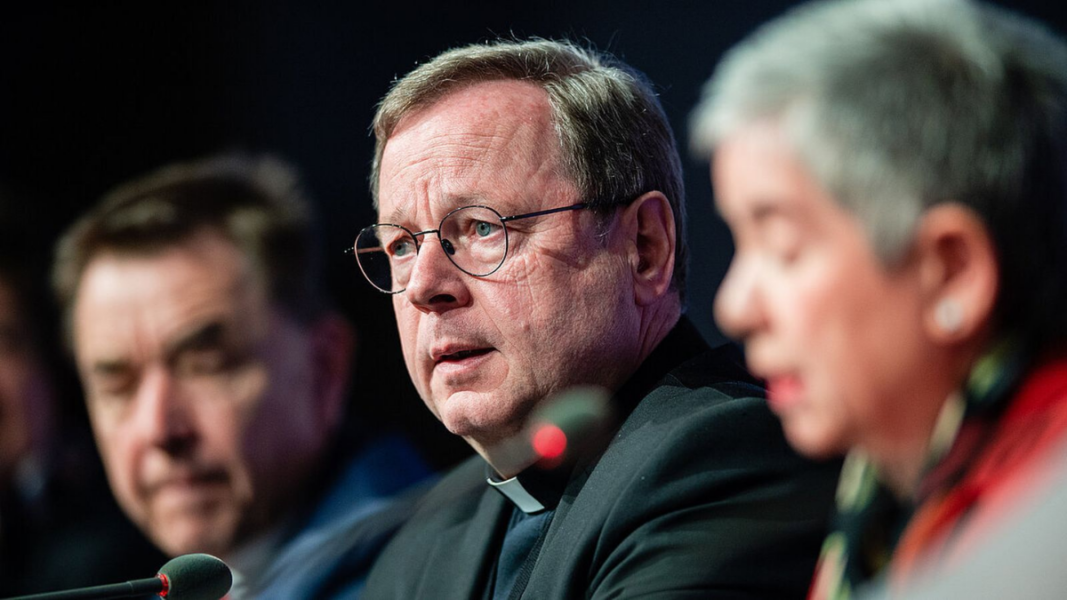
Georg Bätzing ended his term as president of the German Bishops’ Conference (DBK) with a homily centered on the cultural crisis of the West, the rise of populism, and the need for a concrete Christian response based on the works of mercy.
According to the German portal Katholisch.de, the bishop delivered the sermon this Monday at the opening of the spring plenary assembly in Würzburg, where he also recalled that he will not run for a second term. His successor will be elected this week.
Crisis, Fear, and Social Weariness
Bätzing described the current moment as a stage of profound transformations affecting almost all areas of life. He pointed to the Russian invasion of Ukraine as a geopolitical turning point, alluded to the weakening of social cohesion, the loss of trust in parliamentary democracy, economic fragility, the climate emergency, and the impact of artificial intelligence.
In his view, the old narrative of progress has been replaced by fear of loss, weariness, and overload. That climate of insecurity—he affirmed—leaves many people in a feeling of helplessness that favors isolation.
In response, he warned against populist responses that offer simple certainties, identify culprits, and promise radical solutions. That type of discourse, he argued, transforms frustration into intense political emotions but does not solve the underlying problems.
The Christian Response: “Acting Helps”
The core of the homily was the passage of the final judgment in the Gospel of Saint Matthew: “Whatever you did for one of these least brothers of mine, you did for me.”
Bätzing insisted that the Christian alternative to resignation is not complaint or nostalgia, but concrete action in favor of the poor, the sick, foreigners, and the marginalized. Helping—he emphasized—not only transforms the situation of the needy but also the one who acts, restoring their awareness that they are not condemned to helplessness.
In this context, he quoted Dietrich Bonhoeffer, highlighting the idea that God manifests in “being for others.” The conversion toward the neighbor, he affirmed, constitutes the decisive experience of transcendence for the Christian.
Silence on the Synodal Way
Beyond the spiritual content of the message, there was a striking absence: no reference to the German Synodal Way or to synodality, despite Bätzing having been one of its main figures and defenders.
During his term, the synodal process promoted in Germany has advanced controversial resolutions on sexual morality, ecclesial power, and governance structures, generating tensions with Rome and explicit warnings about the doctrinal and legal limits of certain proposals. Issues that remain pending and will have to be resolved in this time.
However, in his public farewell as president of the DBK, the bishop chose not to mention that process or claim his legacy in that area.
A German Church in Tension
The election of Bätzing’s successor—for a six-year term according to the conference’s statutes—thus appears as a barometer of the future direction of the German episcopate: whether the reformist dynamic is consolidated or a stage of containment and reconstruction of bridges with the Church opens.
Names like Udo Markus Bentz, Heiner Wilmer, or Peter Kohlgraf are circulating in analyses as possible candidates, although there are no official candidacies and what will be decisive is the implicit mandate that the majority of the bishops want to give.
This moment, framed by canonical tensions, debates on ecclesial authority, and the role of synodal processes, places the German Church at a crossroads that goes beyond a simple internal election: it is a test of authority and ecclesial identity for the Church.