


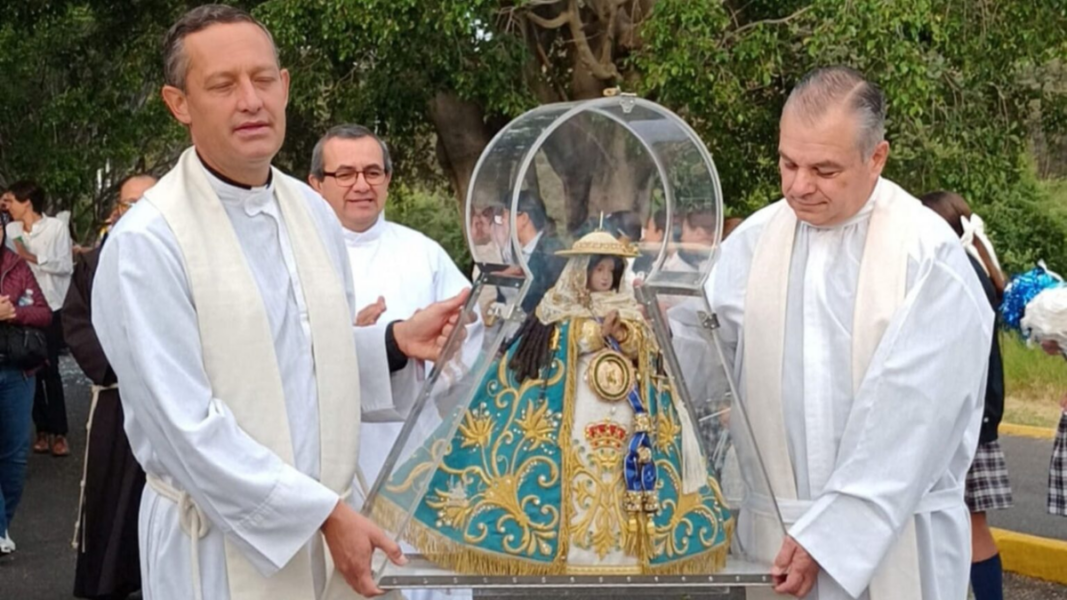
While Jalisco is still nursing its wounds from the wave of violence unleashed by the takedown of Nemesio Oseguera Cervantes, “El Mencho”, the small image of Our Lady of the Expectation of Zapopan, the Virgin of Zapopan, just 34 centimeters tall and made of corn cob paste and orchid, has once again been invoked as The Peacemaker. The Archdiocese of Guadalajara, priests, and Cardinal José Francisco Robles Ortega himself have invoked her intercession and exposed the Blessed Sacrament on church rooftops, calling for prayer to ask that, as almost five centuries ago, the also “General” move hearts and restore peace to the State of Jalisco and to all of Mexico.
More than 250 narco-blockades in 20 states, hundreds of vehicles burned—especially in Puerto Vallarta and Guadalajara—, armed confrontations, shootouts, prisoner escapes, and a death toll exceeding 60, including 25 members of the armed forces, schools closed, businesses paralyzed, and a Red Code in effect until Tuesday, February 24, persisted in western Mexico.
In the midst of the anxiety, the Church of Guadalajara did not hesitate. “May The Peacemaker, who has already quelled wars in our land, grant us reconciliation today,” declared Cardinal Robles Ortega through social media, but this is not a new devotion; it is a return to the oldest and most powerful title held by the Virgin Mary, Our Lady of Zapopan.
The image arrived in New Galicia between 1530 and 1531 in the hands of Fray Antonio de Segovia, a Franciscan who brought it from Pátzcuaro. During the Mixtón War (1540-1542), the largest indigenous rebellion against the Spanish in the region, Segovia carried it on his pacification missions. He climbed hills and crags offering royal pardon in exchange for surrender. Colonial chronicles by Fray Antonio Tello in the 17th century and by Father and historian Matías de la Mota Padilla (1742) recount that the image provoked “heavenly lights” and mass conversions; the rebel indigenous people came down “like meek sheep” to lay down their arms.
On December 8, 1541, after the main pacification, Tzapopan—today Zapopan—was repopulated with Christian indigenous people from Jalostotitlán. That same day, Fray Antonio officially handed over the image to the new settlers. From that precise moment, converted indigenous people, Franciscans, and Segovia himself proclaimed her as “The Peacemaker.” It is the first title the image received and she has never lost it.
In 1653, the Bishop of Guadalajara, Juan Ruiz de Colmenero, conducted the first legal inquiry into miracles and validated her thaumaturgic character. The Guadalajara chapter, in 1734, officially recognized her as protector against lightning, storms, and epidemics after several documented prodigies. On June 13, 1821, after the peaceful entry of the Trigarante Army into Guadalajara, General Pedro Celestino Negrete named her “General of the Trigarante Army,” a title ratified in 1852 and 1894. And on January 18, 1921, Pope Benedict XV granted her pontifical coronation, performed by Archbishop Francisco Orozco y Jiménez in the Guadalajara Cathedral, solemnly proclaiming her “Queen and Mother of Jalisco.”
These are not isolated pious tales. Franciscan chronicles, chapter acts of the cabildo, and ecclesiastical inquiries from the 17th century constitute a solid documentary corpus that Jaliscan historiography has validated as the basis of her popular devotion.
Today, that legacy of pacification resonates with unprecedented force in a period of turmoil in an undeclared war. While the state government announces a gradual return to normalcy for Wednesday, February 25, and the Republic’s presidency reports the lifting of most blockades, the faithful turn to their Peacemaker. “In the Mixtón, she pacified a years-long war; today she can pacify hearts hardened by the narco.”
The Virgin of Zapopan now rises as a symbol of faith and hope, a living reliquary of Jaliscan identity. Every October 12, she goes out in procession paralyzing the city of Guadalajara; every year from June to October, she visits parishes. In times of crisis and calamities, from earthquakes, epidemics, and conflicts, Jalisco has always turned to her. Now, after the violence of February 22, her oldest title takes on new meaning.
Our Lady of Zapopan, as in 1541, may she once again move, reconcile, and bring the peace that Mexico so longs for. While authorities reinforce operations and civil society demands justice, thousands of Jaliscans lift their gaze to the small image that, for 485 years, bears in name and deed what living hope implies. May the Peacemaker restore perpetual peace to the West and to all of Mexico.
Original article published in Sursum Corda