


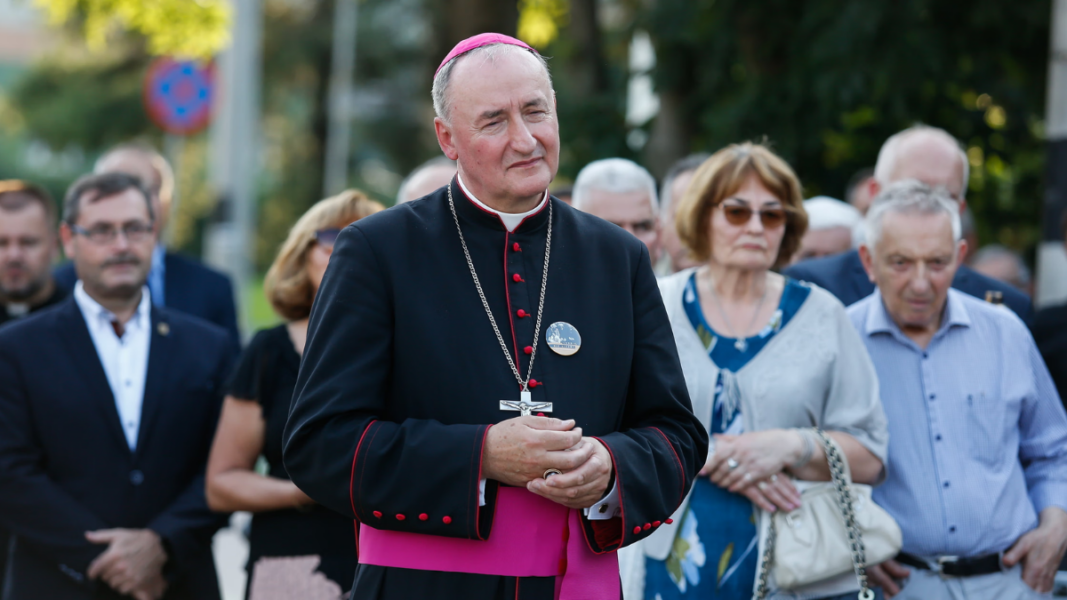
On February 18, the first criminal trial began in Poland against a bishop accused of delaying communication to civil authorities about cases of abuse committed by priests in his diocese, an unprecedented process that tests the boundaries between canon law and state legislation.
According to Aciprensa, Mons. Andrzej Jeż, bishop of Tarnów since 2012, faces a possible prison sentence of up to three years for not having notified the prosecutor’s office «immediately» of the crimes attributed to two priests under his jurisdiction.
The accusation: delayed communication to the prosecutor’s office
The Prosecutor’s Office maintains that the prelate delayed the civil report of the abuses attributed to Fr. Stanisław P. —accused of assaulting at least 95 minors between 1987 and 2018— and to priest Tomasz K., investigated for events that occurred between 2008 and 2010.
Article 240 of the Polish Penal Code, in force since 2017, requires reporting certain crimes without delay, including sexual abuse against minors. The central issue of the trial is not whether the facts were reported —they were— but whether that communication occurred within the timeframe that the law considers immediate.
In the case of Fr. Stanisław P., the criminal proceedings were archived due to prescription, although he was previously expelled from the clerical state after the canonical process. As for Tomasz K., the prosecutor’s office prepared charges, but they were not formalized due to the priest’s delicate state of health.
The defense: «an unprecedented process» and a «scapegoat»
According to the Polish Catholic agency Katolicka Agencja Informacyjna, the first hearing before the District Court of Tarnów lasted approximately one hour. Mons. Jeż did not plead guilty.
His lawyer, Zbigniew Ćwiąkalski —former Minister of Justice— described the process as «unprecedented» in Poland and argued that the bishop has been turned into a «scapegoat.» He emphasized that he is not accused of concealing crimes, but of reporting too late.
The defense argues that the bishop, in addition to being subject to civil law, is bound by canon law, which requires referring the case to the Holy See and obtaining certain authorizations before initiating an ecclesiastical penal-administrative procedure. According to this thesis, the «immediacy» required by criminal law requires prior reliable knowledge of the facts, knowledge that —according to the defense— is obtained after the preliminary canonical process.
At the beginning of his statement, the bishop strongly condemned sexual crimes, especially when they occur in the ecclesiastical sphere. He also recalled that in 2015 he appointed a diocesan delegate with autonomy to receive and investigate abuse complaints.
The bishop himself stated before the court that he initially did not know about the cases and that, once he became aware, he referred them to Rome and subsequently informed the civil authorities in August 2020. In addition, he stated that, paradoxically, the fact of having reported led to the judicial process against him: «If we had not made those notifications, this process would not exist,» he pointed out.
Access to files and chronology of events
During his appearance, Mons. Jeż explained issues related to access to the personal files of the priests, the delegation of powers to diocesan officials, and the chronology of events in the management of the cases.
The defense also pointed out that, in many cases, the bishop is not the first to know the facts, as they can initially be concealed by third parties, and that there is no accusation of any attempt to cover up or destroy evidence.
The next hearing, in which witnesses will be heard, has been scheduled for March 2, and the last session is planned for April 15.
Clear condemnation of abuses and national context
The trial takes place in a context of growing public sensitivity in Poland. According to the report published in 2019 by the Polish Episcopal Conference, between 1990 and 2018, 382 complaints of abuse against minors in the ecclesiastical sphere were recorded, of which 198 affected minors under 15 years old.
It is important to emphasize that the process against Mons. Jeż, at this moment, is not judging the crimes committed by the priests —some already prescribed— but the eventual criminal responsibility of the diocesan ordinary for the management of information and the communication times to the prosecutor’s office.