


By Eduard Habsburg
When it comes to the joys of large families, there is more than an ocean between Europe and the United States. This is what I discovered when I began traveling regularly between the two continents and giving lectures on the topic of the family.
First, a full clarification: I believe that the family is the greatest thing that exists and, by family, I mean a large family. My wife and I have been blessed with six children, and that experience has changed my life; it is the best thing that has happened to me (besides my faith, of course). So, naturally, I enjoy talking about having many children.
It won’t surprise you to know that being happily married and having a bunch of children is not the norm in old Europe. People are usually stunned when I mention six children. You literally don’t hear about anything like that. It’s considered unreasonable even among more traditional-minded families.
In Italy, where I lived for ten years until recently, it took me three years of driving through the streets of Rome to see a pregnant woman crossing the street. And this was supposed to be the Catholic country, the land of the bambini.
But then something very interesting happened a few years ago, when I crossed the pond to speak at an event in the United States. Before the conference, I was invited to a dinner, where I was introduced to many young Catholics. I talked about my marriage and my six children. No one was surprised. In fact, two young people who greeted me said they had seven and eight children respectively, and how wonderful it was to have a large family.
They looked at me with something close to compassion, and you could almost hear them thinking: «Well, perhaps the Lord will grant him some more children.» And I have to admit that, this time, the one who was slightly surprised was me.
The curious thing is that they were not extraordinarily well-off families. They couldn’t «easily afford» many children. No; I had the impression that they were Catholics with the deep conviction that large families are what God loves and encourages in marriage.
As these testimonies multiplied, I discovered a whole world that would be very difficult to find in Western Europe. I found dozens of families (with many children) lining up at conferences on faith and, especially, on the blessed Emperor Charles, the last ruler of my Habsburg family. He, of course, had eight children and was a pillar of the faith. Notably, he seems to be a great inspiration for a considerable number of people in the United States.
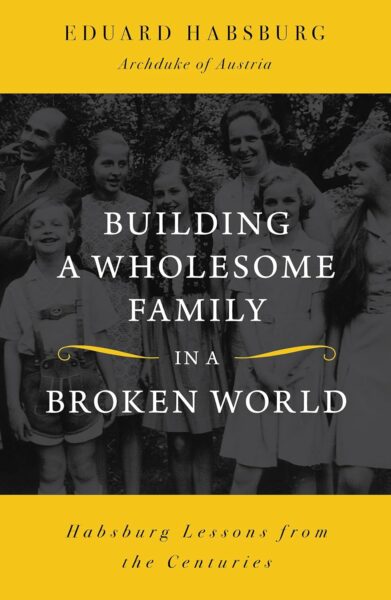
It was this experience (and our own family story) that led me to write my second book, Building a Wholesome Family in a Broken World, which is a strong exhortation to have large families.
Yes, I am very aware that large families are not the norm, not even in the United States. But in America, at least it seems possible to talk about that topic. In much of Europe, that is practically unthinkable.
And sometimes I worry about what will happen when my book is translated, for example, into German. What Americans can understand or at least respect can provoke open hostility in the German-speaking world: a large family is unreasonable, unaffordable, destroys my personal freedom, ties women to the kitchen, and sets back the wheel of progress (or is bad for the environment).
In such a climate (no pun intended), even someone as enthusiastic as me has to choose his words carefully when talking about the family.
The worst is that many Catholic pastors (and, unfortunately, some bishops too) follow the secular game. They encourage couples not to have children too soon, to take their time, to «enjoy themselves,» to postpone the arrival of children until they can afford them, etc.
Although I can understand that such Catholic leaders fear being labeled as «radicals,» they should consider their responsibilities. Because—and this is my main thesis here—I believe that one does not fully embark on the adventure of having a large family without faith.
And if even your leaders in the faith discourage you, then where will you get the courage from?
Hungary, my country, has been trying for about fifteen years to encourage couples to have more children. Viktor Orbán’s government has implemented measures, such as tax exemptions, state subsidies, and, in general, a more child-friendly climate, to stem the catastrophic demographic decline. When one lands at Budapest airport, one sees billboards that say: «Hungary – A family-friendly country.» And yes, there are some good results, but it’s hard work.
That’s why we need our pastors to step forward. Here’s a suggestion. Go online and click on the beautiful series of speeches by Pope Pius XII «Address to the Italian Association of Large Families» from the 1950s. And let them inspire you to encourage young couples to say «yes» to children.
To many children.
It is the greatest gift that spouses can give each other, their children, and society.
About the Author
Eduard Habsburg was Hungary’s ambassador to the Holy See for ten years. He is currently a Distinguished Fellow at the Danube Institute. He is also the Itinerant Ambassador for Family, Churches, and Life. With his wife, he has six children and two grandchildren. Eduard is an active media personality and has published several books.