


By Fr. Thomas G. Weinandy
The second account of Creation in the Book of Genesis states that «the Lord God formed man from the dust of the ground and breathed into his nostrils the breath of life; and man became a living being». Although man was formed bodily from the dust of the ground, it was by the divine breath of God that he became a living being. This conjunction of the dust of the ground and the divine breath is what made man a rational animal. The whole man, body and soul, is created in the image and likeness of God.
Although man was created good along with the rest of Creation, he, in his rationality, possessed free will. It was the sinful use of that free will, by eating the fruit that was in the middle of the garden, that caused Adam and Eve to lose their innocence and stain their divine image. Because of their sin, God told Adam: «By the sweat of your brow you shall eat bread until you return to the ground, for from it you were taken; you are dust and to dust you shall return».
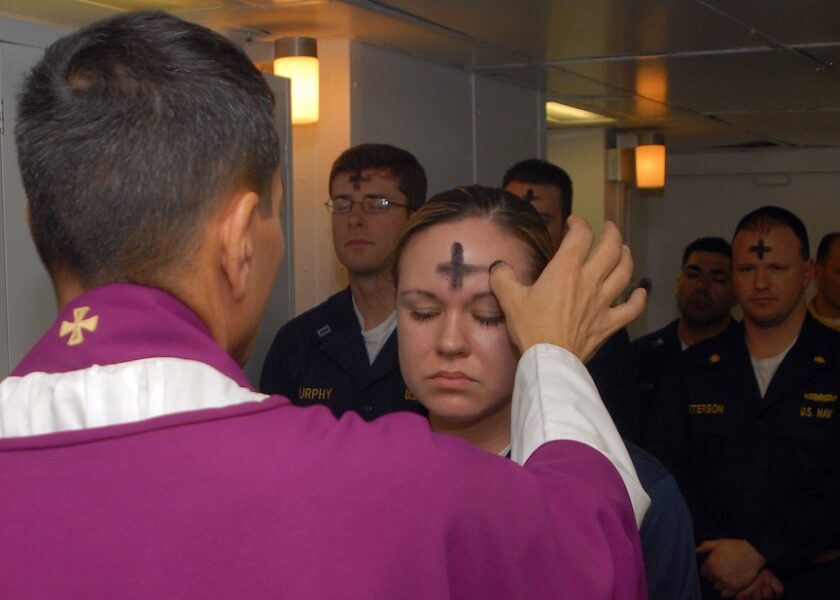
These passages constitute the biblical and theological foundation of Ash Wednesday, the inaugural day that begins the season of Lent. On this day, our foreheads are marked with ash from the previous year’s palms. Upon receiving the cruciform sign, the priest declares: «Remember that you are dust and to dust you shall return». We are sinful children of Adam and, therefore, like him, we shall return to dust.
Now, there is a rather humorous peculiarity here. When I was a child, both I and all my Catholic classmates loved Ash Wednesday. We all hoped that the priest would make a huge Sign of the Cross on our foreheads with so much ash that it would last all day. We were proud of our ashes and, if we had to wash our faces, we made sure not to wash our foreheads: the ashes were sacred.
But not only children are proud of their ashes, adults are too. They also, after receiving them, go to work or return home, proudly carrying their ashes for all to see.
The irony is that what was meant to be a sign of sin, repentance, and humility became a badge of pride. But I don’t think this is entirely bad, for we are bearing witness with pride before the world that all human beings are sinful children of Adam, all in need of redemption.
Our ashes have become billboards of evangelization, a means to proclaim the Gospel. Only in and through Jesus Christ can the ashes of sin and death be washed away and erased. Thus, Ash Wednesday contains within itself a foretaste of Holy Week and Easter. Only through the sacrificial death of Jesus could our sins be forgiven and only in his Resurrection comes the newness of life.
St. Paul was never marked with ash, but he too recognized that we belonged to Adam’s sinful race and that we needed to be recreated. In condemning those who denied the resurrection, he frankly declared its soteriological importance.
Our first body may have become corruptible, but now it is no longer so.
So it is written: «The first man, Adam, became a living being»; the last Adam became a life-giving spirit. But it is not the spiritual that is first but the natural, and then the spiritual. The first man was from the earth, a man of dust; the second man is from heaven. As was the man of dust, so are those who are of the dust; and as is the man of heaven, so are those who are of heaven. And just as we have borne the image of the man of dust, we shall also bear the image of the man of heaven. (1 Corinthians 15:45-47)
God breathed his life-giving breath into the first Adam, but the risen Jesus, the second Adam, has now breathed into the man of dust his life-giving Spirit, making him heavenly. We may have been born in the image of the man of dust, but now we have been born again in the image and likeness of the man of heaven. «For as in Adam all die, so also in Christ shall all be made alive». We have become new creatures in Christ.
Paul concludes that when the risen Jesus comes at the end of time, we will be transformed into his glorious likeness.
For the trumpet will sound, and the dead will be raised incorruptible, and we shall be changed. For this corruptible body must put on incorruption, and this mortal body must put on immortality. When this corruptible body puts on incorruption and this mortal body puts on immortality, then shall come to pass the saying that is written: «Death is swallowed up in victory». «O death, where is your victory? O death, where is your sting?». But thanks be to God, who gives us the victory through our Lord Jesus Christ. (15:52-57)
With the joyful sound of the trumpet, those whose bodies have returned to dust will rise and assume incorruptibility, and their mortal nature will become immortal. The cry of death’s victory will be swallowed up. Death will no longer be the victor. Then the resurrected humanity will give thanks to God, for it has been saved through Jesus, the incarnate Son of the Father, crucified and risen.
Therefore, today, on Ash Wednesday, let us not only be aware that we are dust and to dust we shall return, but also look forward, through the course of Lent, to Good Friday and Easter Sunday. In the first Adam we may have sinned and thus died, but in the second Adam we have been forgiven and brought back to life. The dust of our mortality has been gloriously transformed in the likeness of the risen Jesus, for it is in him that we remain both now on earth and forever in heaven.
About the Author
Thomas G. Weinandy, OFM, a prolific writer and one of the most prominent living theologians, is a former member of the Vatican’s International Theological Commission. His most recent book is the third volume of Jesus Becoming Jesus: A Theological Interpretation of the Gospel of John: The Book of Glory and the Passion and Resurrection Narratives.