


By David Warren
The founder of worldly Christendom, by Christianizing the Roman Empire and putting an end, at least for a moment, to the persecution of Christians in his realm, was famously a pagan until he finally converted on his deathbed.
Until the end, long after his victory under the Sign of the Cross at the Battle of the Milvian Bridge, Constantine took care to maintain the secular signs of his power.
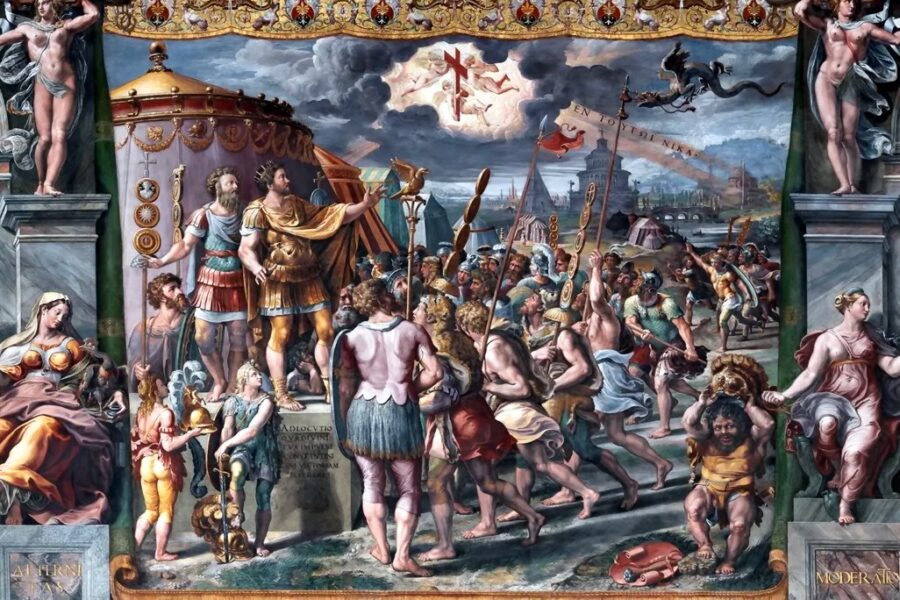
In Eusebius of Caesarea we read that the (self-proclaimed) emperor of the West contemplated the Sign of the Cross, over the sun, on that battlefield, and the words τούτῳ νίκα —»By this, conquer»— radiating from it. That Christianity spread through conquest was a paradox (divine).
In our liberal and modern worldview, it seems an even greater paradox than it was for Constantine’s contemporaries. It conflicts with our abstract Christianity, which cannot confess anything so vulgar and physical as military conquest.
Balancing this, the modern man is also uncomfortable with accounts of physical persecution, which reached its peak under Diocletian.
In his later Vita Constantini, Eusebius reported that, on the following night, Christ appeared to Constantine in a dream and told him to make a copy of what he had seen in the sky; and that this Cross would protect him against very physical attacks.
Once again, I contemplate this with modern eyes. The Church to which we belong owes its historical existence to events that are claimed to have happened in the world.
But, to add to our perplexity, the Church of the very first century was also formed from an event that occurred in the real world. For we recognize that Christ descended from Heaven and ascended to Heaven manifestly AFTER his death in the world.
The mind touches matter in these matters, and it is recorded in the annals of the world. And as long as we live in the world, we are obliged to recognize that recognition, even if we deny or dispute the truth of what happened.
That I do not deny or dispute it is, like faith in general, unlikely to convince anyone, after the passage of so many centuries, though the fact that it remains plausible for many millions may seem, at least, surprising. But when it is considered that the same argument can be made regarding Islam and several dozen other «systems of belief,» we satisfy the modern man precisely by dissatisfying him.
I count «modern science» as one of those systems of belief, or rather among them, for no modern scientist subscribes exactly to the same thing as another, even if it is true what the propagandists say: that 97 percent of them subscribe to anthropogenic global warming. And men like Richard Dawkins compare the Christian God to the Flying Spaghetti Monster, and do so with great levity.
For modern Unbelief does not feel the obligation to be serious, an obligation that constrained Christians and other sincere believers throughout this vast span of time.
It is the combination of a belief in casual and changing things (like «science» constantly updated), with an easy retreat into unbelief in anything, that characterizes our modern view.
Not belief or faith, but a settled attitude of cynicism and radical skepticism has produced an era in which the mere existence of a fact is reason for methodical rejection in academia and other spheres. Our children are taught that nothing can be true except what they choose to believe, or «my truth» in particular.
Use the word «truth,» and you are immediately at a disadvantage in most discussions I have had with moderns throughout my adult life; and, curiously, I left high school when I understood that this was the attitude they were inculcating.
Only in the classics, mathematics, and physics was this ever relaxed. The ancient sophists were not so settled in their own rejections of reality, and tended to accept what they could see and taste.
And so, the Constantinian miracle tends to be ignored, or even ridiculed, when it must be confronted.
Because we are not Christians by philosophical abstraction, but in a historical framework; just as Christ too must be accepted, or rejected, as a historical fact.
And this is the message that our smartest politicians are conveying. (J. D. Vance and Marco Rubio come to mind.) For in their recent appeals to Europe and Europeans, as well as in their ongoing appeals to Americans, they insist on historical reality.
This may be rejected by many, but, as they openly point out, if one does not have a deep historical reality, one has nothing to fall back on. Those who insist solely on fidelity to abstractions end up defending, and being defended by, absolutely nothing.
Our alliance—whether NATO or that broader alliance that keeps us united across the ages—was not the creation of the work of some politicians, but of real events in time. It can be attributed singularly, because it adheres, directly or often indirectly, to a specific heritage.
And that heritage is, in fact, a heritage of Christian faith. Real science, for example, is the peculiar product of the Christian belief that there is something called truth, and that, if pursued, it will produce valuable realities. And it is confirmed, because it has been so.
Similarly, the very concept of religious freedom—that one should be free not only to embrace but also not to embrace Christianity—is a Christian teaching. In fact, almost everything that makes the modern world flourish was conceived and nurtured within the Christian tradition, or what we call «Judeo-Christianity,» a snowball to which the Greek and Roman traditions were annexed, along with, eventually, every other civilized tradition.
Even the Islamic one, which most directly denies our faith and most violently attacks and persecutes Christians and Jews, depends entirely on our methods to spread, and is humanized by our «openness.» (Think, for example, of the Red Crescent, copied from our Red Cross).
For the good of the world, we must preach this openly.
About the Author
David Warren is former editor of the magazine Idler and a columnist in Canadian newspapers. He has extensive experience in the Near and Far East. His blog, Essays in Idleness, is now at: davidwarrenonline.com.