


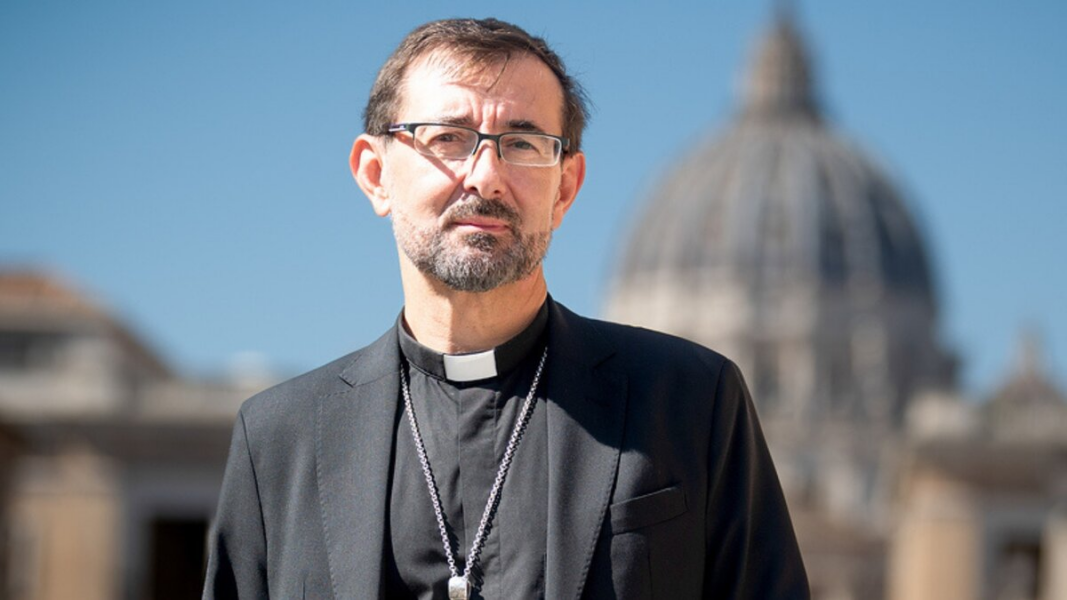
In the public debate surrounding the Valle de Cuelgamuros and the Basílica de la Santa Cruz del Valle de los Caídos, the media dimension has been as relevant as the ecclesial and political ones. Not only for what has been said, but for who has said it and to which interlocutors. The recent coverage by eldiario.es, with Jesús Bastante as the main narrator of Cardinal Cobo’s positioning, has consolidated an editorial line clearly favorable to his actions in this matter.
It is not merely a matter of a one-off chronicle. The reiteration of that approach, combined with the systematic absence of contrast with other ecclesial sensitivities or with the Benedictine community itself, has created the impression that certain statements by the cardinal find in that medium a privileged space for dissemination and legitimization.
To this is added that Cardinal Cobo himself has publicly disqualified certain news portals that have questioned his actions in this matter as “pseudomedios.” That qualification is not irrelevant in the described context. Because the core of the controversy is no small matter: the signing of a document stating that, in the Basílica de la Santa Cruz del Valle de los Caídos, only the altar and the adjacent pews constituted places of worship, while the dome, the nave, the atrium, and the vestibule would not be, leaving the latter open to interventions promoted by the Government within the framework of its process of political and ideological resignification. The issue, therefore, is not limited to a media debate, but to the very delimitation of which spaces in a consecrated temple retain their proper character and which can be subject to external reinterpretation.
In this context, it is significant that the “off the record” press conference convened by Cardinal Cobo was directed solely to a selected group of journalists, excluding some of the religious information media with the largest audience in Spain. The combination of public disqualifications toward certain portals and the restrictive selection of interlocutors configures a communicative model that, far from dispelling doubts, contributes to concentrating the narrative in friendly media spaces. This is not about questioning the archbishop’s freedom to choose his communication channels, but about warning that, in a matter of this ecclesial and social magnitude, transparency and breadth in interlocution strengthen institutional credibility, while informational segmentation tends to increase the perception of opacity.
In that same vein, it is particularly concerning that in certain journalistic approaches it has been suggested that the ultimate responsibility for the controversial document would fall on Cardinal Pietro Parolin, as if the initiative or the decisive endorsement had come from the Secretariat of State. However, the objective fact remains unaltered: the document was signed by Cardinal Cobo himself. The eventual existence of subsequent conversations does not modify the authorship or the responsibility derived from a formal signature. Shifting the burden to Rome, suggesting that the real impetus did not reside in the one who placed his signature, not only introduces confusion in public opinion but projects an image that can be interpreted as a form of institutional disloyalty. In matters of this gravity, clarity in assuming responsibilities is not a rhetorical issue, but a basic requirement of ecclesial coherence.
To this dynamic has recently been added an article published in El País, another of the media invited to the “off the record” press conference, in which those who have expressed alarm and surprise at the content of the document signed by Cardinal Cobo at the Government’s request were labeled as “ultracatólicos” and “integristas.” The use of ideological labels to disqualify a concern centered on the liturgical and juridical nature of a consecrated temple does not contribute to elevating the debate, but to polarizing it. Reducing to sociological categories what, at its core, is a matter of ecclesial coherence and respect for the temple’s sacramental identity shifts the focus of the problem and hinders a serene discussion.
In this scenario, what is at stake is not a media dispute or a clash between ecclesial sensitivities, but the institutional credibility of those who exercise pastoral responsibility and the trust of the faithful in the transparency of their pastors. When a signed document has public and ecclesial consequences of such scope, the clear assumption of responsibilities is not optional, but required. The Church can withstand external criticism; what erodes its moral authority is internal ambiguity. Therefore, beyond media alignments or interested narratives, what is expected is clarity, coherence, and institutional loyalty in the management of a matter that directly affects the very nature of a consecrated temple and the conscience of those who consider it the house of God.