


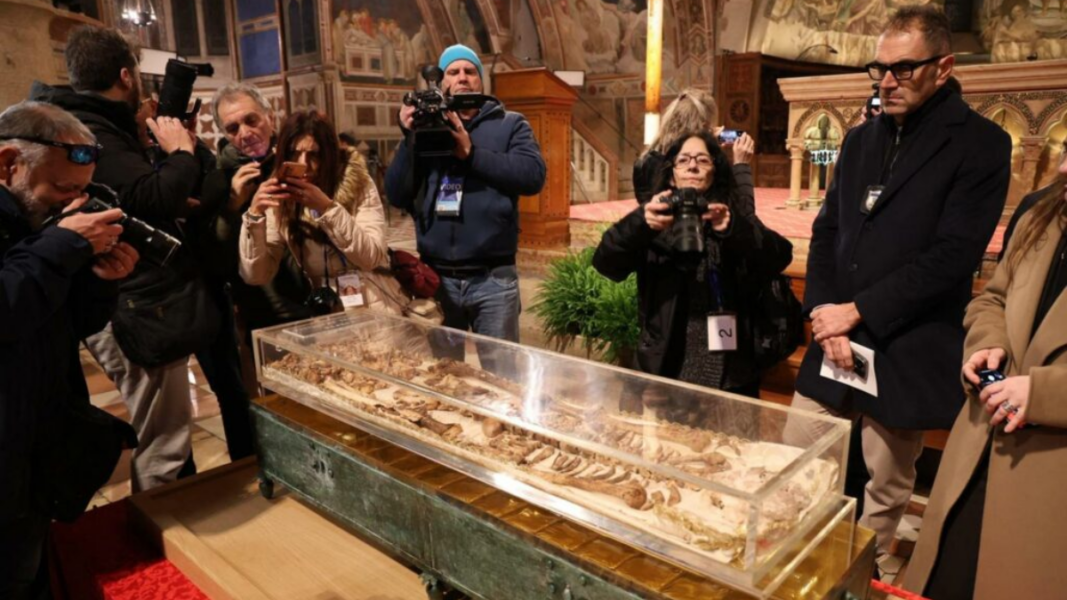
The Basilica of Saint Francis, in Assisi, has been exhibiting since Saturday, for the first time in history, the ossuary with the saint’s remains, expressly authorized by Pope Leo XIV through the Secretariat of State. The exhibition, organized on the occasion of the 800th anniversary of his death, will allow public veneration for one month within the commemorative acts of the centenary.
The transfer ceremony took place at 16:00, when the remains were carried from the tomb located in the crypt to the foot of the papal altar in the lower church of the basilica. The act was presided over by the Spanish cardinal Ángel Fernández Artime, pro-prefect of the Dicastery for Institutes of Consecrated Life.
An unprecedented exhibition in eight centuries
Throughout history, various examinations have been carried out to verify the authenticity of Saint Francis’s remains, but they had never been directly exposed to popular devotion.
The remains were missing for centuries until they were found on the night of December 12 to 13, 1818, after an intense search. A first official examination in 1819 confirmed their identity. Subsequently, studies carried out in 1978 —on the occasion of the 750th anniversary of his death— and in 2015 provided new scientific data that reinforced the certainty about the authenticity of the body.
Spiritual meaning of the gesture
From the Sacred Convent of Assisi, Friar Giulio Cesareo, communications manager, emphasized to RTVE the symbolic value of the event. He highlighted that, in the simplicity of the preserved remains, the radical testimony of a man who gave everything is expressed. In his opinion, the contemplation of these bones can challenge both believers and non-believers.
Mass influx of pilgrims
The expectation has been notable. Already, nearly 400,000 reservations have been registered to access the basilica during this month, with forecasts of up to 20,000 visitors on weekends.
In parallel to this commemoration, the Italian Parliament has reinstated in the labor calendar the feast of Saint Francis, on October 4, half a century after its suppression. The measure, promoted by the Government, underscores the cultural and religious relevance of the saint in Italian identity.
The exhibition of the remains therefore constitutes an exceptional event in Franciscan history and a milestone within the celebrations of this eighth centenary.