


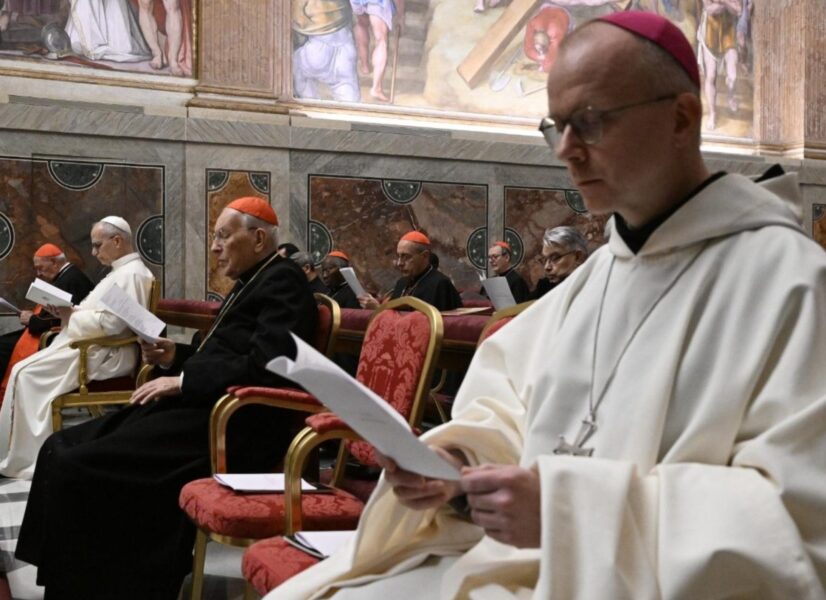
On February 22, 2026, the Lenten Spiritual Exercises preached before Pope Leo XIV and the Roman Curia began in the Pauline Chapel of the Apostolic Palace. The Pontiff, members of the College of Cardinals, and the heads of dicasteries are participating. The retreat is taking place in a regime of silence and without a parallel governmental agenda.
The opening took place with the celebration of the Second Vespers of the First Sunday of Lent, presided over by Cardinal Protodeacon Dominique François Joseph Mamberti, prefect of the Supreme Tribunal of the Apostolic Signatura. The liturgy included the tract Qui habitat (Psalm 90/91), a fixed element of the Roman rite on this Sunday, which precedes the Gospel of Christ’s temptations in the desert.
The preacher and the content of the first meditation
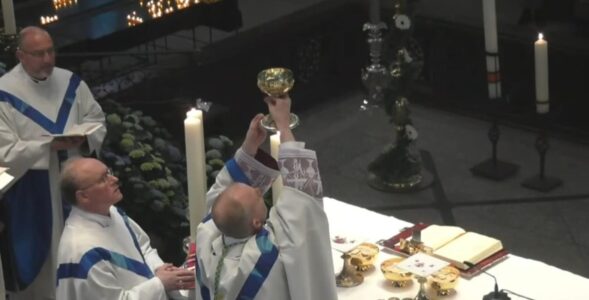
The Pope personally invited Bishop Erik Varden, O.C.S.O., prelate of Trondheim, apostolic administrator of Tromsø, and president of the Scandinavian Episcopal Conference. A Cistercian monk, Varden is known for his solid patristic formation and his marked liturgical sensitivity. In public celebrations, he has maintained traditional gestures such as the joining of the thumb and index finger after the consecration and has celebrated the Novus Ordo in Latin with special ritual care, as occurred in the London Oratory, emphasizing continuity and sobriety.
The first meditation, titled “Entering into Lent,” focused on the essential meaning of the liturgical season. Varden stated that Lent compels one to confront what is necessary, shedding what is accessory, and that spiritual combat cannot be reduced to emotional reaction or public indignation. He pointed out that any instrumentalization of the Gospel or Christian language for extraneous purposes must be corrected with clear teaching and practical demonstration of what authentic spiritual combat is.
He defined Christian peace not as a promise of an easy life, but as the condition of a transformed society, founded on the just and courageous gift of self. He quoted St. John Climacus to recall that anger is an obstacle to the presence of the Spirit. He emphasized that the liturgy of the first Sunday of Lent, with the tract from Psalm 90, introduces one to the hearing of the Gospel of the temptations and places spiritual struggle in an evangelical key.
Program of the week
The itinerary is titled “Illuminated by a Hidden Glory: A Lenten Path.” Each day, from Monday to Friday, follows the same schedule: at 9:00, intermediate hour and meditation; at 5:00 p.m., second meditation, followed by Eucharistic adoration and Vespers. The retreat is structured around the Lenten sermons on Psalm 90 by St. Bernard of Clairvaux, addressing freedom, truth, and hope as axes of lucid discipleship.
The place and its symbolic weight
The Pauline Chapel, built in the 16th century under Paul III, houses Michelangelo’s final frescoes—the Conversion of St. Paul and the Crucifixion of St. Peter—which visually frame any call to conversion and fidelity. It is a reserved space, distinct from the Sistine Chapel, used for papal celebrations of a more intimate nature.
The writer Malachi Martin claimed that a “black mass” took place in the Pauline Chapel in the 1960s. That accusation has circulated for decades in certain ecclesial circles, and some Vatican residents have attributed plausibility to it in private conversations. The persistence of that narrative has, in any case, contributed to reinforcing the symbolic perception of the place as a setting for real, not rhetorical, spiritual combat.
During the pontificate of Benedict XVI, a comprehensive restoration of the Pauline Chapel was carried out, completed in 2009, which restored the original luminosity to the frescoes and involved a reordering of the presbytery, interpreted by various observers as a clearer restitution of the altar’s axis. In that historical and symbolic context, the celebration of the Spiritual Exercises in this space underscores the strictly spiritual character of the encounter: conversion, silence, and interior struggle under the scenes of fall and martyrdom that visually dominate the chapel.