


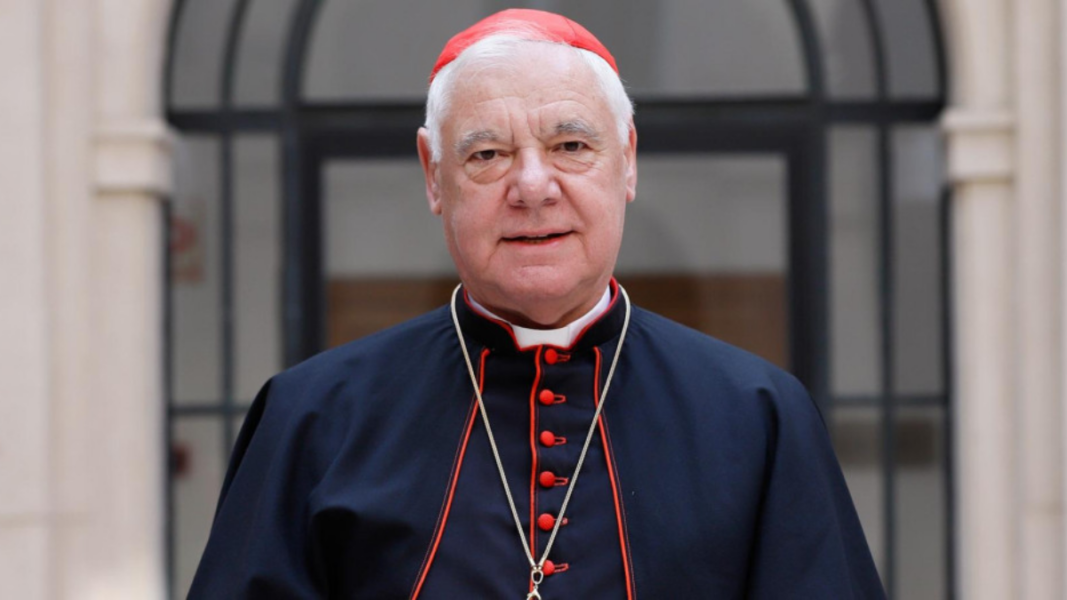
The possibility that the Priestly Fraternity of Saint Pius X (FSSPX) will proceed with new episcopal consecrations without a pontifical mandate in July remains a topic that generates tension and expectation. In this context, various bishops and cardinals have been speaking out, trying to shed light on the debate that has taken place between the Fraternity and the Holy See. Cardinal Gerhard Ludwig Müller, former prefect of the Congregation for the Doctrine of the Faith—now the Dicastery for the Doctrine of the Faith (DDF)—has thus published a substantive intervention in which he addresses not only the immediate issue, but also the doctrinal background of the conflict.
His intervention is not fortuitous, but the new controversy includes an explicit reference to a letter signed by Müller himself in 2017, when he served as prefect. In that text, full communion was established as conditional on the acceptance of the Second Vatican Council and the teachings of the post-conciliar period, in continuity with the preceding magisterium.
Communion with the Pope as a Constitutive Criterion
For Müller, the decisive point is not a specific controversy, but the constitutive criterion of catholicity. Full membership in the Church is not reduced to doctrinal agreement in the abstract, but requires visible communion with the Roman Pontiff.
“This essentially includes full communion with the universal Church and, in particular, with the college of bishops that has in the Roman Pope […] its perpetual and visible principle and foundation of unity”.
Communion with the successor of Peter is not an accessory element, but structural in the configuration of the Church. From that premise, the cardinal is unequivocal regarding episcopal consecrations without a pontifical mandate:
“The well-formed conscience of a Catholic […] will never confer or receive sacred ordinations against the successor of Saint Peter”.
It is not, he argues, a mere administrative disobedience, but an objective wound to the visible unity of the Church, even if those who carry it out consider themselves doctrinally orthodox.
Schism and Historical Precedents
Müller clarifies that not every schism arises from formal heresy. History shows that painful ruptures have also occurred among doctrinally orthodox groups, due to human frailties or theological obstinacies.
Precisely for that reason, he warns that the subjective intention to defend tradition does not neutralize the objective consequences of a break with Rome. Ecclesial history shows that visible separation ends up weakening what was intended to be protected.
Vatican II: Continuity, Not Rupture
Regarding the Second Vatican Council, the cardinal rejects both the rupturist progressive reading and the interpretation that presents it as a substantial deviation.
“The Council itself is animated by the clear awareness of situating itself in the line of all the ecumenical councils”.
It did not proclaim new dogmas, but rather expounded the permanent doctrine in a different historical context. Therefore, he considers it contradictory to affirm that the Council did not define new obligatory truths and, at the same time, treat it as a betrayal of Tradition.
The Church, he adds, does not need an ideological rejuvenation, for in Christ “all novelty has entered the world in an insuperable way”. Revelation is not open to substantial reinventions, but remains alive in doctrine, life, and liturgy until the end of time.
Liturgy and Abuses: Necessary Distinctions
In the liturgical sphere, Müller corrects two opposing extremes. On the one hand, he affirms that “it is theologically erroneous to claim that the Latin liturgy according to the Missal and the Roman Ritual (according to the Antiquior Ritus) is illegitimate”, thus defending that the traditional form of the Roman rite cannot be treated as a doctrinal anomaly.
On the other hand, he considers it “theologically aberrant and unworthy of a serious Catholic” to hold that the Mass according to the Missal of Paul VI contradicts Tradition or is intrinsically contaminated by foreign ideologies.
The cardinal distinguishes between the substance of the sacrament—which the Church cannot alter—and the external ritual form, which can indeed be legitimately regulated. Real liturgical abuses, he acknowledges, exist; but they do not proceed from the rite as such, but from those who deform it “out of ignorance or frivolity”.
The Only Way: Practical Recognition of the Pope
Müller thus warns against the temptation to configure parallel ecclesial structures that recognize the Pope only in a symbolic way. The struggle for orthodoxy—he emphasizes—can only be waged within the Church and in communion with the successor of Peter, not from an external position that ends up weakening the credibility of the doctrinal defense.
Therefore, the only coherent solution lies in recognizing the Pope “not only in theory, but also in practice” and “submitting without preconditions to his doctrinal authority and his primacy of jurisdiction”.
For Müller, visible unity under the successor of Peter is not a negotiable strategy, but a constitutive element of the Church of Christ.