


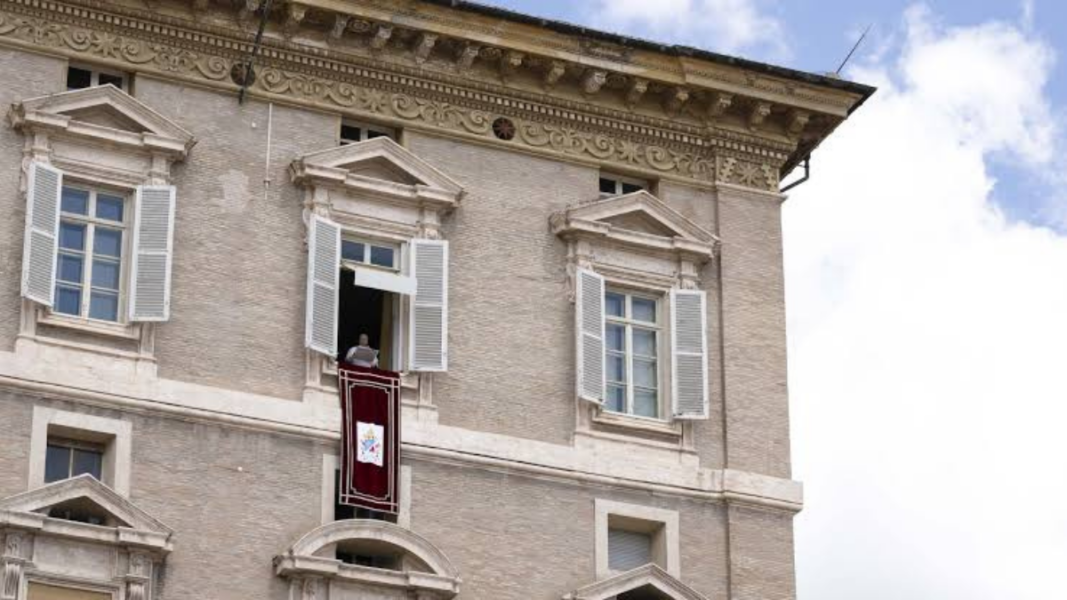
Pope Leo XIV presided over the Angelus prayer this Sunday, February 22, 2026, from the window of the Apostolic Palace before the faithful gathered in St. Peter’s Square, on the occasion of the First Sunday of Lent. In his introductory reflection, the Pontiff centered his message on the Gospel passage of Christ’s temptations in the desert (Mt 4:1-11), emphasizing that Jesus, after forty days of fasting, experiences the weight of the human condition—the hunger and the moral trial—and, by resisting the devil, shows the way to overcome the snares of evil.
Leo XIV presented Lent as a “resplendent itinerary” of conversion, in which prayer, fasting, and almsgiving allow the Christian to cooperate with God in the renewal of their own life. He warned against the false promises of wealth, fame, and power, which he defined as substitutes incapable of satisfying the human heart, and encouraged practicing a penance that purifies and strengthens, following the teaching of St. Paul VI. The Pope exhorted to recover silence, limit the use of electronic devices, frequent the sacraments, and exercise concrete charity with the most needy, finally entrusting the Lenten journey to the protection of the Virgin Mary.
We leave below the full message of Leo XIV:
Dear brothers and sisters: Happy Sunday!
Today, the first Sunday of Lent, the Gospel speaks to us of Jesus who, guided by the Spirit, goes into the desert and is tempted by the devil (cf. Mt 4:1-11). After fasting for forty days, he feels the weight of his humanity: hunger at the physical level and the devil’s temptations at the moral level. He faces the same difficulty that we all experience on our journey and, by resisting the devil, shows us how to overcome his deceptions and snares.
The liturgy, with this Word of life, invites us to consider Lent as a resplendent itinerary in which, with prayer, fasting, and almsgiving, we can renew our collaboration with the Lord to make our life an unrepeatable masterpiece. It is about allowing him to remove the stains and heal the wounds that sin may have caused in it, and committing ourselves to make it flourish with all its beauty until reaching the fullness of love, which is the only source of true happiness.
It is true, it is a demanding journey, and there is the risk that we become discouraged or allow ourselves to be seduced by paths of less exhausting satisfaction, such as wealth, fame, and power (cf. Mt 4:3-8). These temptations, which were also those of Jesus, are nothing more than poor substitutes for the joy for which we were created and which, in the end, leave us inevitably and eternally unsatisfied, restless, and empty.
That is why St. Paul VI taught that penance, far from impoverishing our humanity, enriches it, purifying and strengthening it on its journey toward a horizon “that has as its term love and abandonment in the Lord” (Apostolic Constitution Paenitemini, February 17, 1966, I). In fact, penance, while making us aware of our limitations, gives us the strength to overcome them and live, with God’s help, an ever more intense communion with Him and among ourselves.
In this time of grace, let us practice it generously, along with prayer and works of mercy; let us make space for silence, turn off the televisions, the radio, and the smartphones a little. Let us meditate on the Word of God, draw near to the sacraments; let us listen to the voice of the Holy Spirit, who speaks to our hearts, and listen to one another, in families, in workplaces, and in communities. Let us dedicate time to those who are alone, especially the elderly, the poor, and the sick. Let us renounce the superfluous and share what we save with those who lack the necessary. Then, as St. Augustine says, “our prayer, made with humility and charity, accompanied by fasting and alms, by temperance and forgiveness; practicing good and not returning evil for evil, moving away from evil and devoting ourselves to virtue, will reach Heaven and give us peace” (cf. Sermon 206,3).
To the Virgin Mary, Mother who always assists her children in trial, we entrust our Lenten journey.