


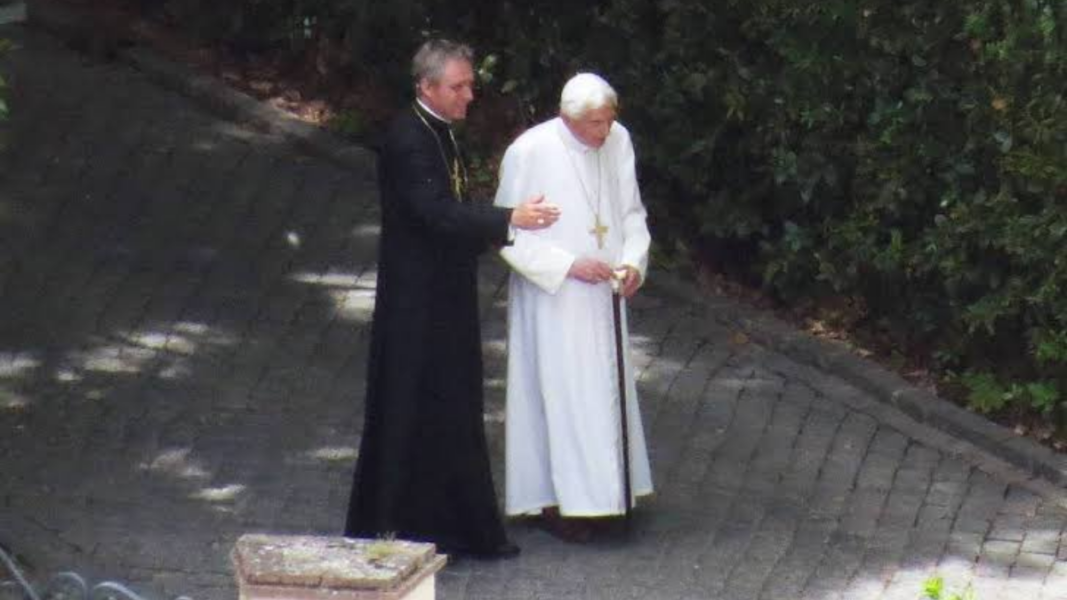
Archbishop Georg Gänswein has defended the recording of private homilies by Benedict XVI that have recently been published in German by the publisher Herder under the title Der Herr hält unsere Hand. The German volume appeared on January 19, 2026 in that language, while the Spanish edition —El Señor nos lleva de la mano, published by Encuentro— had already been released in 2025.
In an interview given to the medium Schwäbische, Gänswein explained that he asked the four women in charge of Benedict XVI’s domestic care to record the homilies when he preached in the small circle of the monastery. “The homilies were not recorded secretly, but discreetly,” he emphasized. According to his testimony, his intention was to preserve a spiritual heritage that one day might prove valuable: “I had no malicious intent, but an honest one that led me to make this decision”.
Benedict XVI was not informed
The current apostolic nuncio in Lithuania acknowledged that he did not previously consult Benedict XVI about these recordings. “And why not? Very simple: because I feared that, out of modesty, he would say ‘no,’ and then this treasure would never have come to light,” he stated.
The book gathers homilies delivered both during the pontificate and in the first years after the resignation, in a strictly private context. According to Gänswein, these texts allow one to discover a face of Benedict XVI that was not always visible publicly.
Beyond the “God’s Rottweiler”
The archbishop regretted that the public image of the Pope emeritus has been for years “too one-sided and distorted.” In his view, there was excessive insistence on the brilliant theologian, the doctrinal prefect, or the Pontiff, forgetting “something essential: the convinced and convincing preacher of the Gospel.”
In the face of clichés such as the “armored cardinal” or the “Rottweiler de Dios,” Gänswein defended the theological coherence of Ratzinger throughout his entire career: “There is no break, there is an undeniable continuity both in his theological work and in his ecclesial preaching.” And he described the reality of a man “humanly and nobly good, gentle, intelligent, and spiritually profound.”
The date of the resignation was not casual
In the same interview, Gänswein also addressed the announcement of Benedict XVI’s resignation, made public on February 11, 2013. According to his explanation, the date was chosen deliberately. That day commemorates in Rome the Lateran Pacts of 1929, which ended the conflict between the Papacy and the Italian State and gave rise to the State of Vatican City.
Furthermore, February 11 celebrates a Marian feast, and that same day a consistory convened months in advance was scheduled. “Benedict saw in it the appropriate moment and framework to announce his resignation from the ministry,” Gänswein noted. The resignation took effect on February 28, 2013, becoming the first papal resignation since the Middle Ages.
With the publication of these homilies, and amid the debate about their recording, the figure of a Pope reemerges who, beyond controversies and labels, wanted above all to be —according to the testimony of his closest collaborator— a preacher of the Gospel.