


Carlos Balén y Mikel Landetxea
A few days ago, the French Jewish thinker and convert to Catholicism, Fabrice Hadjadj, presented the Incarnatus project in Madrid, which he will now direct. It is a truly promising training plan for young people who, throughout an entire academic year, will seek to deepen their Catholic faith and life in community.
Hadjadj is a prolific writer full of the most intelligent insights, a charming conversationalist, a man of deep faith. When he speaks of the Incarnation, of the crisis of our obsession with mere data (what he calls dataism), of the need to form real men in the face of information consumers, one can only nod in agreement. His intuitions are valuable. His denunciation of how the digital «disembodies» us is pertinent. His critique of naive progressivism is well-founded.
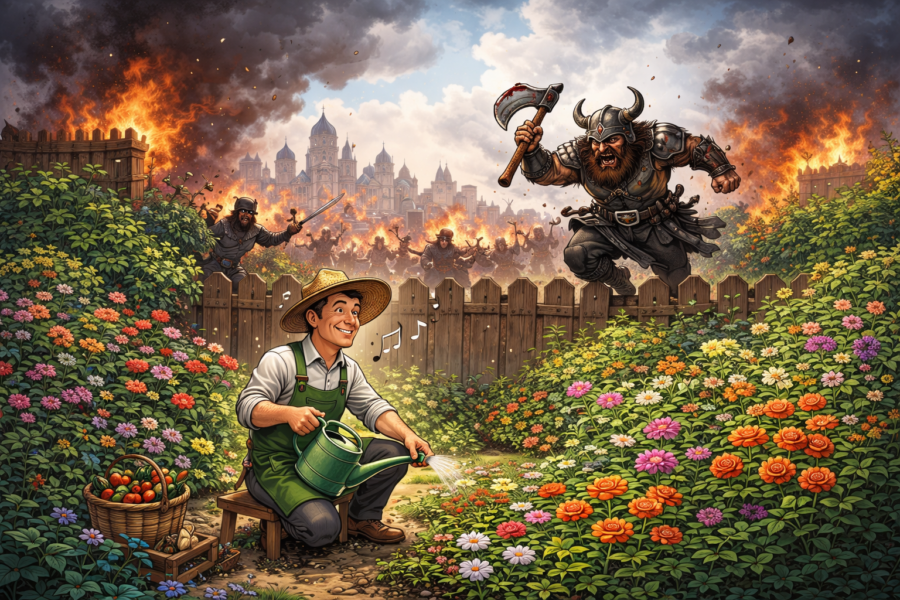
The problem arises when, toward the end of his speech, Hadjadj insisted on starkly opposing «soldiers» and «gardeners.» No, it’s not that Hadjadj came to Spain to stir up battles between different trades.
The French writer contrasted soldiers and gardeners in a metaphorical sense. Soldiers would be those of us who bet on giving the cultural battle, on the combat of ideas, in a world that demands we be meek and nice. Hadjadj denounced such soldiers: he prefers gardeners, who cultivate the garden, who use only love and care for the little flowers. Naturally, he placed himself on the side of the gardeners. Incarnatus, he announced, aims to form this type of gardening Christians; nothing of soldiering. «Christ does not need defenders,» he affirmed. Living culture is not defended: it is given.
This image of Hadjadj is undoubtedly attractive at first glance. But from a conceptual point of view, it is weak; from a historical point of view, shortsighted; and from a theological point of view, risky.
The Church is not only a garden. It is also a walled city. It is a vineyard, but also a fortress. It is a spouse, but also a militia. The tradition has always spoken of the Church militant not out of medieval bellicism, but out of historical realism. From the 1st century, faith has had to defend itself: against paganism, against heresies, against Islam, against Enlightenment rationalism, against the totalitarian ideologies of the 20th century. In Spain, that defense cost thousands and thousands of martyrs. This last is an experience that France has not lived, and therefore perhaps Hadjadj can take advantage of his visit to Spain to learn it better.
The Council of Nicaea itself (whose anniversary Hadjadj invoked in his speech) was not an exercise in spiritual gardening. It was a doctrinal battle. Athanasius was not a «choreographer of hope»; he was a theological combatant exiled five times. Hosius of Cordoba, whom Hadjadj himself cited with admiration, did not discreetly cultivate a pious interiority while imperial power imposed Arianism; he resisted, argued, confronted the emperor, and suffered for it.
To say that Christ does not need defenders sounds lofty. But it is ambiguous. Christ needs nothing; however, he wanted to need apostles. Truth does not need violence; but it does need witnesses who proclaim it and protect it against lies. If no one had defended the faith when it was attacked, there would be no garden to cultivate. And, in fact, strictly speaking, Christ does not need, what one would call need, gardeners either. But he chooses for there to be both things in our world. For a gardener like Hadjadj to set out to criticize soldiers sounds, to say the least, a bit disdainful toward the charisms (courage, commitment to your civilization, strength…) that God distributes in others.
But moreover, the opposition between soldiers and gardeners does not even hold up as a metaphor. Anyone who has had a real garden—not one maintained by invisible brigades—knows that a garden is a field of permanent vigilance and combat. You have to pull weeds before they choke what is sown. You have to eliminate caterpillars that devour in days what has been cared for over months. You have to prune firmly, cut diseased branches, spray when pests appear. You have to protect against animals that ravage at night. The one who «only cultivates» with care and refuses to fight… ends up without a garden.
In other words: the idea that Hadjadj presents of the garden as a peaceful alternative to the soldier is the typical one of an urbanite. We are concerned, therefore, not only with his disdain toward the soldiers of the cultural battle, but also with his knowledge of botany. If one day he decides to cultivate a real garden, we hope someone teaches him the utility of pruning shears, herbicides, pesticides. That someone reminds him that when he enjoys a walk through deliciously maintained parks, it is not because the flowers have grown by consensus. There has had to be cutting, pulling, protecting. Without that, there are no carnations, but brambles.
Nature is not benevolent. It tends toward disorder if not governed. Precisely for that reason, culture exists: to order what, left to itself, degenerates. And often that ordering must be quite forceful: and yes, much to Hadjadj’s chagrin, one must act more like a soldier than like a graceful little shepherdess reciting bucolic poems in her meadow, picking here and there some fragrant flower. The paradox is this: precisely the most refined cultures, the highest civilizations, are those that require the greatest protection. Barbarism does not need walls; it grows on its own. Beauty does need them. That is why great cities were walled. Not out of paranoia or neurosis, as Hadjadj insinuates. But because what is worth preserving attracts those who want to destroy it or appropriate it.
Scripture itself reinforces this realistic vision. Eden has cherubim with a flaming sword. The Song of Songs speaks of a closed garden. An orchard without a fence is fodder for the first one who enters. The gardener of the Gospel digs and fertilizes, but also decides whether to cut or grant one more year. Care and firmness do not oppose; they complement each other.
And Christ himself dismantles the sweetened version. He spent years in Nazareth, yes. But he did not stay cultivating the little home garden. When the hour came, he went out to preach publicly, denounced the hypocrisy of the Pharisees, purified the Temple by expelling the merchants, and proclaimed a truth that uncomfortable both the Jewish religious power and the Roman political power. That’s what giving the battle has: you bother many more than if you stay in your garden.
Jesus did not die for discreetly cultivating an interior spirituality, but for publicly affirming who he was and what truth demands. His word had an edge. His mission was confrontational in the deepest sense: it confronted lies with truth. And that had consequences.
«Do not think that I have come to bring peace, but a sword» is not a bellicose motto, but neither is it an invitation to cultural neutrality. It is the realization that truth divides when it is rejected. The Incarnation was not a retreat to the private sphere; it was a public irruption into history. For the retreat to private gardens, the Epicurean philosophers were already there before Jesus telling us that was what we should do; that politics was too complicated; that why get into trouble. But Jesus came to something much harder than the sophisticated philosophy conversations that Epicurus liked to hold with his friends in a garden; for Christ, the garden par excellence was that of a tragic, vital, profound combat: Gethsemane.
Perhaps, in the end, as we have already advanced, what we have here is a difference of historical experience. It is not the same to be French as Spanish.
Hadjadj is the former. His cultural horizon is marked by the Huguenots, by the wars of religion, by Gallicanism, by Quietism, by secularism: in short, by a tradition that ended up resolving the religious conflict in terms of interiorization. That has allowed him to think of a more chic, culturalist, elegant Catholicism, compatible with secularity as long as it does not bother too much. What Juan Manuel de Prada often calls (also with a Gallicism) pompier Catholicism. The constant temptation for a Frenchman consists in reducing faith to a refined personal experience, compatible with the neutralized public space.
In Spain we have learned something else. Spain has lived the Reconquista. It has lived eight centuries of Islamic presence and a historical process of territorial, cultural, and religious recovery. It has lived religious persecutions in the 19th century and, brutally, in the 20th: one of the greatest martyrdoms in history. Here it has not been possible for a long time to have a merely decorative, elegant, pretty Catholicism. Here faith has had to defend itself even on real battlefields (or extermination fields): from Covadonga to Paracuellos. It is difficult to be refined in the midst of the Battle of Las Navas de Tolosa. And although these experiences can also lead to excesses, the truth is that Spaniards have learned, by experience, that faith, when not defended, can be exterminated. That Christian culture, when not protected, is replaced by another.
While the French have been able to live for decades an aesthetic, brilliant, intellectually refined Catholicism of minorities, for Spaniards, unfortunately or by providence, faith has been linked to real historical survival. Here the battle has not been only cultural in an abstract sense; it has been civilizational.
Therefore, for a Spaniard it is (and should be) problematic to discredit the defensive logic as if it were a neurosis. It is not the same as ideological resentment as legitimate defense of truth. It is not the same as fanaticism as firmness. It is not the same as living in a mentality of a fortress besieged by paranoia as recognizing that when the anthropological and moral foundations of a society are attacked, the conflict is already present. And that you evade it does not make you more «peaceful» or a better gardener: it makes you just a bit pusillanimous. And, worse: it does not avoid the battle, it simply places you in the role of loser of it. And you will not lose alone: that is how a civilization is lost.
In any case, it is not about criticizing France and idealizing Spain patriotically. We are simply talking about something obvious: they are two countries with different experiences. And different historical experiences that teach different lessons. When your country has known massive religious persecution less than a century ago—almost 7,000 clerics murdered, 13 bishops, hundreds of churches burned—, when you have seen how a Christian civilization of centuries can be razed in months by an ideology that hates everything you love, you develop a certain sensitivity to threats. It is not paranoia. It is memory. And memory is not resentment; it is prudence. Christ himself advised us to be prudent: the one who has seen his garden burn knows that it is not enough to water the flowers.
Christian culture is not maintained with cannons. But neither is it maintained only with flower games. It is maintained with truth, beauty, and goodness; but also with doctrinal clarity, discipline, limits, and resistance to what destroys it. That is what cultural battle means: not a battle of cannons, but of intellectual vigor.
The alternative is not, therefore, between soldiers and gardeners. It is between fidelity or dissolution. The good gardener is also a guardian. He knows how to distinguish between the plant that must be nourished and the one that must be uprooted. He knows that charity does not reside in allowing the aphid to topple the rosebush in the name of the ecosystem. The Church has survived two thousand years because it cultivated and defended. Because it had contemplatives and had martyrs. Because it had theologians and had men willing to resist. Because it knew that the garden, if not protected, ends up being occupied by those who do not love its flowers.
Forming free children of God implies teaching them to love without bitterness, yes. But also to uphold truth without complexes. To cultivate with patience and to defend with firmness. To recognize that the Incarnation does not eliminate historical conflict, but intensifies it.
Hadjadj is entirely right: Christ is victorious. But precisely for that reason his disciples are not called to naivety. They are called to fidelity and boldness. And fidelity, when put to the test, has never been a purely decorative exercise. Boldness, when it has been true, has not fought only against little worms.
The gardeners that Hadjadj wants to form are necessary, yes. But wise gardeners know that they need walls. Those wise gardeners would never denounce the soldiers who protect them! They know that wonder at a blade of grass is possible when someone has prevented the blade from being uprooted. They know that contemplation flourishes when someone has upheld the order that makes it possible.
700 years ago a French king, Philip IV, ended the warrior monks of the Temple. It was a huge loss for Christendom: the Temple, like in Spain the orders of Calatrava, Santiago, Alcántara, and Montesa, taught how to combine spirituality and manhood, faith and valor, prayer and struggle. It would be a shame to repeat the error of that Capetian monarch.
We do not need, therefore, to choose between soldiers and gardeners. We need gardeners who also know how to be guardians; or, at least, who respect the work of the guardians. We need to contemplate the beauty of a lily, yes; but also to have the courage to uproot the bramble that chokes it. Because in the end, what is at stake is not only a private garden. It is an entire civilization. And civilizations, when no one defends them, are not given: they are lost.
Below is the full speech of Hadjadj:
Thank you. Thank you all.
On occasions like ours, the speaker usually shows himself firm and skilled. His voice does not tremble. His hand points to the destiny. His head rises like a figurehead, ready to plow the seas toward new unknown lands or booming markets. He is the man of the moment. He is going to explain to you the why of things, show you how his innovation, which no one had thought of before him, is precisely the one that everyone has been waiting for forever.
Notice his persuasive and communicative ease, which denotes a macho alpha character. He presents himself as a mix of leader and coach, an icon of victorious voluntarism that conveys security, even when he speaks of vulnerability, because he has already overcome it. Athlete of motivation, he accredits the validity of your presence and most likely of your future investment. For with him it is more about investment than conversion, about security more than precariousness, so that this speaker is never a pray-er.
The pray-er prays, the speaker orates. The pray-er kneels, the speaker steps firmly. The pray-er in his confessed weakness seems fragile. The speaker, on the other hand, seems invincible. This one has to respect the forms, or rather the formatting, and therefore hide the poor human form, this poor human form that each of us carries despite everything to social receptions. He stays behind when our character is standing in the front row. And when this one stands firm, he already staggers, stumbles, comic and tragic at the same time, under a rented suit that tries to cover the nakedness of the Quixote and Sancho that coexist in him.
At the end of his essay Spain Intelligible, in a chapter titled The Enterprise of Our Time, Julián Marías writes that Spain, when faithful to its vocation, feels life as insecurity and does not believe that its justification is success. For that reason it has lived it as adventure and has felt sympathy for the defeated. He continues: the work in which the Spanish has expressed itself with greatest intensity and purity, that of Cervantes, breathes this way of seeing things.
I would like this way to be the one that guides us and not another. It is necessary to pose it from the beginning: a properly Spanish principle, a principle of beginner of the spirit and not of prince of this world. We do not need enthusiastic self-help tricks like a «make Spain great again,» which in their very effectiveness would be an alienation. Everything we need is already in the attic of the house: a rusty sword and a cardboard helmet.
The theme of the presentation imposes on me to take care of the circumstances, because Incarnatus Est is today and here in Spain. Now, today is precisely Shrove Tuesday. And here in Spain it is not that we are in a mission land, but that, according to Julián Marías, the Spanish land, this land of perpetual and renewed reconquests, sinks its foundations in the mission itself, not in the project, not in success, not even in development or progress, but in the mission, that is, in something that comes from further back, that goes further, that flies higher than we can conceive or explain and that, therefore, makes us walk stumbling.
Here I have to talk about the Incarnatus project. However, what if this project is above all a mission, a call that has overwhelmed us? Being on mission means being called by another, for others, carrying a foreign message that surpasses our understanding. If Incarnatus undertakes a mission, how can I express its why, which traps me as much as it escapes me?
Just a year ago I would not have imagined for a second finding myself here in front of you speaking Spanish, a language of which I knew little more than the lyrics of «La Bamba.» It was not what my wife and I had planned. We thought of leaving Switzerland, certainly, but to return to France. And suddenly the unforeseeable, the unimaginable, the impossible happened. The paralytic dances and, suddenly, the stupid lyrics of «La Bamba» sound like something prophetic: a little bit of grace is needed… and up, and up.
Sometimes I wonder: have we done a real foolishness? Moving here with seven children—the three oldest are in Paris—, starting from zero with a white belt when there we were masters with the seventh dan black, measuring and cursing every day the abyss that now separates the ease achieved in French and the clumsiness inflicted by Spanish, the feeling of strangeness that combines with the sense of imposture. You know how the story goes: how to be sure if what we dare to pursue is a feat or a tangle?
What to cling to in a situation like this? For my part, curiously, being French, I have clung for a long time to some verses that have always linked me, without my suspecting it, to the spirit of the mission and the soul of Spain. From The Mount of Perfection:
To come to what you do not know,
you must go by what you do not know.
To come to what you are not,
you must go by what you are not.
When one responds to a call, when one follows a voice instead of a plan, the path reveals itself little by little with each risky step, and what could have been emptiness turns out to be the step of a surprising ascent. Thus, the why is not clear in advance. Insofar as, just like in love, lives are played in the penumbra, it is less about understanding something than about being with someone.
Nevertheless, with that certainty of call, but not of evidence, I am going to talk about the why of Incarnatus according to what I can now discern.
First, I will speak of the why of Spain. More precisely, which is also the Sefarad of my ancestors, so that my unexpected arrival can appear to me as a return home.
There is a very ancient bond between Spain and the Incarnation. It dates back to Saint Paul and beyond. In his letter to the Romans, the last of the apostles warns them that their destiny is not Rome, but Spain. «When I set out for Spain, I hope to see you as I pass by… that you will accompany me on my journey to Spain.»
Suddenly, Spain—not France, not Germany, not England—appears at the end of the Word of God. The Pauline motif is, in a certain way, to transfer from Jerusalem and Rome to Spain and, in this way, fulfill the prophecies. Christ said: «Go into all the world and preach the Gospel to every creature.» Now, at that time Spain coincided with the end of the known world. It was necessary to reach it to finish the race, as Saint Paul said to Timothy.
Spain was also the Tarshish of the prophets, about which Isaiah said: «Who are these that fly like clouds and like doves to their dovecotes? They are ships of Tarshish… to bring your sons from afar with their silver and their gold in homage to the Lord your God.»
From the start, Spain presents itself to the world with this mission: to bring from afar children of God, the same ones who still do not know they are children of God, and bring them with their silver and their gold, that is, to order all worldly riches to the Kingdom of God.
I said order, not subordinate. Because that is the great Spanish temptation: that of theocracy, the confusion between the political and the religious, the temptation of a contradiction in the name of the reconquest, to enter into the same logic of the adversary. I will return to this.
Another event scarcely less ancient justifies the invention of an institute called Incarnatus Est in Spain: the 1700th anniversary of the Council of Nicaea. What was the challenge of this council? To suppress the Arian heresy. To affirm that the true God of true God became flesh.
The key figure in the shadows was a Spaniard: Hosius of Cordoba. He was the great orchestrator of this inaudible musical theme: to affirm that the condition of Son can be perfect, absolute, in the Trinity.
When the emperor wanted to force him to condemn Athanasius, Hosius did not submit, even though he was already a hundred years old, and wrote: «It is not lawful for us to have power on earth, nor do you, O emperor, have it in sacred things.»
That is why I said order and not subordinate. We want to participate in the growth of children of God with all their freedom as children, that they be in the world with distinction, without fundamentalist confusion, respecting the order of realities.
Being a Son of God did not prevent Jesus from striving to be a good carpenter and fulfilling all the demands of his trade.
I come to the why of today. Why 1700 years later does the Nicene article «and by the work of the Holy Spirit was incarnate of the Virgin Mary and became man» sound so current?
This article of the Creed is not a theory about God, but about a historical event. That is why it mentions Mary and Pilate. For this revelation to endure, witnesses are required: men for whom knowledge is not primarily information, but incarnation.
But we are in an era of information to the point of disincarnation. The digital has made us lose our fingers. The net has made us lose the fisherman’s net. Everything tends to be manipulable flow.
In a world of data without gifts and communication without community, nothing touches anyone. Touch can only be found outside the screens.
I would now like to speak of the so-called «cultural battle.» It has three gravely mistaken assumptions.
First: to believe that we are still in the modern era with its revolutionary enthusiasm. But the modern has died. Today everything reeks of desperation.
Second: to believe that there are two opposing cultures. In reality, the battle is of culture against anticulture, dataism, where everything is reduced to variables to optimize.
It is calculated, not cultivated. It is consumed, not consummated.
Third: a defensive mentality. Soldiers are placed in front of the garden to protect it. But a living culture does not seek above all to preserve itself, but to give itself. Before soldiers, we need gardeners.
Christ is already victorious. He does not need defenders. He is the one who defends us. The mission is not to defend him, but to offer him.
Before training soldiers, we want to form gardeners. A new generation that marvels at a blade of grass.
It is not about giving zeal to young people, but receiving it with them. To undo a mentality of a besieged fortress. To taste the good of a wounded but redeemed existence. To savor knowledge for itself. To devote oneself to life itself and not only to a competition. To love without bitterness.
Thank you.