


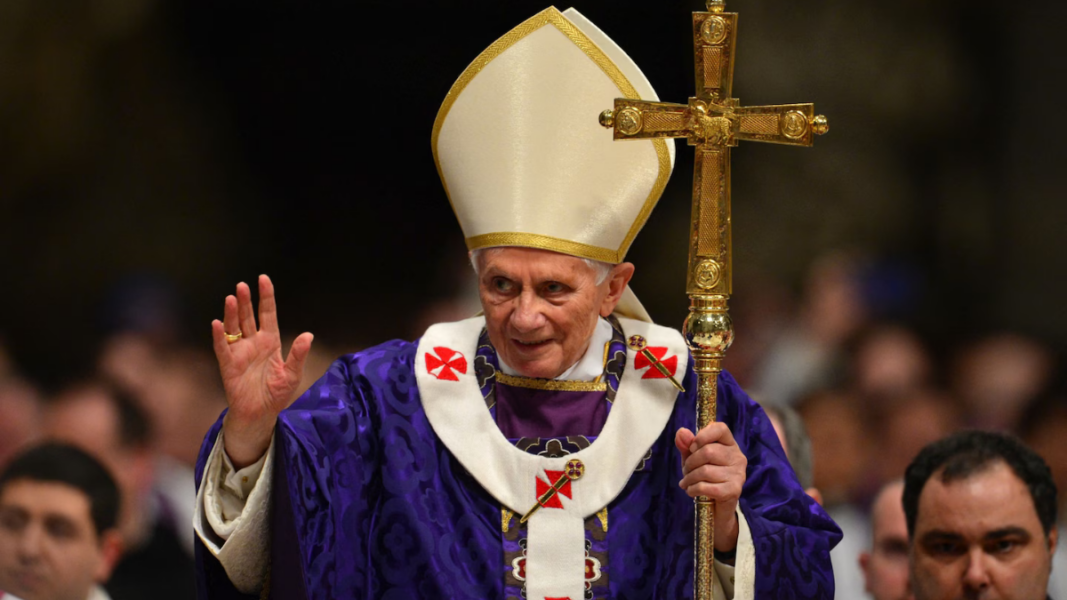
In the initial days of Lent, the book The Lord Leads Us by the Hand —which collects private homilies by Benedict XVI delivered in the Mater Ecclesiae monastery— offers a unique opportunity to rediscover the profound meaning of this liturgical season. The Revista Ecclesia thus highlights the meditation from March 9, 2014, corresponding to the first Sunday of Lent, in which the Pope Emeritus proposes entering what he calls the “sacrament of the forty days,” an expression that refers to the very mystery of the biblical desert.
For Joseph Ratzinger, Lent was not simply a moral preparation for Easter, but a mystery that introduces the believer into God’s logic. Commenting on the Gospel of the temptations, he states that Jesus is led by the Spirit “to enter the Lenten sacrament, the sacrament of the forty days.” That desert recalls the forty years of Israel: a time of closeness with God, but also of trial and purification.
Man’s Hunger and the True Food
Faced with the first temptation —to turn stones into bread— Benedict XVI unveils an ever-relevant question: what does redemption really consist of? The tempter suggests that the Messiah must eliminate material hunger. But he warns that well-being does not exhaust man’s vocation. “We see how precisely in the countries of well-being (…) man destroys himself, self-destructs.”
Even when he possesses what is necessary, the human heart can empty itself if it loses the sense of God. For this reason, “the bread of God is Christ himself.” True Lent begins when the believer understands that the deepest hunger is not only physical, but spiritual.
Fasting, in this context, acquires a concrete and solidarity dimension. It is not an intimate practice, but an openness to the other: “Fasting and renunciation are oriented toward co-responsibility, sharing, love.” Personal conversion necessarily leads to charity.
Do Not Put God to the Test
The second temptation introduces a very contemporary mentality: subjecting God to experiment. “We want to conduct the experiment; God should submit to our experiment,” warns Ratzinger. It is the claim to reduce faith to empirical demonstration.
However, God does not impose himself as a laboratory object. “God leaves us freedom and waits for us on a path of seeking.” That path is prayer, understood as the exercise of the desire for God. Lent thus becomes a school of trust: learning to seek his face without demanding spectacular proofs.
The Mystery of Redemptive Suffering
The third temptation —power over the kingdoms of the world— reveals the logic opposed to the cross. Even Peter, by rejecting the announcement of the passion, tries to divert Jesus from the path of suffering. But the Lord’s response is blunt: salvation does not pass through political dominion or immediate success.
Benedict XVI summarizes this truth with words that condense the core of the Gospel: “Jesus did not come to free us from suffering, but to free us through suffering.” Redemption does not consist in suppressing the cross, but in transforming it from within through love.
An Interior Combat
In the final stretch of his homily, the Pope Emeritus evokes the ancient expression Militia Christi, but redefines it as a “holy war of love against the coldness of the heart.” Lent is a combat, yes, but not against external enemies, but against indifference, selfishness, and pride that nest in one’s own heart.
The petition with which he concludes resonates as a spiritual program for these weeks: “Let us ask the Lord to help us enter the Lenten mystery, to be truly Christian and to learn true redemption.”
In these words, spoken a few years ago in the discretion of a monastic chapel, Benedict XVI reminds us that Lent is not a season of formal practices, but a path of interior transformation. A desert that does not lead to emptiness, but to Christ, true bread, true certainty, and true victory.