


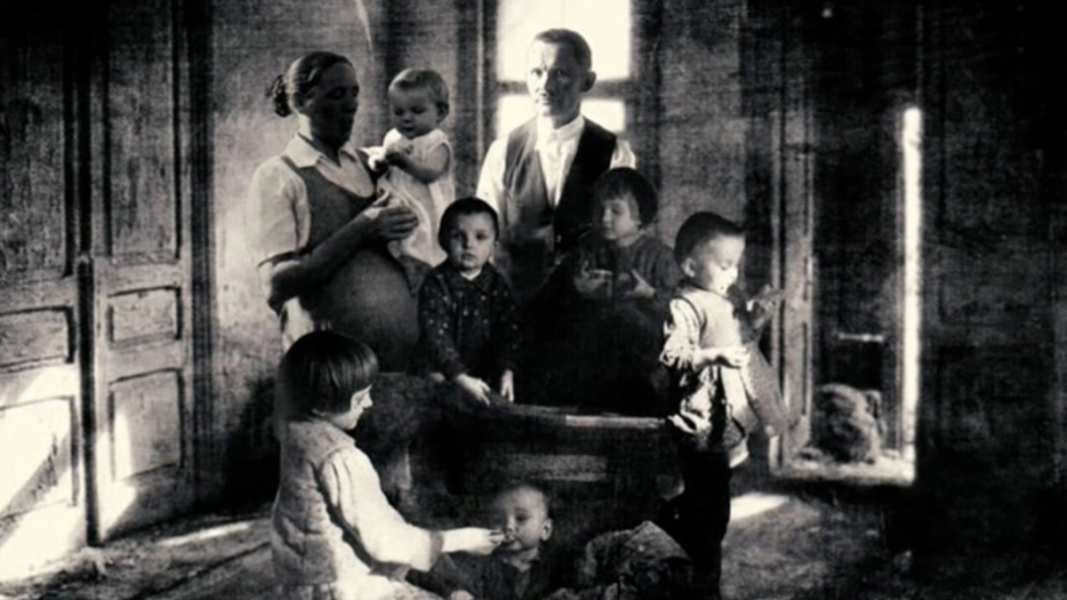
¡An entire family, parents and children, martyred together and beatified in the same ceremony! Indeed, as far as I know, it is a practically unique and entirely exceptional case in the history of the Church. Martyrdoms of entire families exist in the Church; however, normally each family member is canonized individually, each in a separate ceremony. Who is the Ulma family and what is their story for the Church to have decided on their declaration as martyrs in the same ceremony?
Józef, Witkoria and their “six” children
We are situated in the context of World War II, in Poland. There live Józef and Witkoria Ulma with their six children, in Markowa, a small rural village in southeastern Poland. It is 1944; since 1941 the Nazis have implemented a law prohibiting any aid to Jews under penalty of death. Despite this law, punishable by death, Józef and Witkoria decide to shelter two families of Jewish neighbors from the village in their home, in total, eight Jewish people sheltered and kept hidden in their house in secrecy for months.
It is not known for certain how the information reached the German authorities, but the fact is that one day the Nazis showed up at the home of Józef and Witkoria. First they executed all the Jews they were sheltering. Previously, the Germans had called the local neighbors to witness “the fate that befell the Jews and those who helped them“. After murdering the eight Jewish refugees, without any deliberation on their part they executed the parents, Józef and Witkoria, in front of their six children. Finally, and after a brief moment of reflection in which they wondered what to do with the six children, they executed them right there: “Look how the Polish pigs who shelter Jews die!” In less than an hour, 17 people were shot dead: the entire family died together out of hatred for the faith and out of love for their neighbor, a practically unique case in the history of the Church.
The Church opened the diocesan phase of the canonization process for the Ulma family in 2003. On September 10, 2023, Cardinal Marcello Semeraro presided over the beatification ceremony for the entire family in Markowa.
The “seventh” child
But, as if this were not enough, we must go further to note another even more admirable fact. Seventeen people were executed, we said, but the numbers do not add up: the 8 Jews, the parents and their 6 children total 16, not 17. The fact is that Wiktoria was pregnant with her seventh child when the Nazis arrived at their house. Apparently, her pregnancy was very advanced because Witkoria began to give birth to her last child at the moment of her martyrdom. When some neighbors exhumed the family’s bodies that same day, poorly buried hastily in a common grave dug in the ground, they saw that Witkoria had begun to give birth to her child, so they found outside the mother the head and part of the body of the creature.
And so, along with the admirable family martyrdom, beatified jointly parents and their six children, we admire an even greater prodigy, since the seventh child also received recognition of martyrdom by the Church in the same beatification ceremony. And now yes, I believe we can say without fear of being wrong, that it is the first case in which a child born at the moment of his mother’s martyrdom has been recognized as a martyr, the baby associated with the mother at the moment of her death. The Dicastery for the Causes of Saints officially explained that this seventh child was found already born during the moment of his mother’s martyrdom (in childbirth) and, therefore, considered among the children who received the title of blesseds in the ceremony.
Baptism of blood for the youngest of the Ulmas
How is it possible for the Church to beatify a baby who is not even baptized? From its beginning the Church has recognized baptism of blood. The seventh child of the Ulmas received baptism of blood with the martyrdom of his parents and the baptism of blood made him a true martyr. What is exceptional here is not canonizing an unbaptized person, since there are very clear precedents for that. What is incredible about the youngest of the Ulmas is his beatification almost without having “finished being born”, already giving light to the world, and never better said, because the little Blessed is now light for all of us.
The Communiqué issued by the Dicastery for the Causes of Saints regarding the beatification of the family explains it clearly:
“At the moment of the murder, Mrs. Wiktoria Ulma was in an advanced state of pregnancy with her seventh child. This child was born at the moment of his mother’s martyrdom… In fact, with the martyrdom of the parents, he received baptism of blood and was added to the number of martyred children”. “The Church has always had the firm conviction that those who die for the faith, even if they have not received sacramental baptism, can be considered martyred with Christ”.
The little blessed did not have time to live more than a few seconds outside his mother’s womb, since he immediately received the reward of his martyr’s crown. “…Without ever having uttered a word, today the little Blessed shouts to the modern world that welcomes, loves and protects life, especially that of the defenseless and marginalized, from the moment of conception until natural death…” (Homily of Cardinal Marcello Semeraro at the beatification of the Ulma family).
Virtues of Józef and Witkoria prior to their martyrdom
A martyrdom never arises as a mere heroic reaction to a last and supreme moment of trial. Rather, it is the result of an entire life of Christian virtues, lived with constant generosity and dedication. So it was also in the case of the Ulmas.
Józef was a farmer with little education, he only finished primary school. His general education was not high, but his life of faith was intense. A habitual reader of the Bible, he frequently underlined and annotated some passages; his underlining of the story of the Good Samaritan stands out.
His wife, Witkoria, was in turn a deeply believing woman, with simple and persevering faith, that “lifelong faith”, which she knew how to live embodied in the everyday life of her day-to-day as a wife and mother. Witnesses from the time testify to her frequent prayer and her serenity in the most difficult situations, which in times of war and deprivation were constant.
Therefore, the heroic shelter that Józef and Witkoria gave to the two Jewish families is a final act of supreme charity that, in their case, has precedents: it was common for them to welcome the needy, orphans and beggars into their home, and to share their harvests with those in need when there was scarcity. In this way, the help that the Ulmas gave to the Jews was not an exceptional and one-time gesture, but the coherent culmination of a life already oriented toward charity. “…The Ulma house became an inn where the despised, rejected and mortally wounded were welcomed and cared for. Józef and Wiktoria lived a holiness not only conjugal, but fully familial.” (Homily of Cardinal Marcello Semeraro at the beatification of the Ulma family).
Prudent and strong charity
The Ulmas cannot be accused of imprudence or acting recklessly: they knew the risks perfectly well and therefore took measures of discretion, without seeking martyrdom proudly or exposing themselves provocatively. Therefore, it is not a blind charity, but prudent and conscious.
But at the same time, the Ulmas’ charity is strong: they maintained the hiding for a long period, they did not give up in the face of rumors or fears, which must not have been lacking, they did not abandon those they had welcomed; they persevered until the end, ¡and what an end!
We can imagine the difficulties and anxieties that Józef and Witkoria must have gone through in their situation: with their decision they not only put themselves at risk, they knew well that they put their children in danger. In this way, their fortitude is seen not only in the moment of the shooting, but in their daily perseverance prior to the martyrdom. Theirs is a sustained fortitude, not a momentary impulse. In the Ulmas there is sustained moral deliberation: they know, they evaluate, they persevere. That does not make them “more martyrs” than others, but it does reinforce the clarity and beauty of their martyr’s witness.
Therefore, the holiness of the Ulmas does not arise from the martyrdom, but rather their martyrdom crowns a holy life. Martyrdom does not create virtues, but it does reveal and seal them with particular force and evidence for us.
In short, the Ulmas did not die as improvised heroes, they died as they lived!