


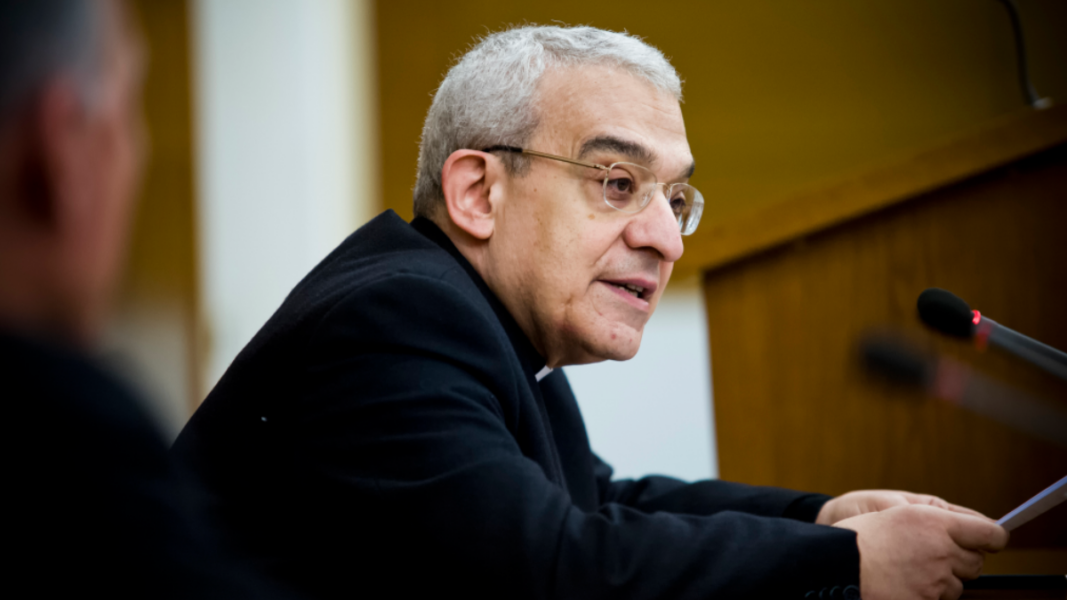
The Pontifical Commission for Latin America has released in advance the message for Hispanic America Day —which will be celebrated on the next March 1— under the title “We walk together, we share joy”. In that document, signed by its president, Msgr. Filippo Iannone, it is stated that the resistances around synodality do not have their main root in structural or doctrinal problems, but in an insufficient personal and community conversion. The text has been officially made known and reported by Aciprensa.
The Council as a Starting Point
The prelate begins with a reflection on the Second Vatican Council. More than sixty years after its closure, he acknowledges that it may seem that its documents have been surpassed by historical evolution. However, he maintains that a careful reading demonstrates the opposite.
“To an unprepared observer, it may easily seem that the documents of this Council have been overtaken by the changing reality of the world and the Church,” he admits. But he adds that, upon rereading them, “we discover that our lack of conversion is, very possibly, the main responsible for the fact that there are still issues that require greater personal and community assimilation.”
The thesis is clear: the problem would not be the Council, nor its interpretation, but the scant internalization of its teachings.
Synodality as Fidelity, Not as Innovation
Iannone applies this diagnosis in a particular way to synodality. He recalls that Pope Francis convened the synodal renewal “not so much because of this or that innovative idea, but as a gesture of fidelity to the Gospel and to the ecclesiology” of Lumen gentium.
In that same line, he states that Pope Leo XIV continues to guide the Church along this path, proposing to understand unity and communion as a dynamic reality: the people of God who walk in history and deepen their baptismal identity and their ministerial dimension.
The approach insists that synodality is not a recent ideological construction, but a direct consequence of conciliar ecclesiology. However, the message avoids entering into an issue that remains open in broad ecclesial sectors: whether all the practical concretions of the synodal process have clearly reflected that fidelity to the Gospel or if, in some contexts, ambiguities have arisen that fuel distrust.
A Church That Does Not Live for Itself
One of the most insistent axes of the message is the missionary dimension. “The Church does not exist for itself, but to announce with joy the beauty of the Gospel to all men and in all places,” emphasizes the president of the Pontifical Commission.
This is a classic affirmation that connects with the missionary impulse of the Church in Latin America and with the Spanish evangelizing tradition. The motto chosen for this year’s day —“We walk together, we share joy”— is a synthesis of the synodal spirit: walking reconciled so that the world may believe.
The message concludes with an explicit reference to the Virgin Mary, taking up chapter VIII of Lumen gentium. Mary is presented as “Mother” and “type” of the Church, a model that precedes and guides the mission.
Finally, on the horizon are the V Centenary of the Guadalupan event (2031) and the Jubilee of Redemption (2033), which Iannone invites to prepare with a spirit of communion and evangelizing commitment.