


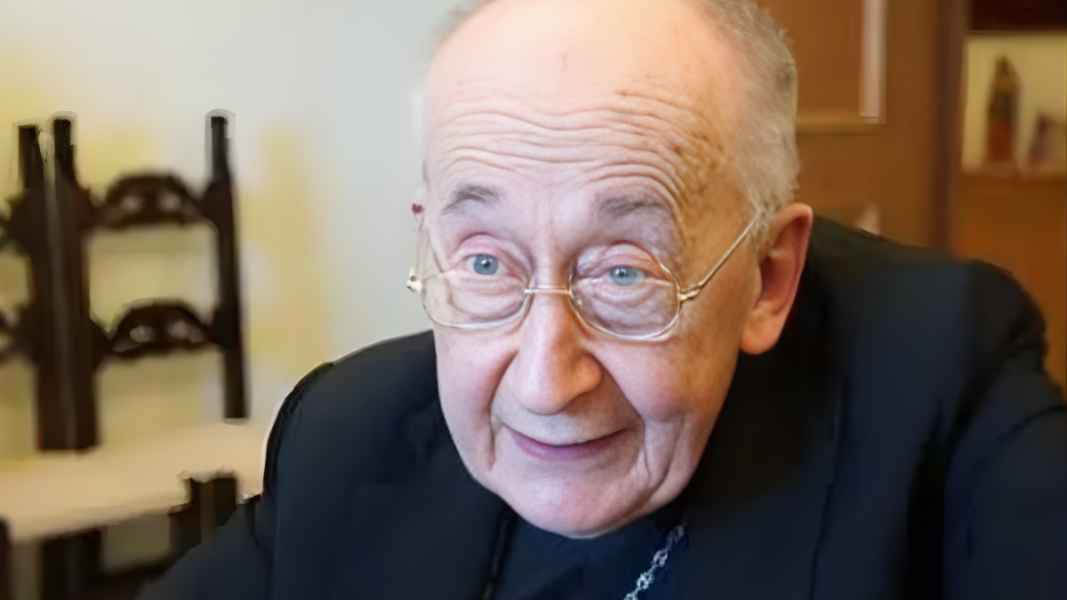
At 95 years old, Cardinal Camillo Ruini does not speak like a retired man, but like one of the great consciences of contemporary Italian Catholicism. In an extensive interview granted to the Italian newspaper Corriere della Sera, the historic president of the Italian Episcopal Conference—for sixteen years—offers a balance on the recent pontificates, the crisis of faith in the West, and the future of Christianity.
His words, measured but clear, contain statements of great significance. Especially regarding the resignation of Benedict XVI and the pontificate of Francis.
“It was a wrong decision”
The resignation of Benedict XVI in 2013 marked a before and after in the modern history of the papacy. Ruini does not hide that the gesture deeply affected him. He assures that it took him “completely by surprise” and that he experienced it with sadness.
And when asked if he considers it to have been a mistake, he responds without beating around the bush:
«I tell you the truth: it was a wrong decision, at least that’s how it seems to me».
However, the cardinal introduces an important nuance: he recognizes that Joseph Ratzinger knew his physical and spiritual situation better than anyone, and avoids judging his conscience. But he insists that the decision did not convince him.
Regarding the profile of the German Pope, he draws a balanced assessment. He highlights his intellectual stature—“above all a great theologian”—but admits that the exercise of governance was not his strong point. It is a significant judgment coming from someone who participated in the 2005 conclave and knew firsthand the internal climate of the Church after the death of John Paul II.
A brusque change and in tension with tradition
The analysis of Francis’s pontificate is more complex and reveals the discomfort of an ecclesial generation in the face of the pastoral shift of recent years.
Ruini acknowledges that the change introduced by the Argentine Pope was “too great and sudden.” He does not speak of a break, but of personal difficulty in the face of an accelerated transformation.
«It seems to me a complex balance, with very positive aspects and others quite less so. It is too soon to say which will prevail».
Among the positive aspects, he mentions the Pope’s personal value: «His great courage.» But, «he has taken too little account of tradition.»
It is no small accusation. For Ruini, tradition is not an ornamental element, but the very structure of ecclesial continuity. And he adds that «not by chance has he perhaps been more loved by non-believers than by believers.»
The indisputable reference
If there is one figure that emerges clearly in the interview, it is that of John Paul II. Ruini does not hesitate to point to him as the greatest Pope of the period he has lived through.
«For me, the greatest is John Paul II».
The reason is twofold: spiritual and geopolitical. Wojtyła was, in Ruini’s words, a “true world leader.” He knew how to confront communism without ambiguities and understood that secularization was not an inevitable destiny, but a challenge that demanded a new evangelization.
Ruini recalls that in the 1980s, some ecclesial sectors considered the world to be already definitively secularized. John Paul II thought otherwise. And Ruini aligned himself with him.
Council yes, post-council no
The cardinal rejects the simplistic reading that identifies the Second Vatican Council with the subsequent crisis. For him, the problem was not the Council, but the period that followed it.
After the conciliar closure, he explains, even central truths such as the divinity of Christ or fundamental aspects of Catholic morality came to be questioned. In the face of that drift, he affirms having reacted firmly.
He does not define himself as a traditionalist in a nostalgic sense. Nor does he defend a return to the liturgy in Latin, since he considers it essential that the faithful understand the language in which it is celebrated. But he precisely redefines the concept he considers decisive:
«Tradition does not mean going back. ‘Tradere’ means to transmit. Tradition is the continuity of the Church».
Crisis of faith and loss of moral references
Ruini does not sugarcoat the diagnosis: in the West, the crisis of faith is “undeniable.” Empty churches and seminaries with few vocations are not, for him, mere sociological phenomena, but signs of a profound cultural transformation.
He recognizes that today less is spoken of than before about the so-called non-negotiable values—the defense of life, the indissolubility of marriage, sexual morality—but warns that the Church cannot renounce them:
«We cannot stop speaking about these values. They are part of the content of our faith».
The main response, he insists, is not tactical or political, but spiritual: prayer, conversion, and new evangelization.
The judgment, hell, and Christian realism
In the final stretch of the interview, Ruini confesses to fearing death, above all because of God’s judgment, although that unease is tempered by trust in divine mercy.
He does not believe, however, that hell is empty:
«I don’t think so. I fear that hell is not empty at all».
When asked if the Son of Man will find faith on earth when he returns, he responds soberly:
«Unfortunately, it is not certain».
And yet, his conclusion is not desperate. In the long term, he declares himself optimistic. The reason is not sociological, but theological:
«At the origin of Christianity there is not only man. There is God».
At 95 years old, Ruini does not offer recipes or directives, but historical memory, doctrinal conscience, and the conviction that the Church only endures when it transmits—without amputations or ambiguities—what it has received.