


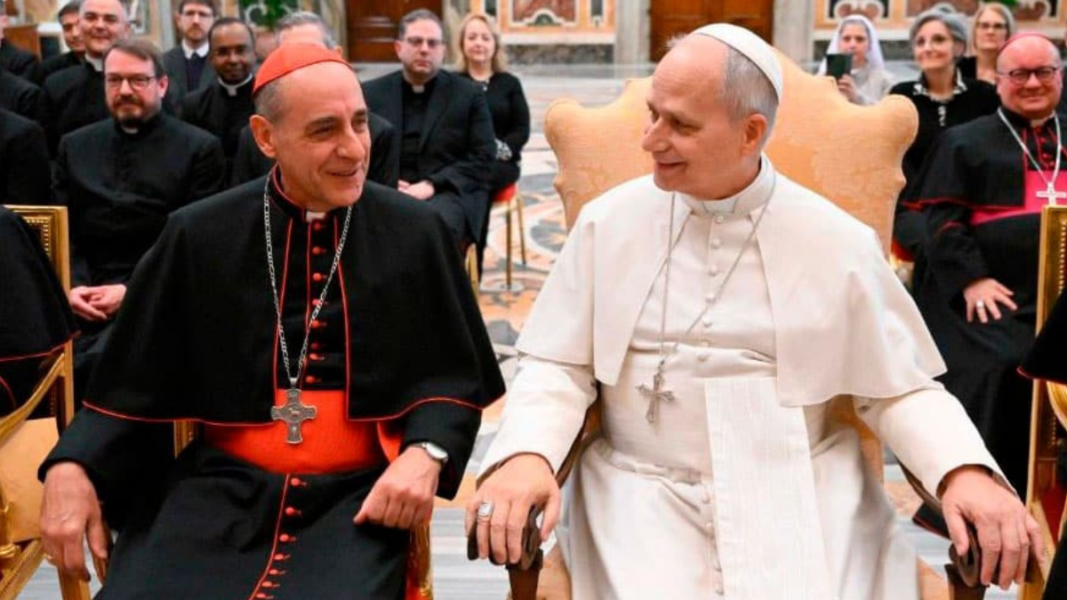
Someone should warn Leo XIV and Cardinal Fernández that they are making a fundamental mistake in managing the case of the Society of Saint Pius X: acting as if we were in 1988. We are not. Back then, Écone was a small earthquake in a slow, hierarchical, and easily framed information ecosystem from the centers of power. Today the scenario is radically different.
We live in the era of social networks, of transnational digital communities that organize and mobilize in hours. The traditional world is not an isolated periphery. It has seminaries, priories, vocations, and a direct communication capacity with millions of faithful. In some countries, the vocational vitality of the traditional sphere contrasts strikingly with the decline of entire diocesan structures. The post-45 certainties on which the postmodern world and the post-conciliar world were built have been crushed, the Overton window has exploded.
Playing this conflict with a strategy typical of the nineties is playing with fire. An “Écone” in 2026 would not be an encapsulated episode. It could become an uncontrollable explosion, amplified globally, capable of consolidating a stable structural counterweight. Thinking that the dynamic will be the same as almost forty years ago is ignoring the ground one is treading on.
A fearful strategy and pastorally weak
Rome offered a “specifically theological dialogue” making it clear that the conciliar texts are not corrected and that the legitimacy of the liturgical reform is not up for discussion. From a doctrinal point of view, the position is coherent, but it is disconcerting that this field was chosen as the central axis of the negotiation. What was at stake was not an academic symposium on documents from the 60s and 70s, but the sacramental continuity of the traditional rite and its largest community in the world.
Can you imagine the image of a Pope who personally receives the dissident and listens, instead of delegating everything to a controversial prefect? Can you imagine a charitable proposal in which Rome offered to guarantee ordinations and confirmations through bishops in communion, in parallel to the doctrinal debate? Can you imagine a Rome more concerned with ensuring that souls can fulfill the precept and receive the sacraments validly than with pulling out disputes over documents from the sixties and seventies?
That move would have changed the terrain. It would have forced the Society to show its true colors before millions of faithful. Instead, a quick statement was chosen, necessarily prepared before the meeting itself, incorrectly labeling a disobedience as schism, and putting at the center an abstract technical debate with a predictable outcome and marked cards.
Personal failure and structural risk
If the consecrations are consummated, as already seems irreversible, it will not be just a negotiation failure. It will be perceived as a personal failure of the Pope in managing unity. Not because he must yield on doctrine, but because he did not know—or did not want to—deploy all the pastoral charity and symbolic authority that the situation demanded.
Many faithful who do not belong to the SSPX nor share all its positions observe with concern two simultaneous errors: the unilateralism of consecrating without a mandate and the clumsiness of a Roman strategy marked by neglect and lack of vision. Defending the Pope’s authority does not oblige one to applaud ineffective decisions.
If souls are truly a concern, the priority cannot be to win a debate already won, but to avoid a fracture that can acquire unpredictable dimensions in the current context. Governing is anticipating consequences. In this case, the growing sensation is that the reaction has been with schemes from the past before a new and explosive scenario. And that, in today’s Church, is an imprudence of great scope.