


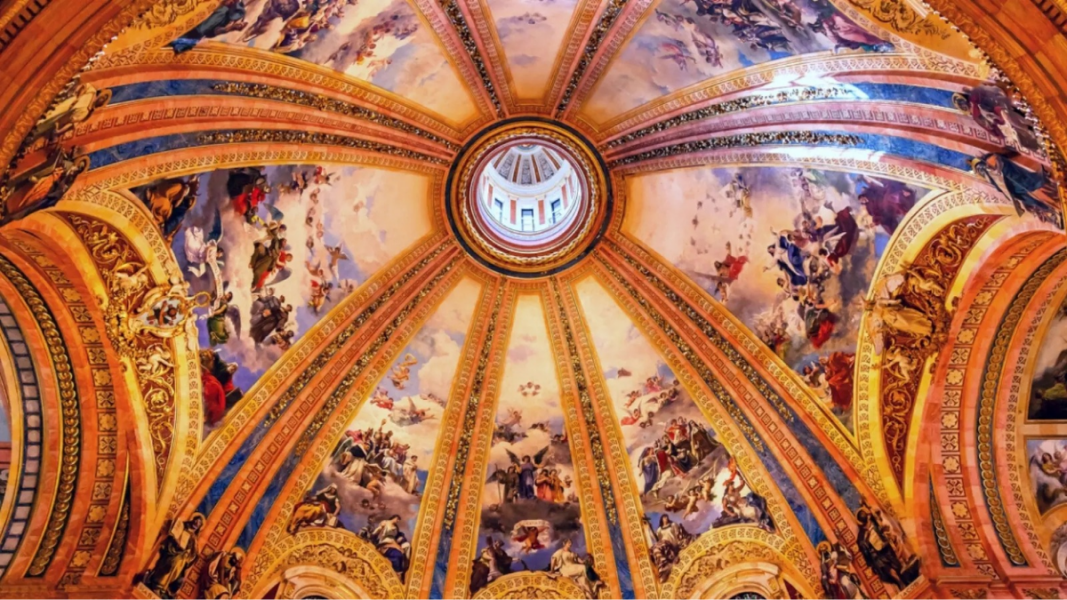
The Royal Basilica of San Francisco el Grande, in Madrid, has reopened to the public its imposing dome after two months of restoration work. The temple, one of the most significant in Spanish religious heritage, thus fully recovers one of the most outstanding architectural elements of Christendom.
The intervention has allowed the restoration of both the structure and the mural paintings that decorate the interior of the dome, returning visibility and splendor to a space conceived not only as a technical feat, but as a theological manifestation through art.
One of the largest domes in the Christian world
With 70 meters in height and 33 meters in diameter, the dome of San Francisco el Grande is the largest in Spain and ranks among the largest in the Christian world. Only surpassed by that of St. Peter’s Basilica in the Vatican, that of the Pantheon in Rome, and that of Santa Maria del Fiore in Florence.
Built in the 18th century, the dome responds to the late Baroque and Neoclassical ideal of lifting the gaze of the faithful toward heaven, integrating architecture and visual catechesis. In Christian tradition, the dome symbolizes the firmament, transcendence, and the communion of saints, becoming a space that invites contemplation of the divine mystery.
History of a Franciscan temple
The current basilica was built between 1761 and 1784 on the site of an ancient 13th-century Franciscan convent, linked according to tradition to the presence of Saint Francis of Assisi in Madrid. Its circular plan and monumental dome respond to the enlightened taste of the 18th century, but retain a clear religious intentionality.
Declared a National Monument in 1980, the basilica has been the setting for significant liturgical acts and preserves an important artistic heritage from the 18th and 19th centuries. Among its walls are works by Goya, Zurbarán, Casto Plasencia, Francisco Jover, Martínez Cubells, and Antonio Carnicero, among others.
Art that evangelizes
The recent restoration has allowed the recovery of the dome’s frescoes, made with traditional techniques that include the use of egg white as a binder, which provides luminosity and chromatic depth. These representations do not fulfill a merely decorative function; they form part of the Church’s catechetical tradition, which over the centuries has used art as a means to teach the faith, elevate the spirit, and express beauty.
The reopening of the dome returns to Madrid one of its great sacred spaces, reminding us that churches are not only historical monuments, but places where architecture, art, and faith converge to proclaim the Gospel.