


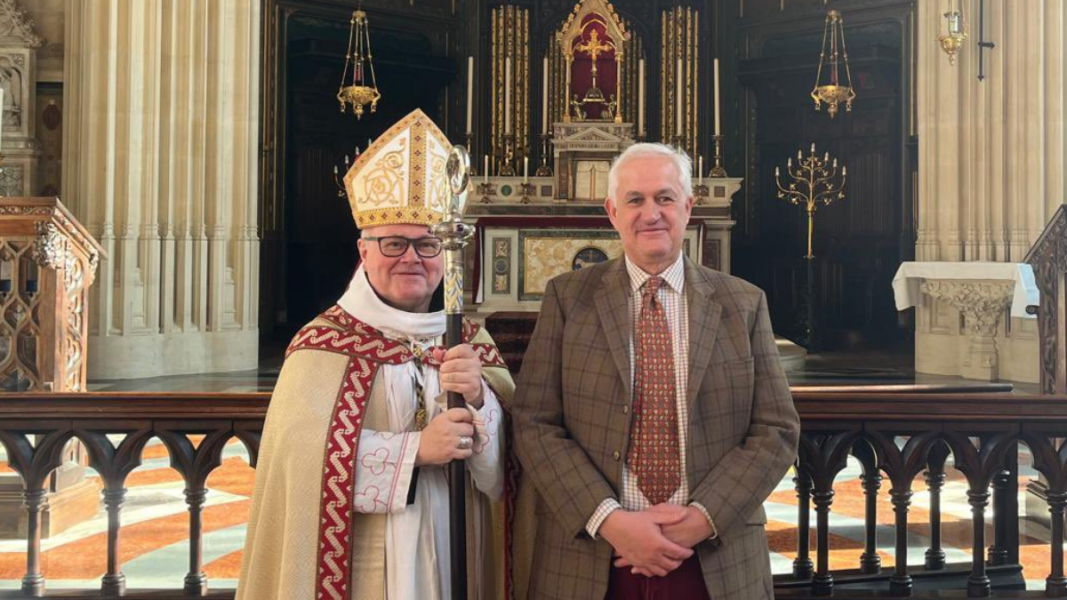
The Anglican canon Robin Ward, who served for 19 years as director of St. Stephen’s House in Oxford, was received into the Catholic Church on February 14 at the Benedictine Abbey of St. Michael in Farnborough, by its abbot, Dom Cuthbert Brogan.
According to National Catholic Register, Ward announced the news on social media and later confirmed to the U.S. outlet that he had received the sacrament of confirmation, thus culminating a spiritual journey begun approximately four decades ago.
“I have received the seal of the Holy Spirit in the sacrament of confirmation,” he explained, adding that he is glad “without regret or hesitation” to now find himself in the Catholic Church.
A prominent figure in academic Anglo-Catholicism
Ward, 60 years old, is a recognized cleric and academic in the field of Anglo-Catholicism. He studied medieval English at Magdalen College, Oxford, and trained for ministry at St. Stephen’s House between 1988 and 1991. He later obtained a doctorate at King’s College London with a thesis on the schism of Antioch in the 4th century.
Ordained in the Church of England in 1992, he served as assistant vicar, parish priest, and chaplain to a healthcare service. In 2004, he was appointed honorary canon of Rochester Cathedral and represented that diocese in the General Synod, the Church of England’s governing body. In 2006, he was appointed director of St. Stephen’s House, a position he held until 2025.
Married and father of two children, Ward has been described by Gavin Ashenden—also a former Anglican cleric received into the Catholic Church in 2019—as an academic specializing in patristics and Church history, with extensive teaching work and publications on early Christianity, liturgy, and Anglican identity.
St. Stephen’s House and the legacy of the Oxford Movement
Founded in 1876 and colloquially known as “Staggers,” St. Stephen’s House has been a key institution in the Anglo-Catholic tradition. According to Ashenden, it is the last theological college representing the aspirations of the 19th-century Oxford Movement.
The so-called Tractarian movement sought to recover the continuity between Anglicanism and the Catholic Church, decisively influenced Anglo-Catholic spirituality and worship, and was linked to significant conversions, including that of St. John Henry Newman.
Ward acknowledged the constant influence of Newman on his own spiritual journey and chose “John Henry” as his confirmation name. In his view, Newman is today widely recognized as a teacher for our time.
The reasons for a spiritual journey
Ward explained that he was educated in a “low church” Anglicanism, characterized by the use of the Book of Common Prayer, a sober liturgy, extensive preaching, and a Protestant-style sacramental approach.
During his studies at Oxford—in the same college where C. S. Lewis taught—he discovered Anglo-Catholicism, which he described as a fusion of 19th-century theology and romantic ritualism. Over the years, however, he began to perceive that certain developments within Anglicanism were affecting his understanding of the Church.
At the helm of a seminary, he explained, the fundamental questions were: who is Jesus Christ, what is a priest, and what is the Church. It was precisely the answer to this last question that began to seem increasingly unsatisfactory to him, a concern that, as he indicated, some of his students shared.
His process was also influenced by his closeness to various Catholic communities in Oxford, such as the Dominicans of Blackfriars, the Jesuits of Campion Hall, and the Oratorians of St. Aloysius.
An Anglicanism in transformation and tension
Ward’s decision takes place within a period of tension and debate within the Church of England. In recent years, the General Synod has faced intense discussions around sexual morality, particularly following the Living in Love and Faith process and the approval to bless same-sex couples.
This context is compounded by the recent election of Sarah Mullally as ‘archbishop’ of Canterbury, whose appointment has been received unevenly within global Anglicanism itself.
Read also: Anglican schism: England is left without 80% of its followers
Additionally, tensions continue between the Church of England and several African provinces, especially regarding moral doctrine and ecclesial authority. Some African primates have openly questioned certain decisions made in England, which has accentuated a growing fracture within the worldwide Anglican communion.
A broader phenomenon: conversions and a surge in Oxford
Ward’s reception adds to other incorporations of Anglican clerics into the Catholic Church recorded in recent years in England. National Catholic Register itself recalls that, since 1992, around 700 Anglican clerics and religious in Great Britain have been received into the Catholic Church.
At the same time, some Catholic circles in Oxford have noted an increase in conversions. The Oxford Oratory, in the parish of St. Aloysius—a place that Ward mentions as significant for his Catholic life in the city—stated that it had received more people in the first two months of 2026 than in the entire previous year.