


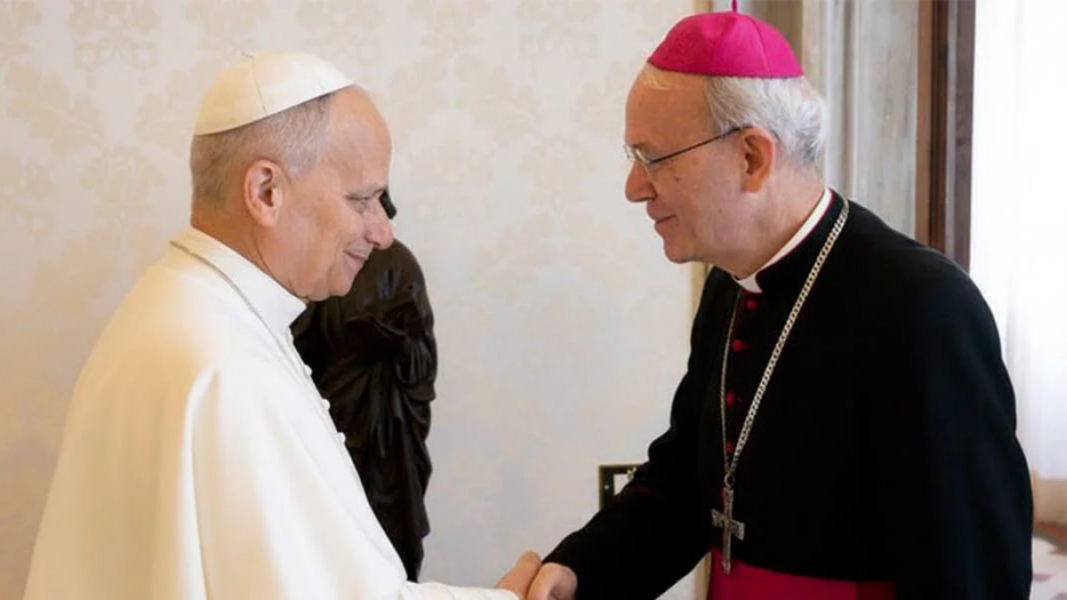
Bishop Athanasius Schneider, auxiliary bishop of Astana (Kazakhstan), has made public new details of the private audience he held with Leo XIV on December 18th last, in an interview with Robert Moynihan broadcast by Urbi et Orbi Communications. On this occasion, he delved into the diagnosis he presented to the Pope about the current situation of the Church, resuming some points he had already pointed out in January, when he alluded to the need for an Apostolic Constitution to guarantee liturgical peace.
As he explained, the dialogue with the Pontiff took place in an “open and cordial” atmosphere, and in it he emphasized, among other matters, both the wounds he perceives in the Church and the spiritual impact that the extraordinary form of the Roman rite has had on numerous faithful, especially among the young.
Five wounds that weaken the Church
During the audience, the bishop presented the Pope with a list of what he defined as the five main wounds affecting the Church today and which, in his opinion, require urgent attention:
- Doctrinal confusion, which erodes the clarity of the message of faith and which could be remedied through a solemn binding profession of faith.
- Liturgical anarchy and confrontation around the Mass of the Roman rite, which has generated divisions within the ecclesial community.
- Questionable episcopal appointments, with bishops and cardinals who, in his opinion, would act in tune with secular agendas rather than with the traditional teaching of the Church.
- Deficient priestly formation, especially in doctrine, morals, and liturgy, which would have weakened the preparation of future generations of priests.
- Difficulties affecting contemplative life, including references to problems arising around the application of the instruction Cor Orans to the life of contemplative nuns.
The impact of the Traditional Mass on young people
One of the most significant passages of the audience, according to the bishop’s account, was when the Pope shared having heard from young people—directly from them—that their conversion to God had occurred through the Traditional Latin Mass. Schneider recounted that the Pontiff mentioned this testimony with a smile, expressing surprise at the spiritual force that this liturgical form exerts on new generations.
The Priestly Fraternity of Saint Pius X
In the course of the conversation, Monsignor Schneider also addressed the situation of the Priestly Fraternity of Saint Pius X (FSSPX), pointing out that it is right to warn that certain passages of the Second Vatican Council have been extrapolated from a pastoral council toward a new ecclesial paradigm which, in his opinion, requires correction.
He also agreed that the Church must honestly examine the ambiguities present in some expressions of the Council, especially on issues such as religious freedom or collegiality, emphasizing that these are pastoral formulations and not definitive teachings of the magisterium.
Schneider warned that it would be a tragedy if the FSSPX were to remain completely separated from the Church, comparing the situation to the schism of the Old Believers in Russia, and stated that if this “arm” is lost, the Church would be harmed and disfigured. Therefore, he called on Pope Leo XIV to act with historic generosity, allowing at least a partial integration of the Fraternity into the life of the Church without the doctrinal issue becoming the first and main obstacle.
At this point, Monsignor Schneider was especially clear when referring to the current stance attributed to Cardinal Víctor Manuel Fernández, which demands resolving the doctrinal dialogue beforehand before any canonical regularization. The bishop described this approach as unrealistic, excessively harsh, and unpastoral, considering that it blocks any practical progress and prolongs an unnecessary situation of tension.
In his opinion, historical experience shows that processes of reconciliation and integration do not always begin with full doctrinal resolution, but can advance gradually, favoring visible communion first and leaving space for a subsequent, more serene and fruitful theological dialogue.