


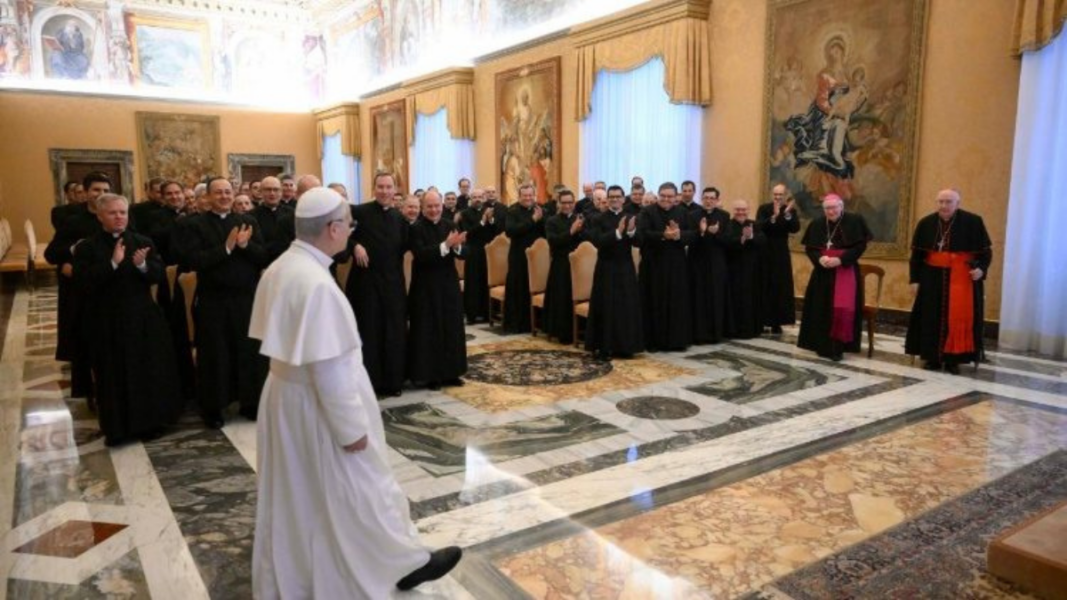
Pope Leo XIV received the participants in the General Chapter of the Legionaries of Christ this Thursday, February 19, in the Consistory Hall, where he exhorted them to live this time as a moment of communal discernment and spiritual renewal. In his speech, the Pontiff emphasized that the charism is not the property of those who receive it, but a gift from the Holy Spirit of which they must be custodians and servants, called to safeguard it with creative fidelity and openness to the Spirit.
Leo XIV placed emphasis on the need for an exercise of authority understood as fraternal service and not as domination, insisting on mutual listening, co-responsibility, and communal discernment. In a context marked by the call to synodality, he recalled that unity does not imply uniformity, but rather harmonizing diversity to seek God’s will together and strengthen the mission entrusted to the congregation within the Church.
We leave below the complete message from Leo XIV:
In the name of the Father and of the Son and of the Holy Spirit.
Peace be with you.
Eminence, Excellency, dear brothers:
I am pleased to receive you in the final phase of your General Chapter. As in the life of every religious institute, this is a time of grace, since it constitutes a privileged moment of communal discernment and listening to the Holy Spirit, who continues to guide your history and sustain the mission entrusted to your congregation, in fidelity to the charism received as a gift from God for the Church.
It is also the occasion for you to recognize yourselves as heirs of a charism that, through various paths and historical expressions—sometimes painful and not exempt from crises—has given rise to the congregation of the Legionaries of Christ, united by a common spiritual root and apostolic passion. This shared memory does not look only to the past, but impels a constant renewal in the present, faithful to the Gospel.
The charism is a gift from the Holy Spirit. Every institute and each of its members are called to embody it personally and in community, in a continuous process of deepening their own identity that situates and defines them within the Church and society. This path in turn constitutes a valuable contribution to the Church as a whole and, in a particular way, to the spiritual family of Regnum Christi.
The diversity of forms, styles, and accents in living the received charism does not weaken unity, but enriches it, as in “the polyhedron, which reflects the confluence of all particularities that in it preserve their originality” (Exhort. ap. Evangelii gaudium, 236). For this reason, plurality should not be feared, but welcomed and discerned, and allowed to be expressed in order to respond with greater transparency and fidelity to God’s call. Just as in a family each member possesses their own identity and mission, so too among you the plurality of gifts manifests the fruitfulness of the Spirit and strengthens the common mission.
As has been mentioned, the charism is a gift from the Holy Spirit; it is He who distributes His gifts (cf. 1 Co 12,11), and He does so for the renewal and building up of the Church. As Saint Paul says, “in each one is manifested for the common good” (1 Co 12,7). Therefore, the charism must be received with gratitude and consolation (cf. Const. dogma. Lumen gentium, 12). Remember, then, that you are not owners of the charism, but its custodians and servants. You are called to give your lives so that this gift may continue to be fruitful in the Church and in the world. For this reason, this Chapter invites you to continue asking yourselves how to live today, with creative fidelity, the charismatic intuition that gave rise to your religious family.
A General Chapter is also the moment to evaluate the path traveled and discern, with the help of the Holy Spirit, the path to be taken. In this way, you have considered the exercise of government and authority in the institute as one of the central themes. Authority, in religious life, is not understood as domination, but as spiritual and fraternal service to those who share the same vocation. Its exercise must be manifested in the “art of accompaniment,” to learn to take off one’s sandals before the sacred ground of the other (cf. Ex 3,5). […] With a respectful gaze full of compassion but which at the same time heals, frees, and encourages maturation in Christian life” (Exhort. ap. Evangelii gaudium, 169). Authority in religious life is also at the service of animating common life, centering it on Christ and orienting it toward the fullness of life in Him, avoiding any form of control that does not respect the dignity and freedom of persons.
Among the fundamental tasks of religious government is, likewise, that of promoting fidelity to the charism. To do this, it is necessary to strengthen a style of government characterized by mutual listening, co-responsibility, transparency, fraternal closeness, and communal discernment. Good government, instead of concentrating everything in itself, fosters subsidiarity and the responsible participation of all members of the community.
Consecrated life, called to be an expert in communion, creates spaces where the Gospel is translated into concrete fraternity. During these days, undoubtedly, you have lived a concrete experience of communion among brothers from diverse cultures and realities, from different generations, and between those who exercise responsibilities of government and those who serve daily in communities and missions.
Your mission consists in offering this visible witness of mutual listening and joint seeking of God’s will, both for your communities and for those you encounter on the way while fulfilling your mission.
“Missionary unity, obviously, must not be understood as uniformity.” It is not a matter of eliminating differences, but of having the capacity to harmonize diversity for the benefit of all, accepting divergences as a richness and discerning together the paths that the Lord proposes to us.
This process requires humility to listen, interior freedom to express oneself with sincerity, and openness to accept joint discernment. It is a requirement inherent to every vocation lived in community.
The Church today lives an intense call to synodality, that is, to walking, listening, and discerning together. The General Chapter is, by its very nature, a synodal exercise in which all are called to contribute their experience and sensitivity to build together the future of the institute.
Dear brothers, I exhort you to continue living in an attitude of prayer, humility, and interior freedom. Do not follow particular or regional interests, nor seek mere organizational solutions, but above all the will of God for your religious family and for the mission that the Church has entrusted to you.
May this Chapter open you to a time of hope. The Lord continues to call and send; healing and purifying, for this reason your task consists in discerning how to respond with fidelity to the present that God places in your hands.
Entrusting this new stage of your congregation to the maternal protection of Our Lady of Guadalupe, I impart upon you from the heart the Apostolic Blessing. Thank you.