


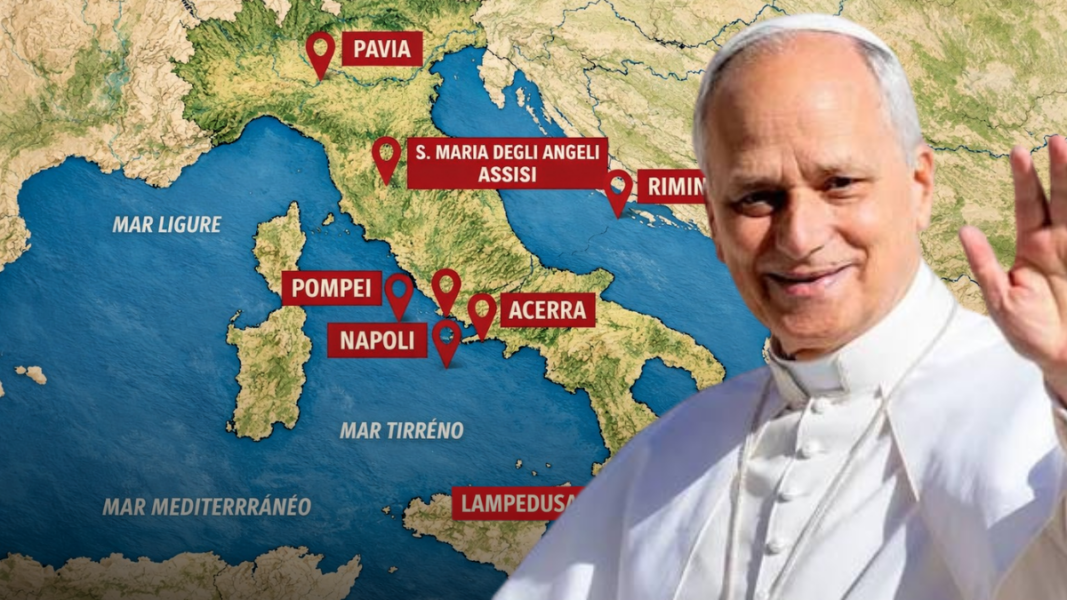
The Prefecture of the Papal Household has made public on this February 19 the calendar of pastoral visits by Pope Leo XIV in Italy between May and August 2026. The program includes Pompeii, Naples, Acerra—in the so-called “Land of Fires”—Pavia, Lampedusa, Assisi, and Rimini.
Among them all, the visit to Lampedusa on July 4 stands out, a place that has become a symbol of the migration crisis in the Mediterranean. It was there that Pope Francis made his first pontifical trip in July 2013, marking from the beginning a central axis of his pontificate.
Lampedusa and the «pull effect»
The choice of Lampedusa is not a neutral gesture. Leo XIV takes up one of the most symbolically charged scenarios from the previous pontificate and once again places the focus on welcoming as the priority response to the migration phenomenon.
But the migration problem in the Mediterranean is not solely a humanitarian drama. It is also a structural phenomenon with social, demographic, and security consequences that affect both countries of origin and destination. The insistence on messages centered exclusively on welcoming, without a clear framework of political responsibility and effective border control, contributes to the «pull effect»: it reinforces the perception that Europe remains open and fuels increasingly dangerous routes.
Read also: The “pull effect” and the romanticization of migration routes
This dynamic not only increases migration pressure but also strengthens human trafficking networks and exposes thousands of migrants to mafias, exploitation, and death in the Mediterranean. Christian charity cannot be detached from realism. Ignoring the practical consequences of certain messages is not compassion; it is imprudence.
Acerra and the “Land of Fires”: social denunciation
On May 23, Leo XIV will visit Acerra, in the province of Naples, within the well-known “Land of Fires,” a region devastated by the illegal dumping of waste managed by the Camorra. Francis had planned to go there in 2020, but the pandemic prevented it.
The visit has a clear component of denunciation against organized crime and environmental degradation. The message is unequivocal: the Church positions itself against criminal structures that destroy entire communities and force many families to abandon their land.
Major ecclesial events: Assisi and Rimini
The program also includes a visit on August 6 to Santa Maria degli Angeli, in Assisi, on the occasion of the Eighth Centenary of the Transit of Saint Francis, where the Pope will meet with young people and preside over the Mass.
On August 22, he will travel to Rimini to participate in the 47th Meeting for Friendship Among Peoples, organized by Communion and Liberation, also celebrating the Eucharist with the faithful of the diocese.
Clear signals of the pontificate
Leo XIV’s Italian agenda combines Marian devotion—Pompeii on May 8— theological reference—Pavia, where the relics of Saint Augustine are venerated—and scenarios with a strong social charge.
The visit to Lampedusa confirms that the migration issue will continue to occupy a central place in his practical magisterium. The challenge will be to articulate charity and prudence, compassion and responsibility, avoiding the pastoral symbolism becoming a factor that, albeit unintentionally, perpetuates dynamics that harm both Europe and those who embark on routes marked by risk and exploitation.
Complete itinerary of Leo XIV
- May 8 – Pompeii and Naples
- May 23 – Acerra
- June 20 – Pavia
- July 4 – Lampedusa
- August 6 – Santa Maria degli Angeli (Assisi)
- August 22 – Rimini