


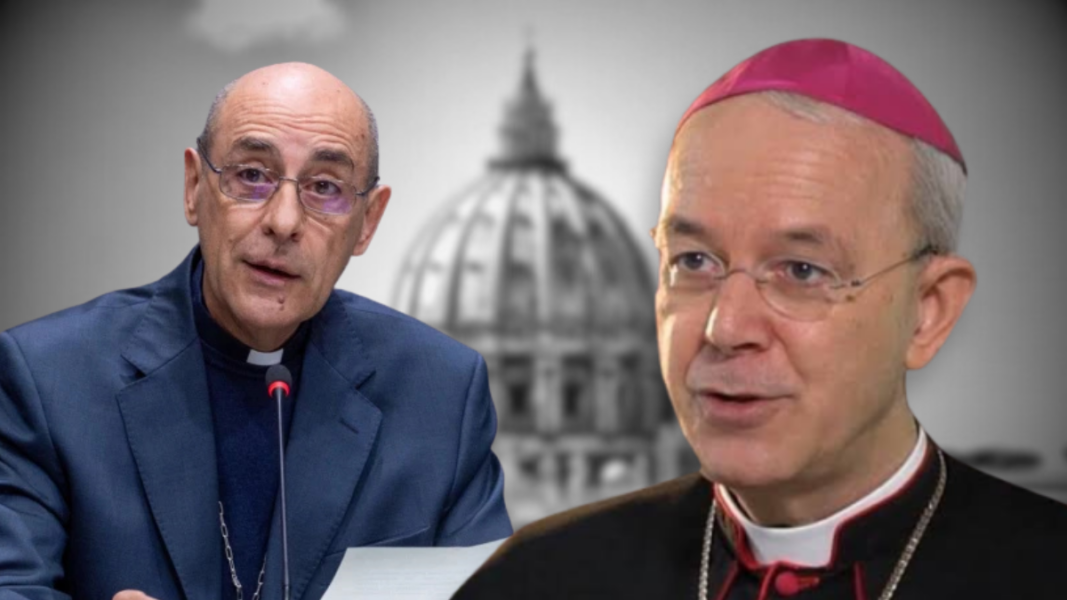
Nearly a week after the meeting of the Priestly Fraternity of Saint Pius X (FSSPX) at the Vatican, Monsignor Athanasius Schneider—auxiliary bishop of Astana, Kazakhstan—has expressed his disagreement with the statement by Cardinal Víctor Manuel Fernández—prefect of the Dicastery for the Doctrine of the Faith—that the texts of the Second Vatican Council “cannot be modified,” and has defended the idea that pastoral expressions can indeed be revised or corrected. This is reported by journalist Niwa Limbu, of The Catholic Herald, in a message posted on the social network X, where he previews excerpts from a conversation held with the prelate.
Schneider maintains that only the Word of God is immutable in the strict sense. “What cannot be changed is only the Word of God. The Bible cannot be changed because it is the Word of God,” he states. In his view, Cardinal Fernández’s formulation would be “completely erroneous” if applied without distinction to the conciliar texts.
The Pastoral Character of the Second Vatican Council
The auxiliary bishop recalls that St. John XXIII, when convening the Second Vatican Council, made it clear that it was not about defining new dogmas or resolving doctrinal issues definitively. According to Schneider, the Pope expressly explained that the council had an explanatory and catechetical purpose, adapted to the language of the time.
In the same vein, he quotes Paul VI, who would have reiterated that the council did not intend to proclaim dogmas or define doctrines definitively, but rather that its character was “primarily pastoral.” Therefore, he argues that pastoral formulations—since they do not constitute dogmatic definitions—could be improved or corrected, given their circumstantial nature.
Schneider clarifies that the dogmas cited by Vatican II, drawn from previous councils, cannot be modified. However, he distinguishes between those definitive teachings and the pastoral expressions proper to the historical context of the council.
The Example of the Fourth Lateran Council
Schneider mentions the Fourth Lateran Council (1215), noting that some of its pastoral provisions would be unacceptable today. Specifically, he refers to the obligation imposed at that time on Jews to wear distinctive signs in Christian cities, describing that provision as a form of discrimination.
From this example, he raises the question of whether such conciliar expressions can be corrected. According to his reasoning, if the possibility of revising pastoral formulations from previous councils is admitted, the same option could also be considered with regard to certain expressions of Vatican II.
The bishop then emphasizes the need to honestly examine what he considers “evident and undeniable ambiguities” in some conciliar texts, and maintains that other ecumenical councils have undergone adjustments in their pastoral declarations.
The Situation of the FSSPX
Schneider referred to the situation of the FSSPX by proposing that they first be granted canonical regularization and that doctrinal dialogue continue afterward.
In his opinion, allowing the Fraternity to contribute its reflection could help clarify and specify debated aspects, for the benefit of the entire Church. Finally, he expressed concern over what he described as a “harsh” and “imprudent” behavior on the part of the Holy See in handling this issue.