


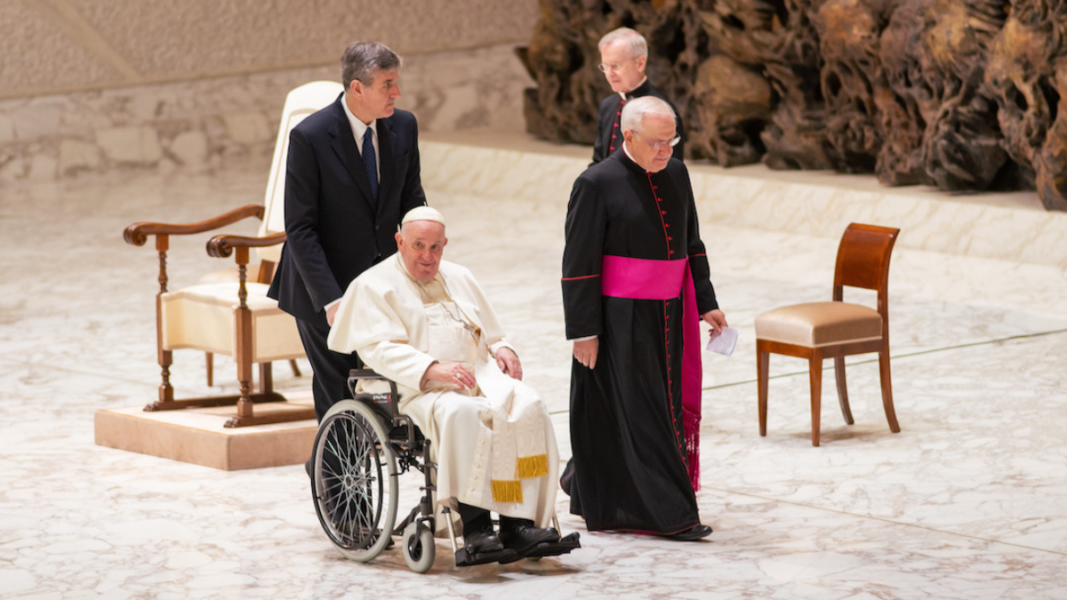
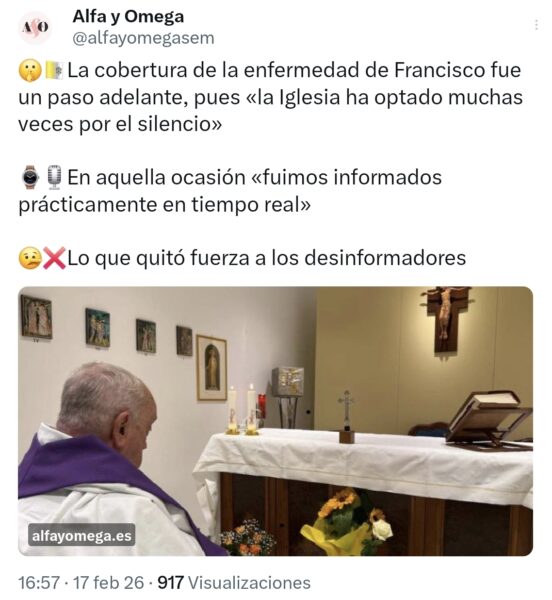
Ten months have passed since the Pope’s death. Ten months after that clinical spectacle broadcast in installments, it turns out that it was a “successful case study in communication.” They say it with solemnity. With aplomb. Almost with academic pride.
One has to give them something: they don’t lack audacity.
For weeks we were informed practically in real time. We knew when he slept. When he didn’t sleep. How much mucus he accumulated. How many bronchoscopies they performed on him. When he had bronchospasms. When he vomited. When he aspirated. When they connected non-invasive mechanical ventilation at night and when they removed the nasal cannula in the morning.
We even knew what he had for breakfast and when he switched from a liquid diet to solids.
What we didn’t know—a minor detail, apparently—was whether he requested the Anointing of the Sick. Whether it’s true that he died in the elevator amid tantrums from the mysterious nurse he became obsessed with.
We didn’t know if he was spiritually prepared to die, but we did know the state of his gas exchange.
Exemplary transparency.
In the morning, the report was minimalist: “He slept well.” In the afternoon, clinical baroque: detailed description of the excess of endobronchial mucus and the response to pharmacological therapy. One day administrative silence; the next, pathological anatomy narrated as if it were a medical series.
And now they tell us that it “took the wind out of the disinformers’ sails.”
Of course. Nothing deactivates doubts better than a bulletin that tells you how he was drowning in his own vomit but doesn’t clarify who signs the decrees in his name.
Nothing conveys more institutional serenity than announcing scheduled nighttime mechanical ventilation while, simultaneously, episcopal appointments are published as if the pontifical office were operating at full capacity.
Nothing projects more dignity than the idea—which was also defended—of parading him in pajamas through St. Peter’s to prove he was still alive.
It was masterful. Really. Surgical communication.
Sacramental discretion versus bronchial transparency.
The result was an unsettling spectacle: a spiritual authority turned into a medical soap opera in installments.
And now they try to sell it as a model.
Perhaps an uncomfortable question is in order: Is reporting in real time on an old man’s pulmonary state transparency… or institutional degradation? Is telling everything except the essential clarity… or narrative manipulation?
Because in the end, the problem wasn’t the excess of medical data. The problem was the absence of a simple answer to two basic questions:
Was he dying?
Was he in real condition to govern?
There was no daily report on that.
But we did know about the bronchospasm.
And we saw him walking in pajamas through St. Peter’s Basilica.
Successful communication, without a doubt.
Give them a Bravo award.