


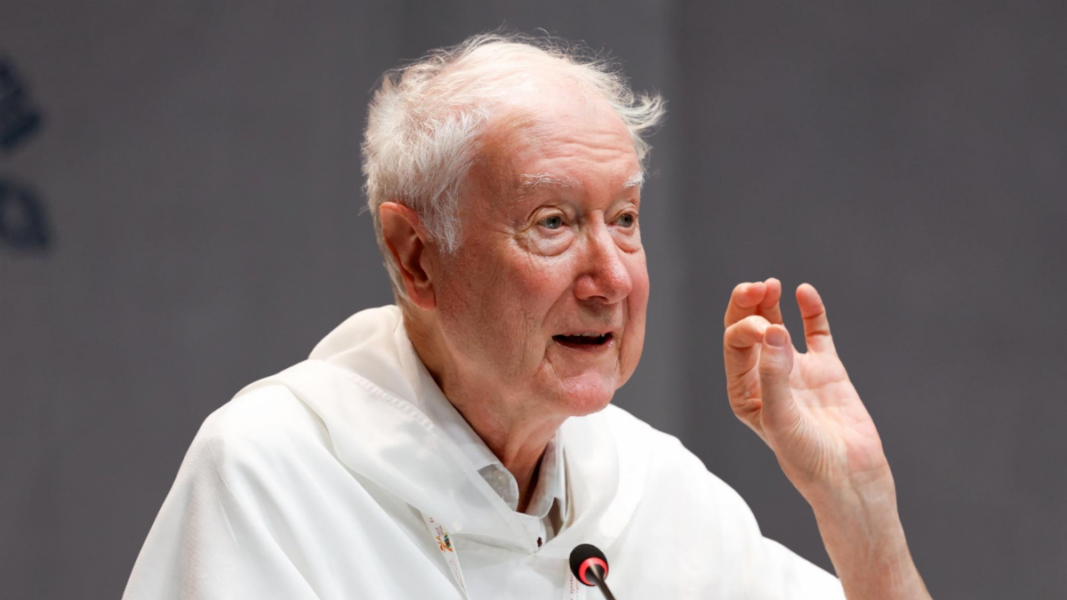
Dominican Cardinal Timothy Radcliffe has firmly responded to those who pigeonhole him as a “progressive,” after some conservative sectors criticized his selection to open the consistory convened by Leo XIV with a meditation. In an interview granted to La Repubblica, the English cardinal laments that he is reduced to an ideological label and states that “labels are fine for jam jars, not for human beings.”
Radcliffe assures that many of those who judge him “have not read a single word” of his books or articles and maintains that the polarization between “traditionalists” and “progressives” is alien to the essence of Catholicism. In his view, faith lives from a fruitful tension between fidelity to tradition and openness to the renewing action of the Spirit, not from a radical opposition between the old and the new.
Defense of the Synodal Impulse
The cardinal, chosen by Francis to preach at the Synod and now invited by Leo XIV to speak before the cardinals, considers that the current Pontiff continues the synodal path initiated by his predecessor. In fact, he defines the last consistory as “profoundly synodal,” in which—as he recounts—the cardinals voted on the topics they wished to address.
Read also: Radcliffe and the “opening to novelty”: an ambiguous motto for the Church
Radcliffe holds that Francis’s “extraordinary creativity” and Leo XIV’s “ministry of unity” are “perfectly complementary.” In his opinion, the Church needed the reformist impulse of the Argentine Pope and now requires specific work of reconciliation for those who felt uneasy about certain changes.
Tensions in the Church
Regarding internal tensions, he admits that documents like Fiducia Supplicans provoked “indignation and anger” in numerous bishops and recognizes that a broader process of listening would have been desirable before its publication, without thereby renouncing the idea of a Church that is a “home for all.”
In that same framework of ecclesial debate, he reaffirms his stance “totally in favor” of the female diaconate. Radcliffe sees no decisive theological objections against it and, although he recognizes the reservations expressed by Francis about clericalization, he says he understands the frustration of many women who demand greater recognition of their authority in the life of the Church.
On synodality, Radcliffe admits that there is fear of a loss of authority in a general context of institutional crisis. However, he maintains that authority is not weakened when the People of God are listened to, but rather strengthened. Therefore, to overcome internal polarization, the cardinal does not propose a simple middle ground between extremes, but rather to seriously address deep concerns. Unity, he concludes, is not built with labels, but from communion and mutual listening.
There is No Unity Without the Truth
The Church is not built on labels or on circumstantial majorities, but on the revealed and transmitted Truth. The unity that is invoked today will only be solid if it is rooted in the apostolic tradition and in doctrinal clarity. Everything else—including good intentions—increases confusion; the faithful need certainties, not ambiguities.