


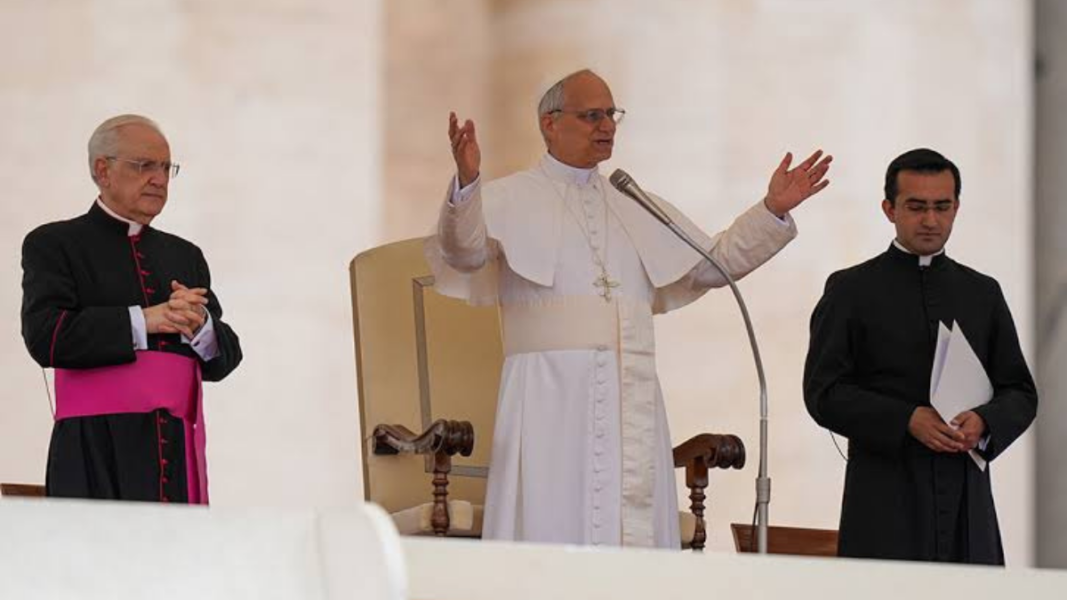
Pope Leo XIV presided over this Wednesday, February 18—Ash Wednesday—the general audience in St. Peter’s Square, where pilgrims from Italy and various countries around the world gathered. Within the framework of the catechesis cycle dedicated to the documents of the Second Vatican Council, the Pontiff centered his meditation on the dogmatic constitution Lumen gentium, emphasizing the mystery of the Church as “a sacrament of union with God and of the unity of the entire human race”.
Drawing from the letters of Saint Paul, Leo XIV explained that the term “mystery” does not refer to something obscure, but to God’s plan which, hidden for centuries, has been revealed in Christ to reconcile and gather the humanity scattered by sin. The Church—he affirmed—is not merely a sociological reality, but the visible sign and effective instrument through which God continues in history the work of Christ’s Easter, calling men to communion with Him and among themselves.
The Holy Father recalled that this unity has its source in the Lord’s cross and resurrection, which tear down the walls of separation and constitute the Church as “universal sacrament of salvation”. The audience concluded with the recitation of the Our Father and the apostolic blessing imparted to the faithful present.
We leave below the complete catechesis of Leo XIV:
Dear brothers and sisters, good morning and welcome.
The Second Vatican Council, to whose documents we are dedicating the catecheses, when it wanted to describe the Church, was concerned, above all, to explain where its origin comes from. To do so, in the dogmatic Constitution Lumen gentium, approved on November 21, 1964, it took from the Letters of Saint Paul the term “mystery”. By choosing this word, it did not mean that the Church is something obscure or incomprehensible, as is sometimes commonly thought when the word “mystery” is heard. Exactly the opposite: in fact, when Saint Paul uses, especially in the Letter to the Ephesians, this word, he wants to indicate a reality that was previously hidden and that has now been revealed.
It is about God’s plan that has an objective: to unify all creatures thanks to the reconciling action of Jesus Christ, an action that was carried out in his death on the cross. This is experienced first of all in the assembly gathered for the liturgical celebration: there the diversities are relativized, what matters is meeting together because we are drawn by the Love of Christ, who has torn down the wall of separation between people and social groups (cf. Eph 2:14). For Saint Paul, the mystery is the manifestation of what God has wanted to accomplish for the entire humanity and it is made known in local experiences, which gradually expand to include all human beings and even the cosmos.
The condition of humanity is a fragmentation that human beings are not able to repair, although the tension toward unity dwells in their hearts. In that condition is inscribed the action of Jesus Christ, who, through the Holy Spirit, overcame the forces of division and the Divider himself. Meeting together in celebration, having believed in the proclamation of the Gospel, and lived as an attraction exercised by the cross of Christ, which is the supreme manifestation of God’s love; and feeling called together by God: for this reason the term ekklesía is used, that is, assembly of people who recognize having been called. Thus, there is a certain coincidence between this mystery and the Church: the Church is the mystery made perceptible.
This call, precisely because it is carried out by God, cannot, however, be limited to a group of people, but is destined to become the experience of all human beings. For this reason, the Second Vatican Council, at the beginning of the Constitution Lumen gentium, states thus: “The Church is in Christ as a sacrament, or sign and instrument of intimate union with God and of the unity of the entire human race” (n. 1). With the use of the term “sacrament” and the consequent explanation, it is intended to indicate that the Church is in the history of humanity the expression of what God wants to accomplish; therefore, by looking at it, one grasps to some extent God’s plan, the mystery: in this sense the Church is a sign. Furthermore, to the term “sacrament” is also added that of “instrument”, precisely to indicate that the Church is an active sign. In fact, when God works in history, he involves in his activity the people who are the recipients of his action. It is through the Church that God reaches his goal of uniting people in himself and gathering them among themselves.
Union with God finds its reflection in the union of human persons. This is the experience of salvation. It is no coincidence that in the Constitution Lumen gentium in chapter VII, dedicated to the eschatological character of the pilgrim Church, in n. 48, the description of the Church as a sacrament is used again, with the specification “of salvation”: “For Christ – says the Council – lifted up from the earth, drew all to himself (cf. Jn 12:32 Gr.); having risen from the dead (Rom 6:9), he sent upon the disciples his life-giving Spirit, and through Him made his Body, which is the Church, a universal sacrament of salvation; sitting at the right hand of the Father, he acts ceaselessly in the world to lead men to the Church and, through it, to unite them more closely to himself and to make them partakers of his glorious life by nourishing them with his body and blood”.
This text allows us to understand the relationship between the unifying action of Jesus’ Easter, which is a mystery of passion, death, and resurrection, and the identity of the Church. At the same time, it makes us feel grateful for belonging to the Church, body of the Risen Christ and unique people of God pilgrim in history, which lives as a sanctifying presence amid a humanity still fragmented, as an effective sign of unity and reconciliation among peoples.